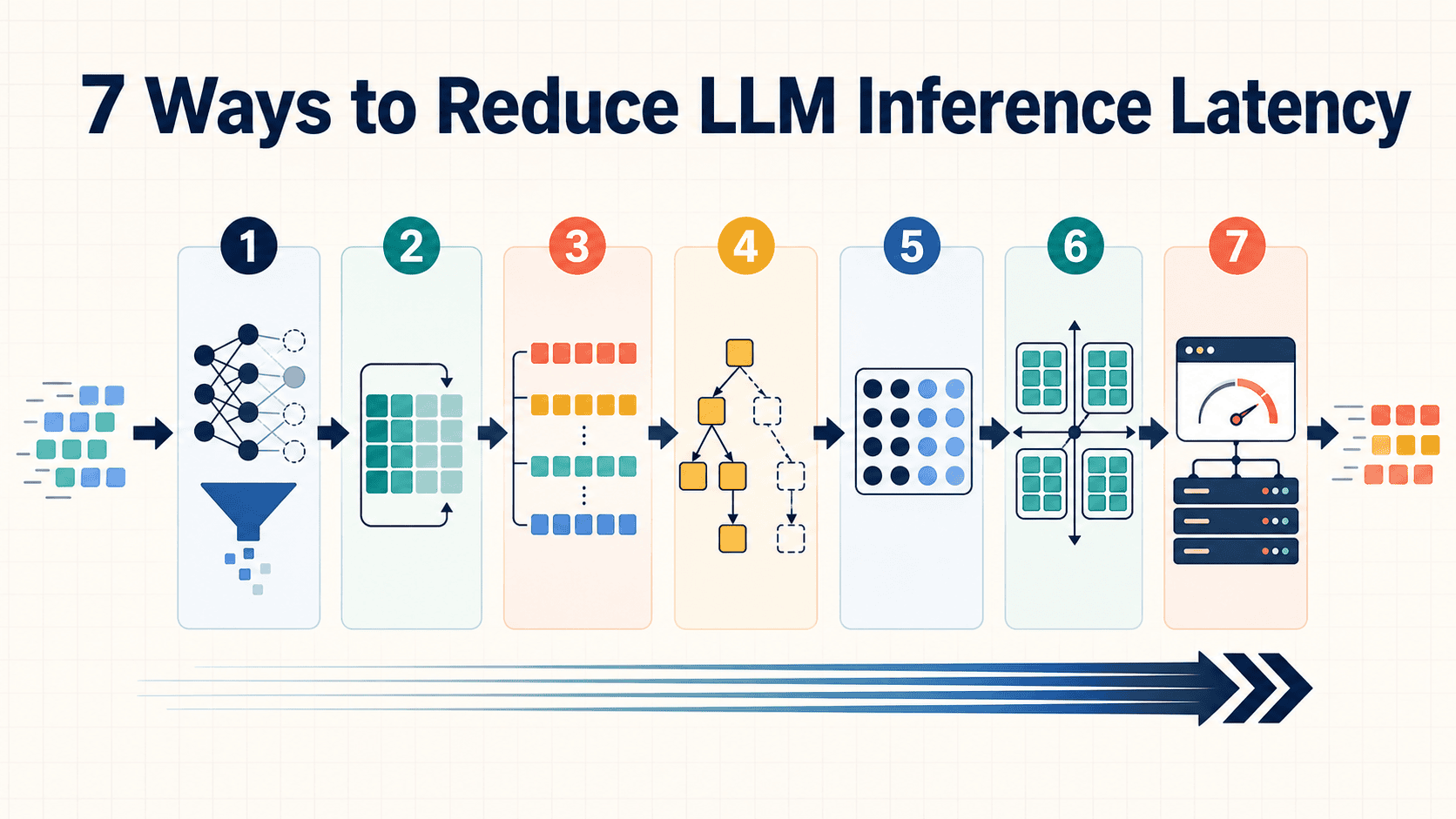
Latency is the quiet killer of good generative AI. You can have the most capable model, the most thoughtful prompts, and the most elegant application logic, but if the response takes ten seconds to start typing, users have already moved on. That is why the seven engineering strategies covered in this piece matter. They are not abstract optimizations for the sake of performance metrics. They are practical levers for keeping people engaged with your product instead of watching a spinner. When we talk about reducing inference latency, we are really talking about respecting the user's time and attention, which is the most human thing a technical team can do.
Approaches like quantization and speculative decoding are covered, and while the technical details are important, the bigger takeaway is about mindset. Too many teams treat model quality as the only variable that matters, then ship something that feels sluggish and wonder why adoption stalls. The reality is that a faster model, even one with slightly lower accuracy, often delivers a better user experience than a perfect one that tests patience. Our read on this is straightforward: you should treat latency as a feature, not a bug fix. If you are building on top of large language models, you need to build a playbook for speed just as rigorously as you build one for accuracy. The teams that crack this early will have a massive advantage over those who treat it as an afterthought. For a deeper look at how these tradeoffs play out in real products, consider how AI-powered spreadsheet tools handle real-time data processing and why response time is a core differentiator in modern data workflows. Both hinge on the same principle: the tool should feel like an extension of the user, not a bottleneck.
What we would tell a reader who asked us about this is simple: do not try to implement all seven techniques at once. Start with the one that addresses your biggest bottleneck, whether that is model size, memory bandwidth, or sequential token generation. Quantization is often the lowest-hanging fruit because it reduces the model's footprint without requiring changes to your application logic. Speculative decoding, on the other hand, is more complex but can dramatically speed up generation when you have a smaller draft model that works alongside your primary one. The key is to measure first. Profile your current inference pipeline, identify where the time is actually going, and then apply the technique that targets that specific pain point. The techniques give you a menu, but you still have to do the tasting.
The honest take here is that latency reduction is not glamorous, but it is foundational. It is the difference between a demo that impresses and a product that people actually use daily. As you evaluate these approaches, watch for the tension between complexity and payoff. Some strategies, like batching or caching, are relatively simple to implement and offer immediate wins. Others, like dynamic inference or model distillation, require significant engineering investment. Our advice is to be pragmatic. Ship the easy wins first, learn from the data, and let the harder techniques earn their place through measurable impact. The one detail worth watching closely is how these techniques interact with each other. A combination of quantization and speculative decoding might sound great on paper, but the overhead of managing both could negate the benefits. The teams that win will be the ones who treat latency reduction as an iterative, empirical process, not a one-time checklist.