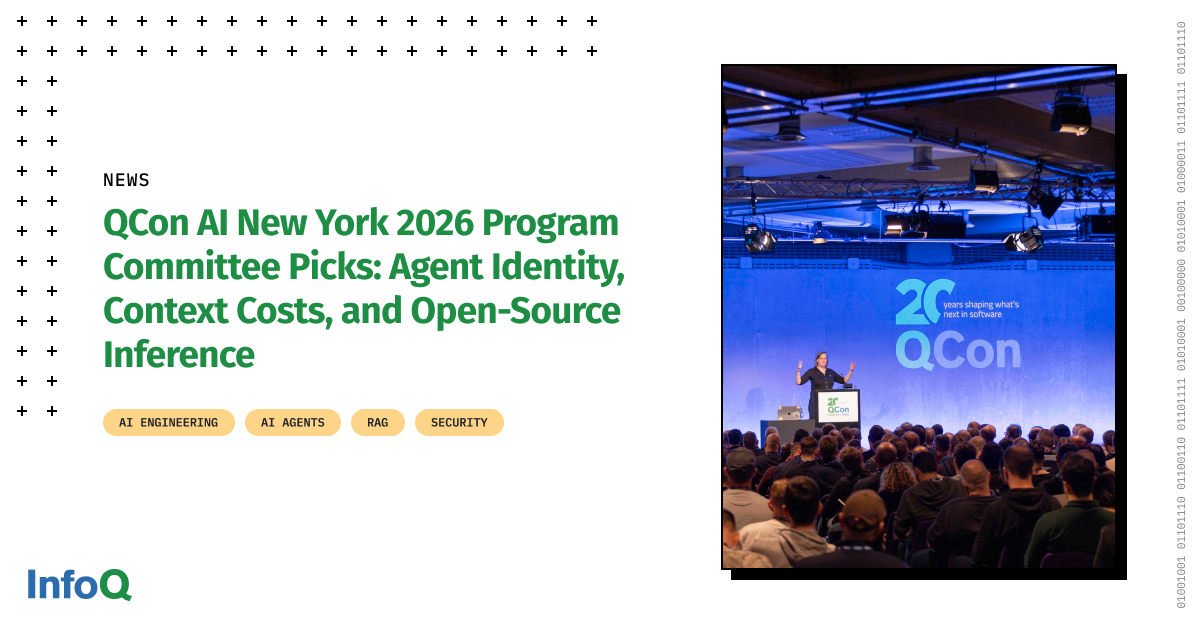
The most practical question in AI today isn't about model architecture, it's about who approves what an agent does next. The QCon AI New York 2026 program committee has surfaced six sessions that confront this head-on, alongside context costs, open-source inference, agent standards, and audio AI. We think this selection reflects a needed shift: the industry is moving from "can we build it?" to "how do we trust it and pay for it?" For teams already wrestling with ballooning context windows or wondering whether to route inference through cheaper models, these sessions point to concrete answers rather than theoretical debates.
Context costs are eating budgets faster than most teams realize. The committee's focus on managing those costs aligns directly with what we've seen in practice: model switching can erase the savings of cheaper inference when you don't account for state retention. As we noted in Why Model Switching Can Erase the Savings of Cheaper AI Inference, the overhead of rebuilding context often offsets the per-token discount. The QCon sessions on agent identity and authorization add another layer: even if you control costs, you need governance over who, or what, triggers those expensive actions. The open-source inference track, meanwhile, ties into the broader bet on non-Nvidia hardware, like the one General Compute is making on inference chips outside the dominant ecosystem, as covered in A $100M bet on AI inference beyond the Nvidia ecosystem. Cheaper hardware only helps if your agent architecture can actually use it without fragmenting context.
The session on agent standards is the sleeper hit here. Standardization is the only path to making identity and authorization work across different AI systems, and it's the missing piece that keeps many teams from scaling beyond prototypes. Without shared protocols, every agent deployment becomes a custom integration project, and every context-cost optimization has to be reinvented. The audio AI session rounds out the list with a reminder that agents aren't just text-based anymore, multimodal inputs multiply both the value and the complexity of authorization decisions.
Our takeaway is specific: if your team is building autonomous agents, start auditing your context costs and authorization flows now, before you hit the scaling wall. The QCon sessions suggest that the next bottleneck won't be model capability, it will be the operational discipline to know which agent is spending what, and who said yes. That is the conversation worth tracking.