Three InfoQ Certification Cohorts Start This August: Meet the Facilitators
Our take
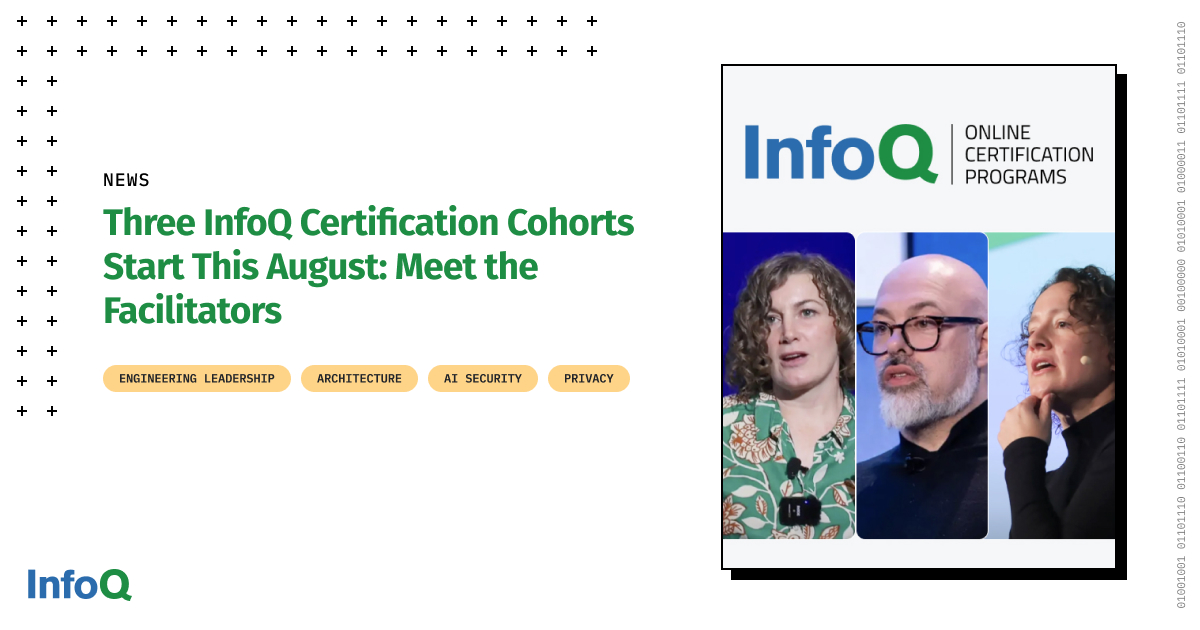
The continued evolution of professional development in the tech space is a welcome sign, and InfoQ’s recent announcement of three new online certification cohorts is a compelling example of that trend. The focus on practical application, leveraging the established QCon talk frameworks, speaks directly to the desire for learning experiences that translate into tangible skill development. It’s a move away from purely theoretical knowledge and toward a model where participants actively apply concepts to their own work, facilitated by experienced practitioners. This resonates particularly well given the current landscape – a world where specialized skills in areas like software architecture, engineering leadership, and crucially, AI security and privacy are in high demand. The need for robust leadership is highlighted in articles like Am I focusing on the wrong skills as a CS student in the AI era? (Need brutally honest advice), demonstrating that even promising students are evaluating their career trajectories in light of rapidly evolving technological advancements.
The selection of cohort topics – architecture, engineering leadership, and AI security and privacy – is particularly astute. Architecture remains a foundational discipline, and the opportunity to refine these skills under the guidance of Luca Mezzalira is a significant draw. Simultaneously, the emphasis on engineering leadership, guided by Michelle Brush, acknowledges the growing complexity of managing and motivating high-performing teams in today's software development environment. However, it's the AI security and privacy cohort, led by Katharine Jarmul, that feels especially timely given the accelerating integration of AI across industries. We've seen the vulnerabilities inherent in poorly secured AI systems, and the potential for misuse is considerable. Addressing these concerns requires not simply technical expertise, but also a deep understanding of ethical considerations and regulatory landscapes. This is further underscored by the need for robust infrastructure, as illustrated in DoorDash Uses Envoy and Valkey for a 1.5M RPS Proxy Cache with 99.99999% Availability, where even seemingly unrelated architectures must be meticulously secured and performant. The rising sophistication of AI also necessitates a focus on the underlying data, as explored in [Deep learning tackles single-cell analysis – A survey of deep learning for scRNA-seq analysis [R]](/post/deep-learning-tackles-single-cell-analysis-a-survey-of-deep-cmrt6doaf03k7djxxw3a1m0iq), where the integrity and privacy of data are paramount for reliable and ethically sound results.
The five-week format represents a commitment to focused, intensive learning, a model that can be particularly effective for busy professionals. The use of QCon talk frameworks is also a smart decision; it means participants will be exposed to proven methods of communication and knowledge transfer, valuable skills in themselves. Moreover, the fact that these cohorts are led by “senior practitioners” reinforces the practical, real-world application focus. This isn’t about abstract theory; it’s about equipping individuals with the knowledge and skills they need to tackle the challenges they face daily. It’s a clear departure from the often-criticized “certificate mill” approach to online learning, and positions InfoQ’s offerings as a credible and valuable investment for those looking to advance their careers. The emphasis on applying learning to participants’ own work ensures that the knowledge gained is immediately relevant and actionable, maximizing the return on investment.
Ultimately, InfoQ’s initiative reflects a broader shift in the tech industry towards continuous learning and specialization. As AI continues to reshape the landscape, the demand for professionals with expertise in areas like architecture, leadership, and AI security will only intensify. It's encouraging to see organizations like InfoQ providing accessible and practical pathways for individuals to acquire these skills. The question now is: how will these newly certified professionals leverage their enhanced knowledge and skills to drive innovation and address the emerging challenges within their respective fields, and will other platforms adapt to this model of practical, practitioner-led learning?
InfoQ has opened enrollment for three five-week online certification cohorts starting in August, each led by a senior practitioner applying QCon talk frameworks to participants' own work: architecture with Luca Mezzalira, engineering leadership with Michelle Brush, and AI security and privacy with Katharine Jarmul.
By Artenisa ChatziouRead on the original site
Open the publisher's page for the full experience