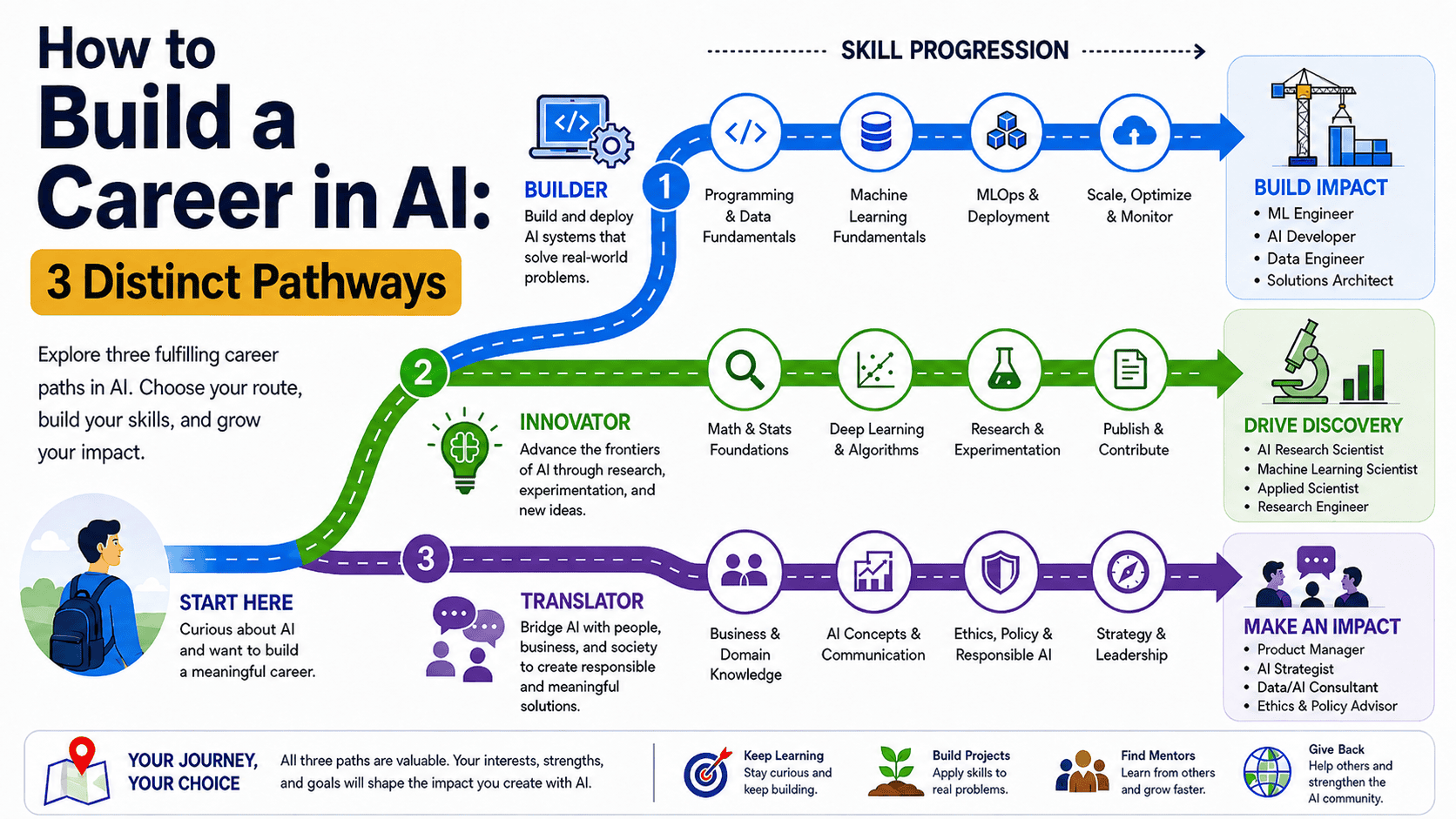
The idea that a career in AI comes down to choosing between three neat pathways is both the most useful and the most dangerous framing we have seen in a while. Useful, because it finally gives people something to hold onto besides the vague imperative to "learn AI." Dangerous, because it suggests that the path you pick today is the path you will walk forever. That was never true for traditional software careers, and it is even less true for a field that is redefining its own boundaries every quarter. Orientation matters more than a list of buzzwords, but we would push that further: the orientation you choose is not a destination, it is a starting point for a conversation with a technology that is going to keep changing on you.
This is where the piece connects to something we have been circling in our own coverage. When we talked to our AI clone, we learned that the technology is not a static tool you master, it is a mirror that reflects your assumptions back at you. Building a career in AI means getting comfortable with that discomfort, because the skills that get you in the door will not be the skills that keep you relevant. The three pathways are not ladders; they are overlapping terrains. A person who starts with applied problem-solving might find themselves drawn into the research side, just as someone who begins with infrastructure might discover a passion for the human factors of deployment. The real contribution is not the taxonomy itself, but the permission it gives you to ask: which of these feels less like work and more like play? That is the question that will sustain you when the inevitable impatience with the learning curve sets in.
What we would tell a reader who asked us directly is this: do not optimize for the job title, optimize for the problem you cannot stop thinking about. The practical skills, the distributed training algorithms, the model evaluation checklists, all of that is learnable. We have written a practical guide to distributed algorithms that shows exactly how far you can get with focused effort, and a simple verification check for tax season that proves the same point: the barrier to entry is lower than the hype suggests, and the real differentiator is curiosity. The people who thrive are not the ones who pick the "right" pathway. They are the ones who treat their career as an iterative experiment, testing a hypothesis, gathering feedback, and adjusting course.
The specific consequence to watch for is the emergence of hybrid roles that do not exist yet, positions that blend the orientation you choose today with the skills you will need tomorrow. That is the open question that should shape your next move. So, when you read the three pathways, do not ask "which one am I?" Ask "which one would I pick if I knew I could not fail, and what is the smallest possible experiment to test that assumption this week?" That is the takeaway we would want you to quote.