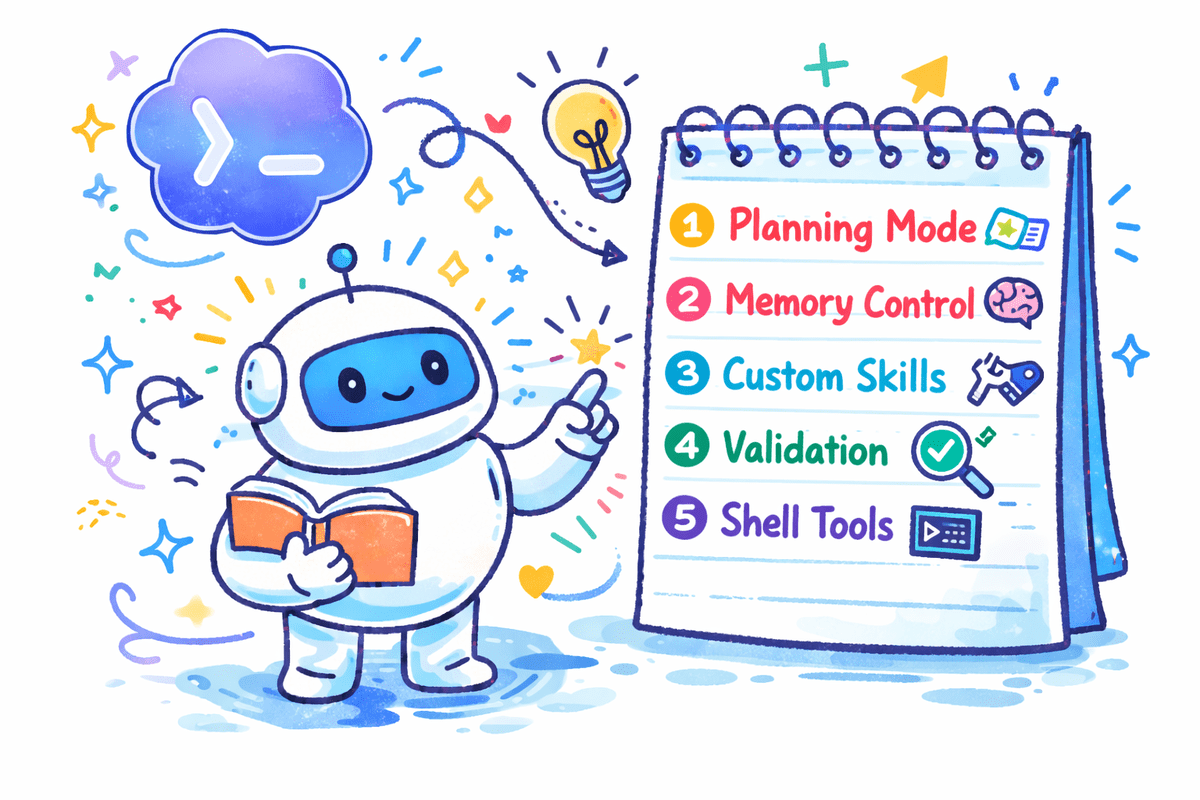
The promise of AI in software engineering has too often been about generating code faster, not about making the process smarter. That's why the five practical strategies for making OpenAI Codex more agentic and reliable are worth paying attention to. They shift the conversation from speed to structure, from "write this function" to "help me build this system correctly." That is a more honest and useful starting point for any real engineering workflow.
What these strategies do, in plain terms, is treat Codex not as a glorified autocomplete but as a collaborator that needs boundaries, context, and feedback loops. The first strategy, for instance, involves breaking tasks into smaller, verifiable steps. That isn't revolutionary; it's what good developers already do when they write tests or review pull requests. The difference is that by encoding those steps into prompts, you give the model a scaffold to work within. It reduces the chance that Codex wanders off into plausible but incorrect territory. Another strategy focuses on iterative refinement, running the output, checking it against a specification, and feeding the results back in. This mirrors how a developer would debug their own code, but it makes the process explicit and repeatable. These are not abstract ideas. They are workflows you can implement today.
The practical payoff is reliability. Codex, left to its own devices, can produce code that looks right but fails edge cases or ignores architectural constraints. By making it agentic, by giving it memory of previous decisions, a clear goal, and the ability to correct itself, you turn it from a tool that generates text into a tool that helps you solve problems. For example, one of the strategies involves using a "planner" prompt that asks Codex to outline its approach before writing any code. That forces it to slow down and think about dependencies, error handling, and structure. It takes a few extra seconds, but it saves much more time in debugging later. This is not about hype. It is about making AI fit the way real engineering teams work: iteratively, collaboratively, and with an eye on maintainability.
The real insight here is that agentic behavior is not about autonomy. It is about accountability. Each strategy introduces a check, a test case, a re-prompt, a verification step, that holds the model's output to a standard. That is exactly what a senior engineer does when reviewing a junior's code. The difference is that these checks are automated and consistent. For teams already feeling the drag of technical debt or unclear specifications, these strategies offer a way to use AI without lowering the bar. You are not asked to trust the model. You are asked to design a process that makes it trustworthy. That is the only kind of transformation worth exploring.