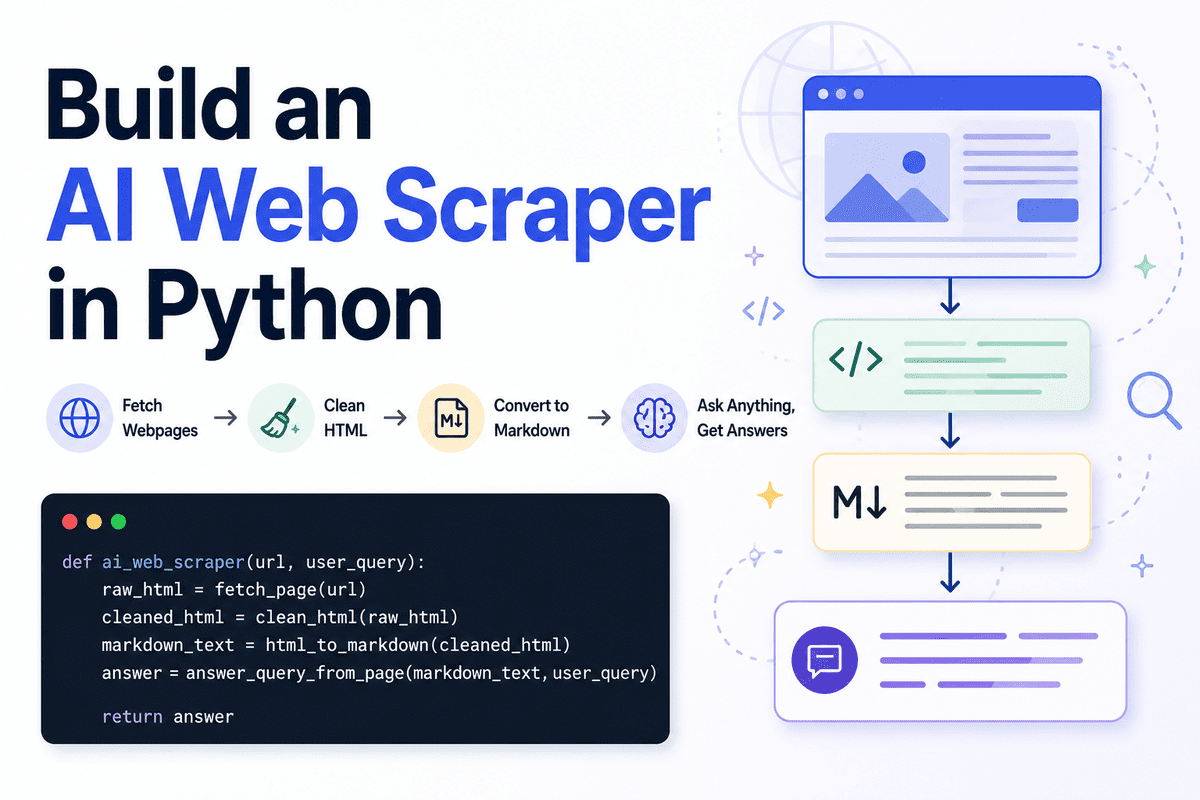
The most practical AI story we've seen in weeks isn't about a new model or a flashy demo. It's about turning any webpage into a focused question-and-answer tool by stripping away the noise. The approach is refreshingly direct: clean the HTML, convert the content to Markdown, and let a language model answer questions with far less token waste. This isn't about building a product that mimics a chatbot. It's about respecting the user's time and the model's context window.
We've written before about the importance of verifying what an AI actually understands, especially when the stakes are high, like during tax season in our piece on Verify Your AI's Understanding: A Simple Check for Tax Season. That guidance pushed you to test your model's reasoning rather than trust its confidence. The scraper approach here complements that mindset perfectly. You're not asking the model to guess from thin air. You're feeding it a controlled, clean dataset, which means the answers it returns are only as good as the structure you provide. It's a reminder that the real skill isn't prompting; it's preprocessing. And if you're a developer or analyst who's felt the pain of copy-pasting text into a chat window, this is the quiet fix you've been waiting for.
What makes this more than a coding trick is what it signals about the direction of AI tooling. We've also covered how Navigating AI/ML Job Requirements: A Shift in Expected Skills means roles now demand software engineering fundamentals alongside model knowledge. This scraper is a perfect example of that hybrid reality. You need to understand HTML structure, Markdown syntax, and API token limits just as much as you need to know how to prompt. The barrier to entry is low, but the discipline required to do it well is real. That's a good thing. It means the field is maturing beyond "ask the AI and hope for the best."
Our honest take is this: stop treating AI as a magic box and start treating it like a junior engineer who needs clean input to give you clean output. The token reduction isn't just a cost saver. It's a forcing function for clarity. When you strip a webpage down to its essential text, you're also stripping away the distractions that lead to hallucinated details or irrelevant tangents. For anyone building a lightweight internal tool or a personal research assistant, this is the pragmatic first step. We'd tell a reader who asked: try this before you pay for a premium API tier or a dedicated web-scraping service. You might find that the answer was already in the HTML, waiting for you to stop drowning it in markup.
The specific detail to watch is how this pattern scales. If a single webpage works, what happens when you apply the same logic to a folder of saved articles or a documentation site? That's where the real productivity gain hides. But that's a question for another day. For now, the takeaway is concrete: clean your data, cut your tokens, and ask better questions. That's not a revolutionary idea. It's just good engineering.