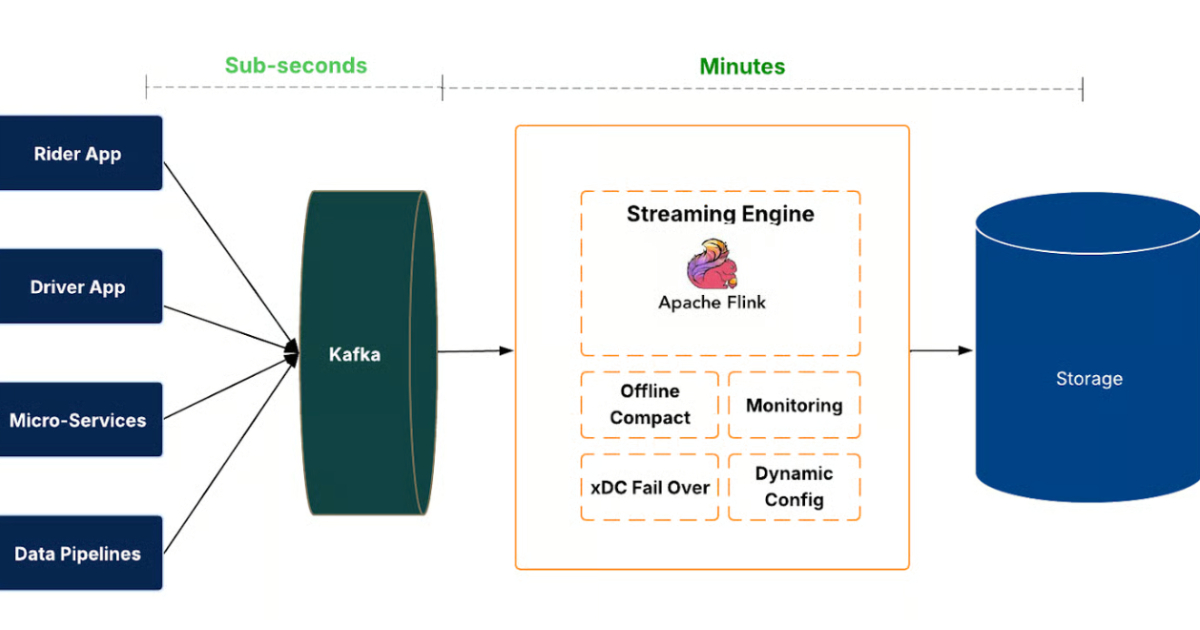
Uber's move to a streaming-first ingestion platform is the kind of practical engineering work that often goes unnoticed but delivers real results. By reducing data latency from hours to minutes and cutting compute usage by 25%, IngestionNext demonstrates that incremental, well-architected improvements can have outsized impact. For anyone managing data at scale, this is worth paying attention to.
What makes this notable is not the technology stack itself, Kafka, Flink, and Apache Hudi are familiar tools, but the discipline required to build a platform that supports thousands of datasets globally. Uber's team solved a specific problem: data sitting in a lake for hours before it's usable. That delay matters when you're running experiments, training machine learning models, or making operational decisions. Shaving that latency to minutes changes what's possible. Analysts can ask questions and get answers in the same meeting. Data scientists can iterate faster on models. Teams can respond to real-time signals instead of yesterday's snapshot.
The 25% reduction in compute usage is equally important. Efficiency gains at this scale compound. Less compute means lower costs, but it also means less infrastructure complexity. For organizations grappling with ballooning cloud bills, this kind of optimization is a clear signal that streaming ingestion isn't just about speed, it's about smarter resource allocation. Uber didn't throw more hardware at the problem; they rethought the pipeline itself.
This approach aligns with a broader shift we see in data architecture. The batch mindset that dominated for decades is giving way to streaming-first thinking, not because streaming is trendy, but because it matches how business actually operates. Decisions don't happen in hourly increments. Customer behavior, market shifts, and system anomalies all occur in real time. A data platform that mirrors that reality reduces friction between data and action.
For teams evaluating their own ingestion strategies, the lesson is straightforward: start with the bottleneck that hurts most. Uber identified latency as the constraint and addressed it without overhauling everything. You don't need to rebuild your entire data stack overnight. You need to find the one pipeline where hours of delay cost you the most, and make it stream. That single change can unlock faster analytics, better experiments, and a platform that actually keeps pace with your business.