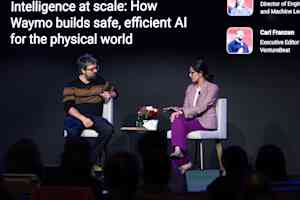
Waymo's approach to AI safety is worth studying not because most of us are building self-driving cars, but because the company has formalized something many enterprises still treat as an afterthought: evaluation as a continuous discipline, not a launch checklist. As Manasi Joshi explained at VB Transform 2026, Waymo judges a project's readiness by the maturity of its tests, not by how well the model performs in isolation. That distinction matters deeply for anyone deploying customer service agents, coding assistants, or financial systems. If you cannot reliably measure performance, you should not put a system into production. This principle echoes themes from our coverage of Orchestrate AI Agents: Google Open-Sources AX for Enhanced Efficiency, where runtime orchestration is only as good as the guardrails around it. Waymo's "eval-forced development" is the guardrail philosophy made concrete.
The practical takeaway here is uncomfortable but clarifying: most enterprise AI teams are not doing evaluation well enough to know whether their agents are safe to use. Waymo pairs every performance claim with information about the properties of the datasets used to test it. That transparency is rare. Many teams rely on broad industry benchmarks that may not reflect their actual use cases, or they test only routine requests and ignore the rare, high-stakes scenarios where errors cause real damage. Joshi noted that Waymo tests for vulnerable road users, railroad crossings, and construction zones, edge cases that mirror the uncommon but costly failures enterprises face in legal, security, or financial contexts. The same logic applies whether you are building a coding assistant or a claims processing agent. If your evaluations do not include the dangerous edge cases, you are flying blind. This is a concrete standard readers can apply tomorrow: ask your team to list the three worst-case failures your agent could cause, then check whether your eval suite covers them.
What makes Waymo's system credible is that it does not leave release decisions entirely to automation. Human safety leaders approve software releases, and Joshi was explicit that "this is not AI-driven and completely automated and zero human oversight." That human accountability is the part of the playbook most enterprises want to skip. It is slower. It requires named decision-makers. It forces teams to connect evaluation results to actual business outcomes rather than abstract scores. But as we saw in Exploring a Career Shift: An MD, a PhD, and a Data-Driven Future, the tension between human judgment and automated systems is not going away. Waymo's answer is not to resist automation but to embed human oversight into the release process itself. For enterprise leaders, the open question is whether they are willing to name the person who signs off when an agent makes a bad decision. That is not a technical problem. It is an organizational one, and it is the hardest part of the playbook to copy.