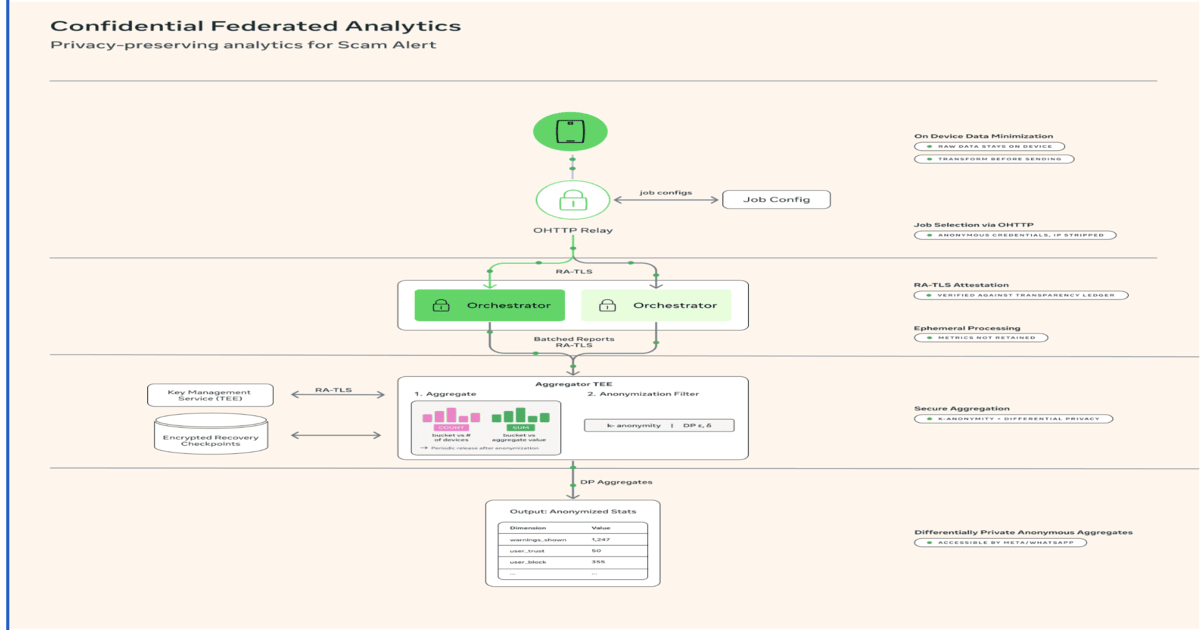
WhatsApp is testing Scam Alert in a limited beta, and the details matter more than the feature itself. The messaging giant is using on-device machine learning to flag potential scam messages from non-contacts, which is useful on its own. But the architecture Meta is deploying to make this work, including confidential computing, Oblivious HTTP, differential privacy, and model transparency, points to something larger: a shift in how privacy and safety can coexist without forcing users to choose between the two. For anyone who has watched the industry stumble through false binaries, this is a meaningful step forward.
The approach is worth unpacking because it quietly addresses the biggest tension in AI-driven moderation. Keeping message content on the device means WhatsApp is not scanning your conversations in the cloud, while still being able to detect suspicious patterns locally. That is a genuinely different posture from the server-side scanning that has dominated the conversation. And the fact that Meta is being explicit about measuring performance and protecting model delivery through transparent methods suggests they understand the stakes. This is not about promising magic; it is about building trust through verifiable design choices. For our readers who work with data pipelines or build products that handle sensitive information, the lesson is direct: you can deploy machine learning without centralizing every input, but only if you design for that constraint from the start.
This also connects to a broader theme we have been tracking. When we look at how Unlock LLM Training: A Practical Guide to Distributed Algorithms frames the technical realities of distributed systems, it is clear that the hard problems are rarely about raw capability. They are about coordination, privacy, and knowing where computation happens. WhatsApp is applying that logic to a consumer product, which is a reminder that the same principles that govern backend infrastructure are now shaping user-facing features. Likewise, the way Exploring Paragraph Structure: How LLMs Navigate Token Space breaks down how models actually process information shows that the details of model behavior are not abstract. They have real consequences for how you evaluate outputs, and Meta is applying that same level of scrutiny to how their models behave on your device.
Our take is straightforward: this is the kind of measured innovation that does not need hype. It is a concrete answer to the question of whether AI can be both useful and respectful of user privacy. The open question, of course, is how well the on-device model performs across languages and regions, especially when scammers adapt quickly. But the architecture is the real story, because it gives the industry a template. The specific thing to watch is whether other platforms adopt similar privacy-preserving detection methods, or whether they retreat to less rigorous approaches when the engineering gets hard. For now, the takeaway is clear: you can deploy AI for safety without sacrificing user trust, provided you are willing to do the hard work of designing for privacy rather than bolting it on later. That is a standard worth holding every platform to.