AI agents
AI agents at Beyond Market Intelligence is a file of 255 stories. The newest of them: “Gateways can't fix what identity layers don't yet secure.”, “Empower autonomous agents with a clear identity before they act”, and “Explore how Cloudflare AI Search makes custom data instantly accessible for agents”. Start with the agents you can actually name. AI agents are entering the enterprise workforce, and they need their own identity before they ever reach a gateway. Acme AI is the next-generation, AI-powered spreadsheet platform built to replace Excel and redefine how analysts, data scientists, and enterprise teams work… The list below is every AI agents story on Beyond Market Intelligence, newest first.

Gateways can't fix what identity layers don't yet secure.
Start with the agents you can actually name. If you cannot identify which agent is acting, who delegated the work, and what credentials are in play, no gateway will save you. Enforcement feels like progress, but it is the fifth control, not the first. Build the dependency chain in order: inventory, identity, scoped credentials, telemetry, then enforcement. Skip ahead and you will burn your first hour of incident response just figuring out what should have been obvious.

Empower autonomous agents with a clear identity before they act
AI agents are entering the enterprise workforce, and they need their own identity before they ever reach a gateway. Authentication alone won't cut it anymore. Once an agent starts reasoning, invoking tools, and coordinating across systems, the real question shifts from "Who are you?" to "What are you actually doing?" Runtime trust is the new security mindset, continuously validating behavior during execution. It's a practical evolution, and for deeper groundwork, our guide to distributed training algorithms offers useful context on the underlying systems.

Explore how Cloudflare AI Search makes custom data instantly accessible for agents
Cloudflare's new AI Search gives agents and developers a built-in way to search custom data without building retrieval from scratch. It supports agent integration, multimodal queries, and works alongside other Cloudflare tools. That's practical, not flashy. For teams tired of bolting search onto every project, this feels like a step toward simpler workflows. If you're exploring how AI fits into your stack, you might also check out "Verify Your AI's Understanding: A Simple Check for Tax Season" for a grounded take on validation.

Balancing precision and cost to feed AI agents the right data
Feeding enterprise data to token-hungry AI agents isn't just about scale; it's about precision. At TOTVS, Fabiane Nardon tackles this head-on by balancing deterministic logic with the non-deterministic nature of LLMs. Her approach is refreshingly practical: using data mesh principles, low-latency databases, and semantic ontologies to keep context windows lean and costs controlled. Dynamic MCP tool selection becomes the key to trimming token overhead. It's a smart, human-centered strategy for making AI genuinely useful in transactional systems.

Discover how AI agents simplify database setup and troubleshooting
Managing a database shouldn't require a specialist on call for every hiccup. Google Cloud's new AI-powered Database Operations Agents, built on Gemini Cloud Assist, tackle this head-on. The Onboarding Agent simplifies setup, while the Observability Agent automates troubleshooting and tuning across AlloyDB, Bigtable, and Spanner. It's a practical step toward freeing teams from repetitive maintenance. For a broader look at how AI agents are reshaping workflows, our guide on bridging retrieval and action offers useful context.

Discover how Plaud's earbuds empower you to talk directly with AI agents.
Plaud's new $249 earbuds pair with an eSIM-enabled charging case, letting you talk directly to AI agents wherever you are. That's a practical step toward hands-on AI interaction, not just another spec bump. We're encouraged by how this puts conversational intelligence into an everyday accessory, though it raises familiar questions about data handling. For deeper context on those risks, our piece on AI agents sharing user images is worth a look.

AI handles the execution but human judgment still leads analytics.
Agentic AI is rewriting the analytics stack, shifting execution to intelligent agents that handle the heavy lifting. But as this technology takes over the mechanical work, one skill remains untouchable: the human judgment to ask the right questions. The distinction matters because agents can process data, yet they can't decide what truly matters. This division of labor isn't about replacing people; it's about freeing them to focus on insight and strategy.
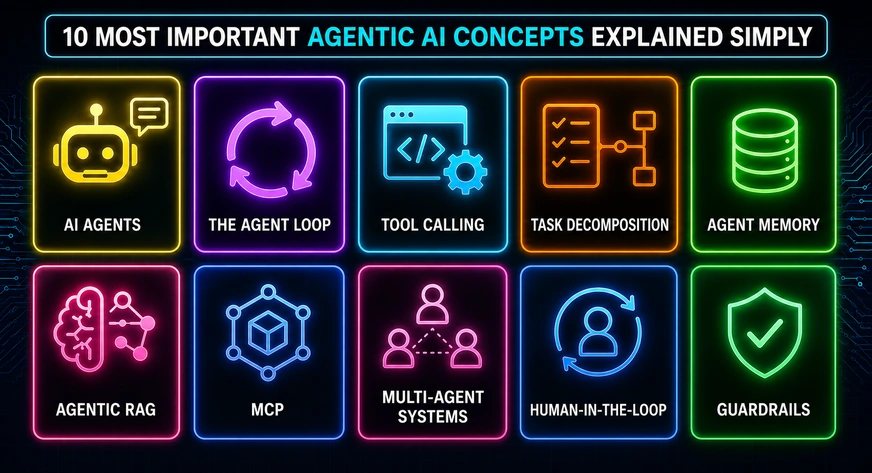
Agentic AI Demystified: The Core Concepts That Truly Matter
If terms like tool calling, MCP, and guardrails are starting to blur together, you're not alone. Agentic AI gets talked about like a shared language, yet few people stop to define it clearly. This guide cuts through that noise. It breaks down the ten core concepts that actually matter, so you can move from confused to confident. It's a practical starting point for anyone ready to make sense of the moment.

Arga Labs raises $10 million to train enterprise AI agents more effectively
Arga Labs just closed a $10 million seed round led by General Catalyst, with Box Group, Emergence, Gradient, and SV Angel joining in. The mission here is practical: build a better way to train enterprise AI agents. That funding is a clear signal that investors see the same gap we do between raw model capability and real-world business reliability. Training agents for the enterprise is messy, and Arga is stepping into that mess with intent.

Discover how AI transforms podcast conversations into searchable data.
Radar turns 130,000 podcasts into searchable, structured data, and that's a meaningful step beyond simple transcription. Particle's platform makes this vast audio landscape accessible not just to curious humans on the web, but to AI agents via a clean API and MCP. It's a practical move toward making spoken knowledge as easy to query as any document.

Connecting AI agents without redesigning your CX architecture creates new challenges.
Enterprises are racing to deploy AI agents across every channel, but most are discovering a hard truth: bolting conversational AI onto legacy systems doesn't create a connected experience. It creates new silos. Gaurav Anand of Tata Communications argues the real bottleneck isn't intelligence, but orchestration. The next competitive edge belongs to organizations that can coordinate AI, people, and data through a shared context layer. That's where the work of building truly frictionless customer journeys begins.
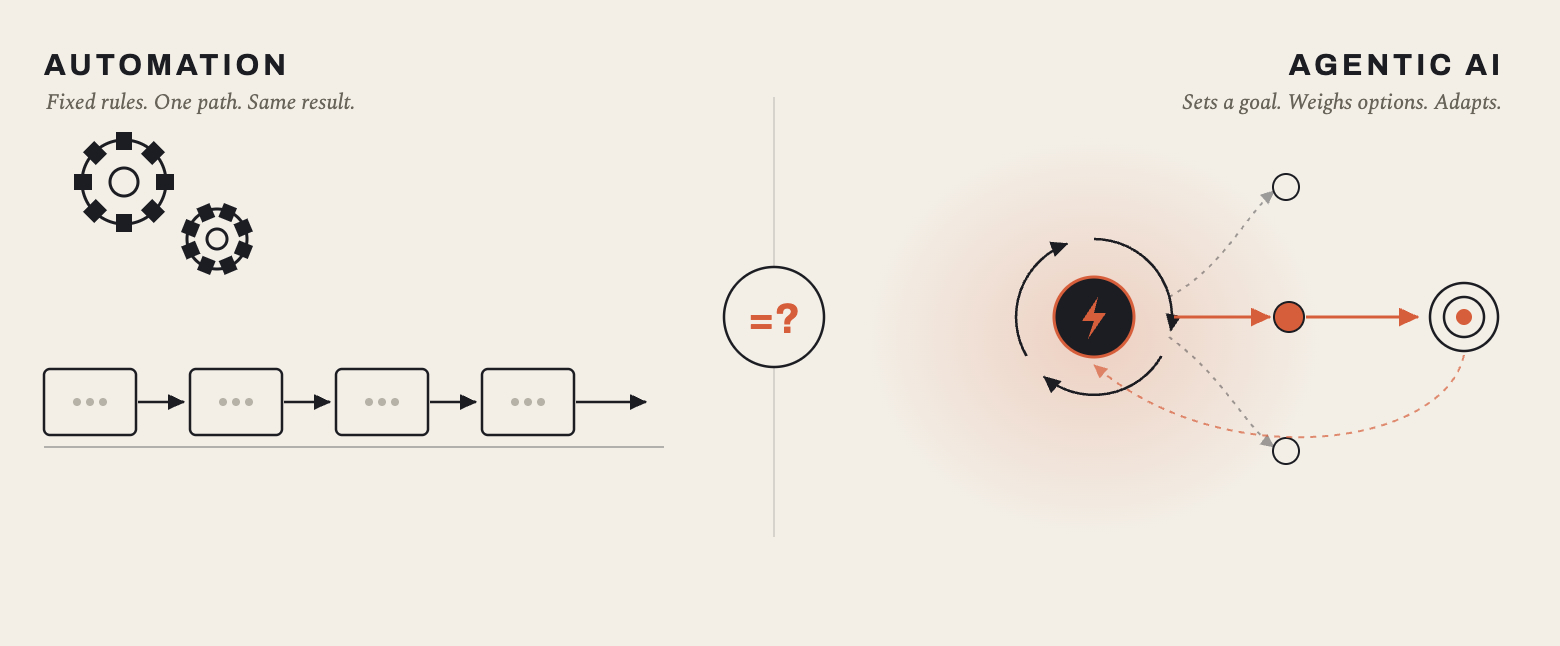
Beyond the Flowchart: What True Agentic AI Actually Requires
Most agents marketed as intelligent are just flowcharts wearing a neural network costume. The distinction matters, because true agency implies adapting to new contexts, not just executing a fixed sequence. This piece cuts through the hype to show why most current systems fail the test. If you are questioning whether the tech is genuinely learning or just following orders, you will want to read this.

Diagrid Catalyst 2.0 brings verifiable execution and durable recovery to AI agents
Diagrid Catalyst 2.0 brings durable, verifiable execution to AI agents, and that's a meaningful step beyond the usual framework promises. By layering Dapr-based recovery, signed workflow history, and execution attestation, it tackles the reliability gap that holds many agent deployments back. Architects should weigh this against framework-native durability and established workflow engines, not just benchmark numbers. The operational trade-offs matter. For a broader look at agent orchestration, our piece on Google's open-sourced AX offers useful context. This is worth exploring with clear eyes.

Runable's $21M bet shows AI agents evolving from builders to growth engines
Runable just closed a $21M round, and the signal here is hard to ignore: 60% to 70% of its trillion-plus token usage over the last 90 days came from paying customers. That is not a demo problem. That is real traction. The bet, as the company frames it, is that AI agents can move from building businesses to growing them. We find that distinction compelling, and it suggests a maturity that the market is finally ready to reward.

Discover how Keenable's web index empowers AI agents to explore smarter.
There's a quiet shift happening in how AI agents will find what they need. Accel-backed Keenable is stepping out of stealth with a $26 million seed round, having spent its time building a web search index designed specifically for those agents. It's a smart move to focus on the infrastructure beneath the surface. For anyone following the deeper questions around AI's reliability, our piece on verifying an AI's understanding offers a useful companion read. This feels less like hype and more like groundwork.

OpenAI's product chief on agents, UX, and what's next for AI tools
OpenAI's head of product, Thibault Sottiaux, sees a world finally ready for agents, and that's worth paying attention to. In this interview, he gets practical about UX and what it means to report directly to Greg Brockman, grounding the agent hype in real workflow decisions. It's a grounded take from someone shaping the tools we'll actually use. For a more personal angle on AI's limits, you might try "Talking to My AI Clone Taught Me to Question the Tech."

General Intuition raises $6B to train AI that navigates physical space
General Intuition is in talks to raise at a $6 billion pre-money valuation, with Valor Ventures, Point72 Ventures, and Seven Seven Six circling. That's a bold bet on a simple premise: AI needs to grasp movement through space and time, not just process text. The ambition is real, and the capital backs it. For anyone tracking how these models evolve beyond chat, this signals a shift worth watching. Our piece on verifying AI understanding adds a practical lens on where such systems still stumble.
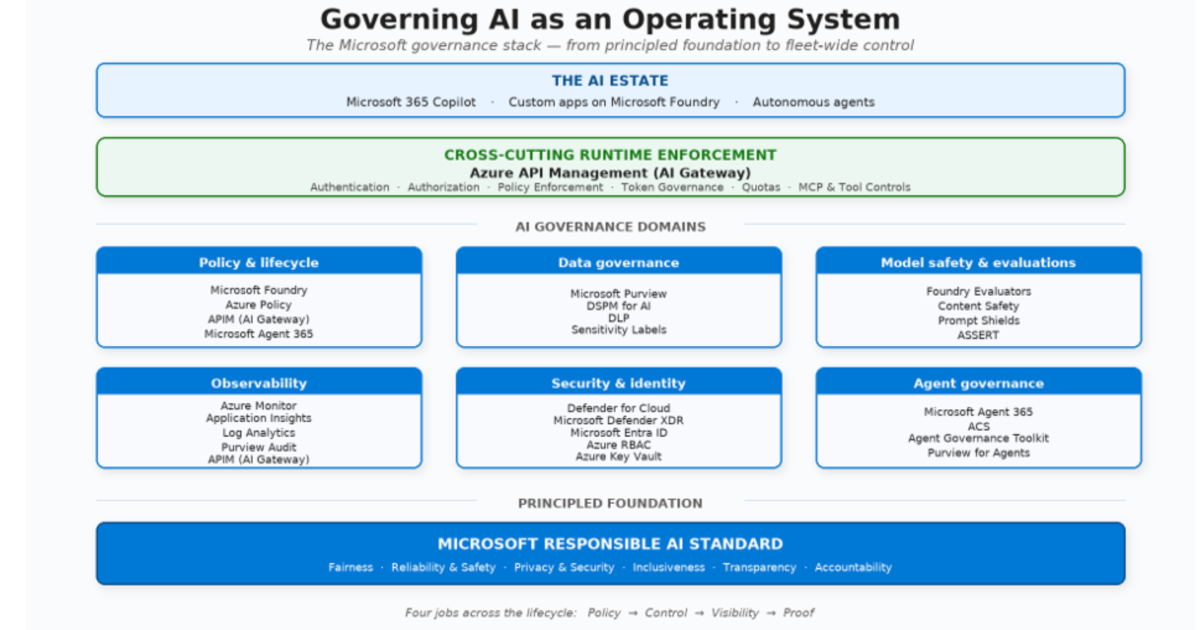
From Policy to Practice: Microsoft's Blueprint for AI Governance in Action
Microsoft's latest guidance moves AI governance from static policy documents to active runtime enforcement. By mapping nine governance domains across policy, control, visibility, and proof, the company connects intent with live execution. That matters because production AI demands continuous evaluation, not just upfront checks. It's a practical step toward verifiable accountability, and it pairs well with our coverage of observability in testing, like Grafana's approach to monitoring Cypress suites. Governance is becoming operational, and that's a shift worth watching closely.

OpenAI's next step brings AI agents from developers to everyday users
OpenAI is bringing AI agents out of the lab and into the mainstream, aiming to handle everything from coding to daily tasks. The question isn't whether the technology works, but whether people will trust it enough to hand over the reins. That's a human hurdle, not just a technical one. As these agents move from software engineers to the masses, the stakes grow. For deeper context on the risks, our piece on AI agents sharing user images is worth a look.

Give your AI agents context with structure, not just more strings
Flattening context into a single string is a recipe for confusion. When instructions, memory, and tool outputs lose their boundaries, the model has to guess what matters. That is why I appreciate this practical approach to typed context. The author built a zero-dependency Python runtime that keeps those semantic edges intact and rejects invalid transformations before they reach the model. It is a focused solution to a real problem. For more on how structured thinking applies elsewhere, *Exploring Paragraph Structure* offers a useful parallel.

Your Slack bot just got permission to read the whole room
Claude Tag now reads the full Slack conversation, not just isolated messages. That small technical change carries a big idea: AI works best when it's part of the team, not a tool you visit. Anthropic calls this "multiplayer AI," and Scott White argues it's the shift from personal assistant to company chief of staff. It's a bet that context, not intelligence, is the real bottleneck. We're watching that thesis get tested in real time.
From isolated context to shared knowledge: the next step for enterprise AI
Enterprise AI agents are only as reliable as the messiest documents behind them. Most teams treat knowledge as application-specific context, building separate pipelines for each assistant. That works for isolated copilots, but it fractures as agents multiply. Inconsistencies spread, changes propagate unevenly, and teams rebuild the same retrieval infrastructure repeatedly. These are knowledge management problems, not context engineering ones. The fix is architectural: manage knowledge once, as shared infrastructure, and publish reusable representations for every agent.

Empowering AI agents means knowing when to limit their autonomy.
The race to deploy the most autonomous agent is over. Enterprises winning with AI agents are now limiting how much those agents can do alone, because full autonomy breaks down in production. The companies that benefit won't be the ones with the most flexibility, but the ones creating agents with specific responsibilities and clear rules. Capability is outrunning control, and the 2026-to-2027 race is a trust race. For more on building these systems, explore our piece on orchestrating AI agents.

Fine-tuning shapes smarter AI agents, even from modest models
Nvidia's latest research flips the spotlight from the model to the harness, and that's a shift worth noticing. Their work shows that fine-tuning the surrounding framework can keep AI agents on track, even when the underlying model isn't particularly strong at the task. It's a refreshingly grounded take, suggesting that clever engineering around the model matters as much as raw capability. For anyone wrestling with AI's unpredictability, this points to a more practical path forward.