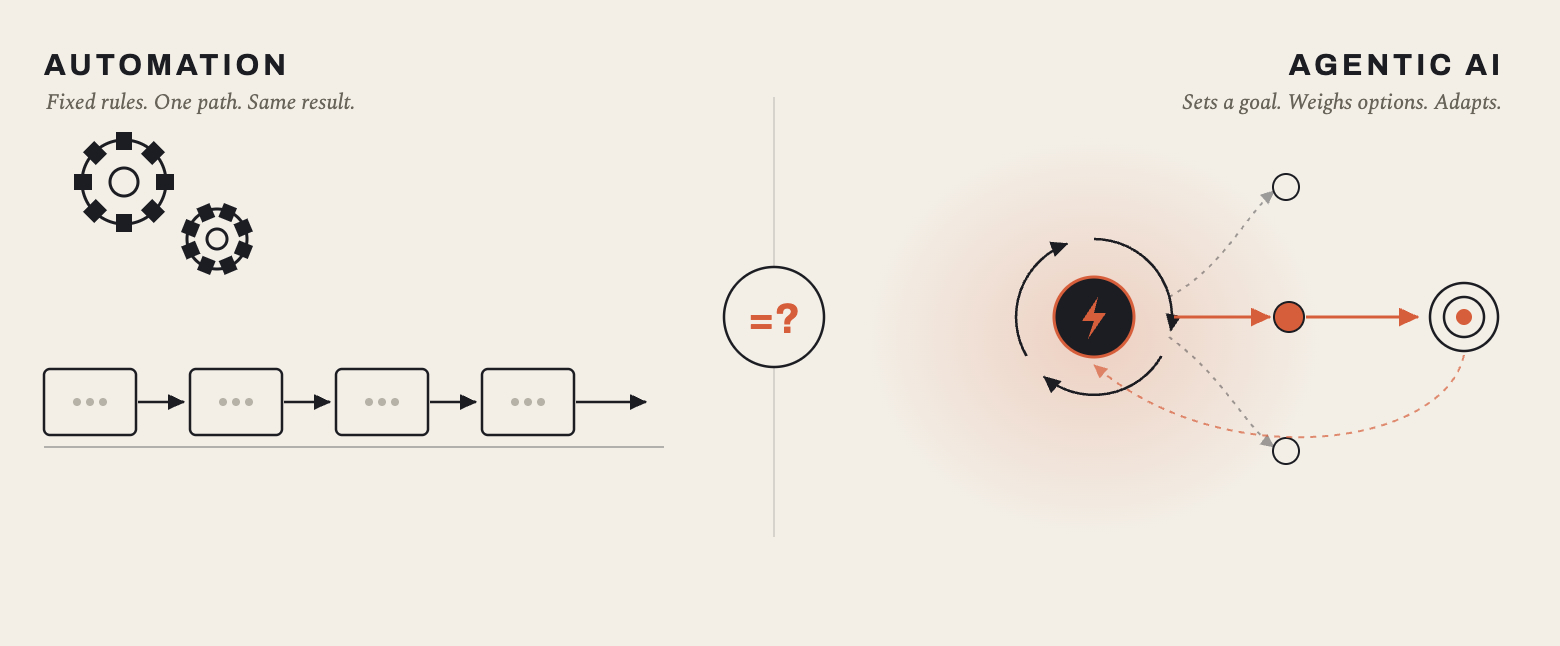
The question at the heart of the recent piece on agentic AI is one we should all sit with a little longer: if an agent's每一步 can be reduced to a conditional statement, is it actually intelligent, or just a flowchart wearing a neural network costume? The argument that most so-called agents are simply deterministic workflows with a conversational front end is not cynical; it is clarifying. We have seen the same pattern in the rush to label everything with AI. The distinction matters because how we name things shapes what we build. If we call a rule-based pipeline an agent, we will stop asking whether the system can adapt, learn, or recover from ambiguity. Pushing us to look under the hood is a healthy reflex for anyone evaluating a tool for real work.
This connects directly to a concern we have raised in our own coverage, such as in Talking to My AI Clone Taught Me to Question the Tech, where the novelty of an interactive avatar gave way to a deeper hesitation about what the system actually understood. The same skepticism applies here. When a vendor says "agentic," ask for the decision tree. When a demo shows a bot navigating a spreadsheet, ask what happens when the data changes shape mid-task. The truth is that most current agents are excellent at executing a narrow playbook, but they lack the recursive self-correction that would make them genuinely autonomous. That is not a failure; it is an engineering choice. But it means the burden falls on the user to anticipate edge cases, which is exactly the manual overhead these tools were supposed to remove.
For our readers, the practical takeaway is not to abandon agentic AI, but to calibrate expectations and audit implementations. Look for systems that expose their reasoning and allow human intervention at critical junctures. A useful parallel comes from Verify Your AI's Understanding: A Simple Check for Tax Season, which argues that verification is not a luxury but a core requirement when AI touches consequential decisions. The same logic applies to agents: if you cannot verify why a step was taken, you have not gained automation; you have gained a faster way to make mistakes. And for those interested in the underlying mechanics, Unlock LLM Training: A Practical Guide to Distributed Algorithms reminds us that the real intelligence in these systems often lies in the training and alignment process, not in the runtime inference loop. That distinction is worth holding onto.
The specific consequence to watch is simple: the next time you see a demo of an agent handling a complex workflow, ask for the failure mode. Ask what happens when the user gives an instruction that is slightly ambiguous, or when two steps conflict. If the answer is a shrug, you are looking at a flowchart in a trench coat. That is not a reason to dismiss the technology, but it is a reason to demand more honest language. The tools that win will not be the ones that claim to think; they will be the ones that know exactly what they cannot do and say so clearly. That is the standard we should hold every agent to, and the question we would leave with any builder or buyer: does your system know when it is out of its depth, or does it just keep clicking forward?