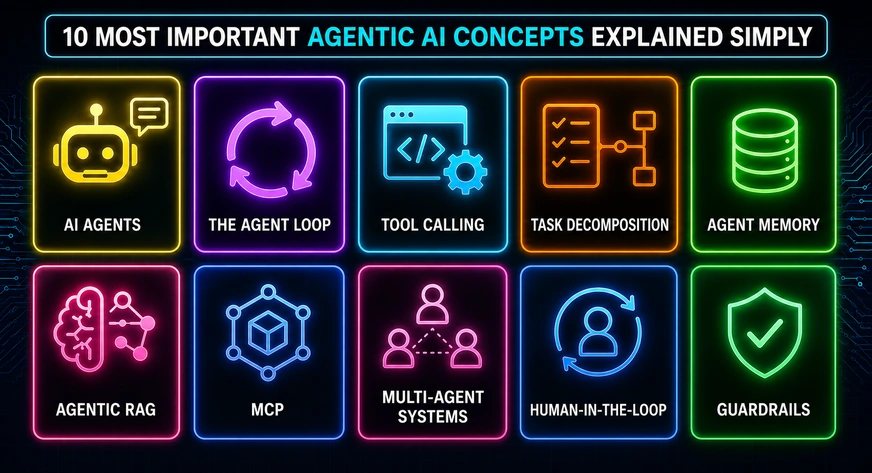
The spreadsheet world runs on jargon, and agentic AI is determined to add another layer of it. Articles like the one from Analytics Vidhya, which breaks down ten core concepts like tool calling and agent loops, are exactly what we need right now. It is honest about the fact that most of us feel left behind when the conversation shifts to MCP or guardrails. That feeling of being out of the loop is not a failure of your intelligence; it is a failure of the people explaining it. We have argued before that exploring how AI agents learn by editing context, not model weights is the real unlock for practical use, and this piece reinforces that by stripping away the mystique and showing you the simple mechanics underneath.
Our take is straightforward: stop being intimidated by the vocabulary and start looking at the verbs. Tool calling is just the agent asking for permission to use a calculator. An agent loop is just a fancy way of saying it checks its work before moving on. When you read past the hype, you realize that agentic AI is not some alien intelligence; it is a process. It is a series of steps that you can trace, debug, and ultimately control. This is why we also point to the importance of verifying your AI's understanding with a simple check, because the moment you treat these systems as magic boxes is the moment they stop being tools and start being liabilities. These concepts are not academic; they are the difference between blindly trusting an output and being able to audit the logic that produced it.
What does this mean for you, practically? It means the barrier to entry just dropped. You do not need a PhD in machine learning to understand why an agent stopped or why it called a specific function. This gives you the map, but we would push you further: do not just read it, use it. The next time you see a term like "guardrails," do not nod along. Ask yourself what boundary is being enforced. Is it keeping the model from accessing sensitive data? Is it preventing it from taking a destructive action? That line of questioning is the same critical thinking you already use in your daily work. It also resonates with the shifting expectations in AI/ML job requirements, where pure model-building skills are giving way to a need for people who can reason about systems and their failure modes.
The most useful takeaway here is not a definition; it is a mindset. Treat agentic AI as a junior colleague who needs clear instructions and constant supervision, not as an oracle. The concepts you learn today are the building blocks for debugging the complex workflows of tomorrow. So, the real question is not whether you understand all ten terms, but whether you can look at an agent's action and explain *why* it took that step. If you can do that, you are no longer a spectator. You are the one in control. Watch for the moment when a simple "tool call" becomes a multi-step negotiation between systems; that is where the next layer of complexity, and opportunity, lives.