conversational data analysis
conversational data analysis at Beyond Market Intelligence is a file of 99 stories. The newest of them: “Why a perfect AI conversation can still signal a broken product”, “From prompt to publish: Canva puts AI website building in every user's hands.”, and “ChatGPT learns to listen and speak at the same time, like a real conversation”. A single AI agent conversation can look flawless on its own and still point to a broken product. Code is about to get a lot more visual. Acme AI is the next-generation, AI-powered spreadsheet platform built to replace Excel and redefine how analysts, data scientists, and enterprise teams work… The list below is every conversational data analysis story on Beyond Market Intelligence, newest first.
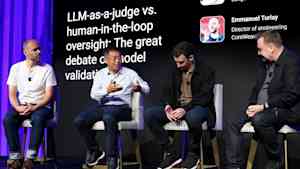
Why a perfect AI conversation can still signal a broken product
A single AI agent conversation can look flawless on its own and still point to a broken product. That gap is driving a shift in how enterprises evaluate agents, away from scoring individual traces and toward comparing cohorts of users against a baseline. At VB Transform 2026, Harrison Chase of LangChain, Hui Zhang of Conviva, and Emmanuel Turlay of CoreWeave described the move toward contrastive analysis and cheaper, narrower judge models. The takeaway: evaluation criteria are becoming the new product spec.

From prompt to publish: Canva puts AI website building in every user's hands.
Code is about to get a lot more visual. Canva Code 2.0 brings AI-powered website building to every user, including free accounts. The focus isn't just on generating functional code but on making the output genuinely yours. With drag-and-drop editing and direct access to Canva's design library, the gap between a raw prototype and a polished, on-brand experience just closed significantly. It's about giving everyone the tools to build something that looks like it came from them.

ChatGPT learns to listen and speak at the same time, like a real conversation
OpenAI has launched GPT-Live, a significant upgrade to ChatGPT’s voice capabilities, fundamentally redesigning how users interact with the AI. Featuring a full-duplex architecture, GPT-Live allows for simultaneous listening and speaking, mimicking natural human conversation and eliminating frustrating delays. Rolling out globally today, GPT-Live prioritizes a more fluid, intuitive experience, particularly for paid users, and introduces visual cards for enhanced interaction.

Slackbot now pulls your CRM data and charts directly from a chat message
Unlock a new level of productivity with Slack’s latest integration, connecting Slackbot directly to the Salesforce platform. Now, from a simple chat message, you can pull CRM data, generate insightful charts, and even send DocuSigns—all without leaving Slack. This marks a significant step toward a unified system, leveraging Salesforce’s extensive data and AI capabilities within the familiar Slack workspace. Discover how this transformative change can streamline workflows and empower your team, echoing insights explored in our recent article, "Information Theory and Ensemble Models."

Claude Cowork expands beyond coding to empower every knowledge worker.
Anthropic is expanding the reach of Claude Cowork with a mobile and web launch, driven by compelling usage data demonstrating its broad appeal. Contrary to the narrative surrounding developer-centric AI, data reveals that the majority of Cowork users leverage the tool for "the work around the work"—business processes, content creation, and information assembly—rather than coding. This strategic shift positions Anthropic to capture a significantly larger market of knowledge workers, empowering them to transform their productivity across devices, even offline.
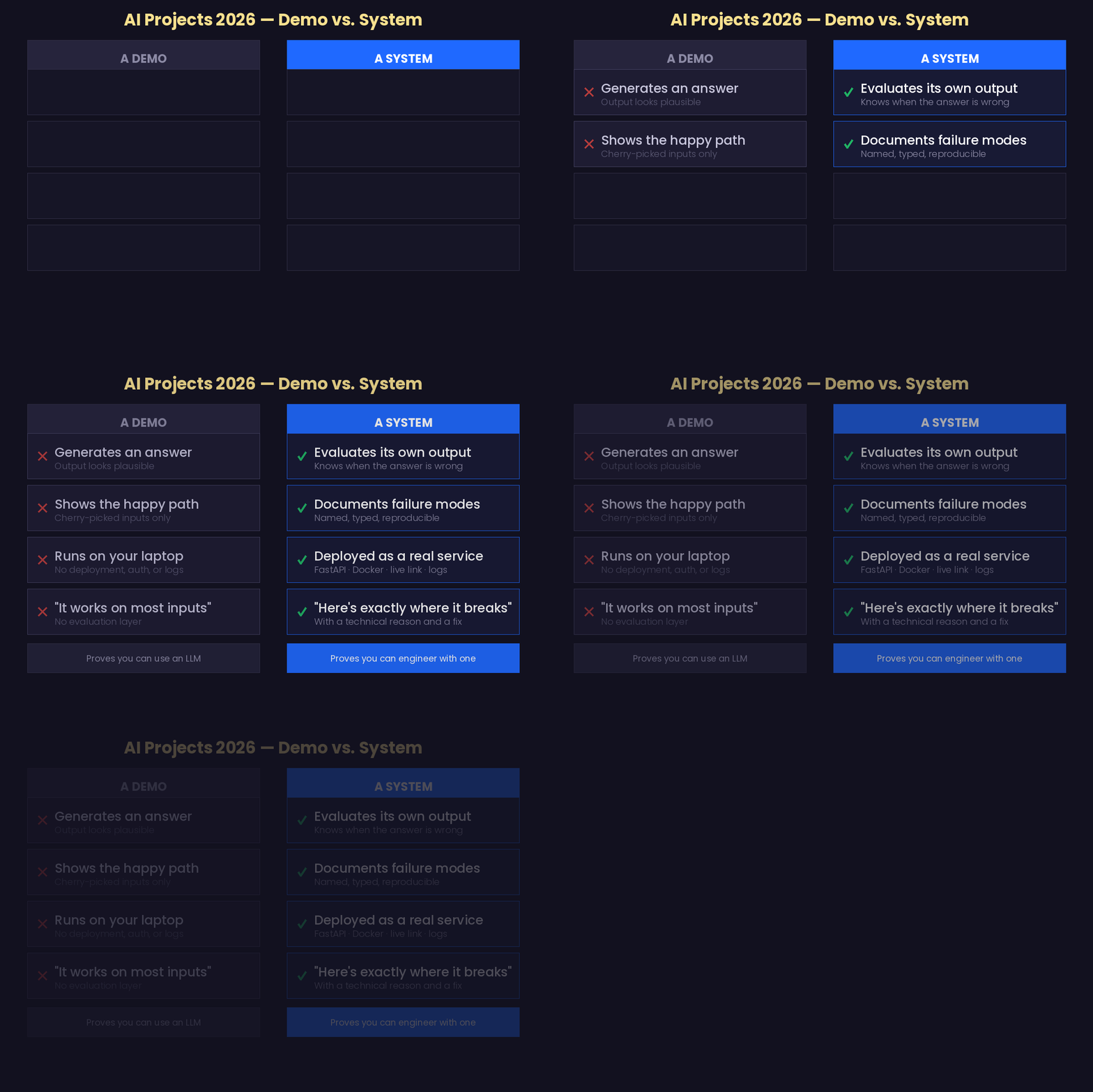
Build AI projects that prove you know where your system fails
Navigating the landscape of AI projects for 2026 requires a focused approach. The most compelling projects aren't about sheer complexity; they're about demonstrating a clear understanding of system limitations and articulating those failures confidently to potential employers. Forget wading through 50 ideas – this post delivers the top 10 AI projects poised to impress. Discover how to build demonstrable skills and showcase your expertise. For deeper insights into user interface design within AI, explore "Matching AI Modality To User Intent."
Design AI interfaces around user intent, not just chat
The rush to integrate AI often defaults to chat interfaces, overlooking a fundamental principle of user experience: matching modality to intent. Simply because Large Language Models thrive on dialogue doesn’t mean every AI capability should be presented conversationally. Great UX prioritizes the user, adapting the interface to their context and cognitive load. Explore how shifting beyond conversational tunnel vision unlocks more intuitive and effective data interactions—as discussed further in "Users Don’t Need More Tools: They Need Seamless Integrations."

Turn video production into a conversation your team can actually finish
Google’s Gemini Omni Flash API is poised to fundamentally reshape enterprise video production, transforming a complex, multi-stage process into a streamlined conversation. Previously limited to consumer use, this new API empowers marketing and learning-and-development teams to edit finished video clips conversationally, collapsing a five-tool pipeline into a single interaction. Priced aggressively at $0.10 per second for 720p output, Omni Flash currently leads the Text-to-Video Arena leaderboard, offering a compelling solution for internal training and social video—though higher resolutions remain a consideration.

Explore how DeepSeek's DSpark framework accelerates AI inference by 85 percent.
DeepSeek has open-sourced DSpark, a new framework poised to significantly accelerate large language model (LLM) inference by up to 85%. This MIT-licensed system optimizes speed by employing a "scout" that anticipates likely text paths, allowing the LLM to quickly verify and proceed. The release, including technical papers and codebases, aims to address a key challenge in AI deployment – efficiently serving large models for real-time user experiences.
Empowering small-scale farmers with AI and NASA data for smarter planning.
AgroVision DEMO offers a future-focused solution for small-scale farmers in Nicaragua, addressing the challenges of crop loss due to climate uncertainty. This free demo, built using NASA data and machine learning, empowers producers to decide what to plant and when, simulating future climate conditions to optimize planting strategies. The system assesses potential losses and gains, providing insights in real córdobas, and features an AI advisor, ARI, to guide decision-making. Explore the possibilities at [https://agrovision10.vercel.app/](https://agrovision10.vercel.

Explore how OpenAI's Sol, Terra, and Luna models could reshape your workflows.
OpenAI today initiates a limited preview of its next-generation GPT-5.6 model series—Sol, Terra, and Luna—designed to transform developer and enterprise workflows. Following coordination with the U.S. government, access is currently restricted to approximately 20 organizations. Sol, the top-tier model, excels in complex reasoning and security applications, while Terra balances performance and efficiency, and Luna prioritizes speed and cost-effectiveness. This phased release reflects a novel landscape of safety interventions and compliance parameters for enterprise buyers. "It’s not about Anthropic vs.

Explore how GPT-5.5 Instant adapts to your intent with sharper, more natural responses.
OpenAI has significantly updated GPT-5.5 Instant, the default language model powering the free version of ChatGPT, delivering tangible improvements in shopping, complex instruction handling, and user intent understanding. This upgrade, now available to paid subscribers and rolling out to free users, represents a move toward a more intuitive and responsive AI experience. Developers can access these enhancements via the updated chat-latest API alias, though OpenAI still recommends the separate gpt-5.5 model for production environments.
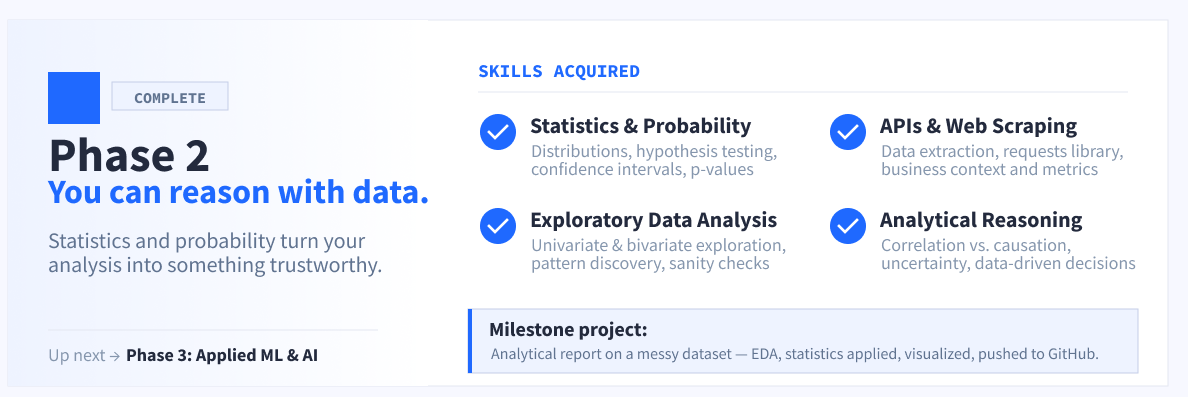
Your Practical Roadmap to Becoming a Data Scientist by 2027
## Data Scientist Roadmap for Beginners (2026–2027) Navigating the path to becoming a data scientist can feel overwhelming. This roadmap clarifies exactly what to learn, in what order, and how long it realistically takes to achieve job readiness by 2027 – whether you’re starting from zero or transitioning from data analysis, engineering, or research. We cut through the noise surrounding Python vs. R, degree requirements, and the rise of Generative AI to provide a focused, actionable plan.

Meet your new teammate: Claude Tag brings persistent AI into Slack
Anthropic’s Claude Tag introduces a transformative approach to enterprise collaboration, replacing its Slack app with a persistent, AI-powered teammate. This isn't a chatbot; it's an agent designed to learn, monitor, and autonomously work within teams, delegating tasks via @Claude. Built on Claude Opus 4.8, Tag offers multiplayer interaction, proactive insights, and asynchronous project management, streamlining workflows and boosting productivity. For organizations seeking to integrate AI into their daily operations, Claude Tag represents a significant step forward—a shift from reactive tools to an always-on, intelligent collaborator.
Embrace Uncertainty to Make Smarter Design Decisions with AI
In an increasingly AI-driven design landscape, it's crucial to move beyond treating predictions as definitive truths. Probabilistic Design is a future-focused mindset empowering UX and product teams to embrace uncertainty and intelligently interpret AI outputs. Learn how to make adaptive decisions, transforming potential pitfalls into opportunities. Discover a framework for navigating complexity and building more resilient solutions. For deeper insights into the evolving AI landscape, explore "Probably raises $9M to build a more reliable kind of AI."

AI speeds your data pipelines but can't replace their documentation
Vibe coding offers remarkable speed for generating isolated implementations, but prompts’ inherent temporality creates challenges for enterprise data platforms. These platforms, often fragmented across diverse teams and technologies, risk accumulating inconsistent logic and hidden dependencies as operational context resides in scattered conversations rather than the system itself. Spec-driven development (SDD) addresses this by converting prompts and knowledge into executable, versioned specifications—persistent operational memory for both humans and AI.

Confidence in AI ownership drops sharply when leaders are asked directly.
Recent Ivanti research reveals a concerning disconnect: while 85% of IT teams confidently assert every AI agent has a designated owner, a stark 42% admit that ownership remains unclear. This gap, a staggering 43 points, highlights a critical vulnerability as organizational leaders are nearly twice as likely to conceal AI usage, often citing a "secret advantage.

New benchmark reveals GPT-5.5 outperforms Claude on complex professional tasks
A significant shift has occurred in AI evaluation with the launch of Agents’ Last Exam (ALE), a rigorous new benchmark designed to assess AI’s ability to handle economically valuable, long-horizon professional workflows. OpenAI’s GPT-5.5, operating through the Codex harness, currently leads the ALE Leaderboard with a 24.0% pass rate, surpassing Anthropic’s Claude Fable 5.

Navigate the LLM Learning Landscape: Find the Right Course for You.
The landscape of Large Language Model (LLM) learning can feel overwhelming. You'll discover a vast range of options, from brief prompt engineering tutorials to extensive engineering programs. Finding the right course to match your experience and goals requires careful navigation. Explore our guide to understand what each type of LLM course prepares you for, empowering you to confidently choose the path that best transforms your data skills and unlocks your future-focused potential.

When AI agents act on incomplete context, your incident review has no template.
As enterprises increasingly adopt AI agents, a concerning gap in chaos engineering practices is emerging. Many organizations are unaware that agent actions, while technically correct, can trigger cascading failures due to incomplete context. This disconnect leads to confusion over accountability between teams. With 79% of organizations deploying AI agents and predictions of widespread integration by 2028, it’s crucial to recognize these agents as chaos injectors. To navigate this landscape effectively, companies must audit their agent actions and link them to chaos engineering frameworks.

A tiny memory fix that stops AI agents from forgetting
In the evolving landscape of AI, the introduction of delta-mem offers a groundbreaking solution to the long memory challenge faced by agents. Traditional methods, like expanding context windows or relying on retrieval-augmented generation (RAG), often lead to inefficiencies and increased costs. Delta-mem compresses historical interactions into a compact matrix, enhancing memory retention without bloating model size. This innovative technique empowers AI agents to carry forward relevant information seamlessly, streamlining workflows and reducing latency.

Find the SQL course that actually matches your skill level
In 2026, finding the right SQL course can be a daunting task, especially with so many options available. Most lists either skim the surface or offer a one-size-fits-all approach, ignoring the distinct needs of different users. Whether you're a complete beginner, a working analyst, or an engineer developing production systems, your SQL training should align with your specific goals. In our comprehensive ranking and comparison, we break down the best SQL courses tailored for various skill levels and use cases.

The search box is evolving: discover what Google's redesign means for you
Google's recent redesign of its iconic search box marks a pivotal shift in how users will interact with information online. For the first time in 25 years, the search box transcends its traditional role, evolving into an AI-driven interface that accommodates text, images, and more. This transformation invites users to engage in open-ended conversations rather than mere keyword searches, reflecting a future where AI enhances our quest for knowledge. As this new functionality rolls out, it signals a significant evolution in user experience.

When your AI needs a manager, Fin builds one to lead the work.
Fin, formerly known as Intercom, has launched Fin Operator, a groundbreaking AI agent dedicated to managing another AI agent. Announced at a live event in San Francisco, this innovative tool is designed for back-office teams, simplifying the complexities of configuring and monitoring Fin, the company’s customer-facing AI. Rather than replacing human support agents, Fin Operator empowers support operations professionals by automating tasks like data analysis and knowledge management. This development marks a significant evolution in customer service technology, underscoring the shift towards AI-driven operational solutions.