data analysis tools
data analysis tools at Beyond Market Intelligence is a file of 223 stories. The newest of them: “Master Your Spreadsheet Precision Without Cluttering Your Data”, “AI spreads across AWS as cloud exclusivity gives way to openness”, and “Agentic AI needs clean data; catch pipeline failures before they strike.”. If you're facing issues with Excel displaying excessive decimal places after executing functions, you're not alone. Amazon Web Services (AWS) has marked a pivotal moment in the cloud landscape with its latest announcements, unveiling a suite of tools that integrate OpenAI's powerful models into its Bedrock platform. Acme AI is the next-generation, AI-powered spreadsheet platform built to replace Excel and redefine how analysts, data scientists, and enterprise teams work… The list below is every data analysis tools story on Beyond Market Intelligence, newest first.
Master Your Spreadsheet Precision Without Cluttering Your Data
If you're facing issues with Excel displaying excessive decimal places after executing functions, you're not alone. Many users encounter this challenge, especially after installing tools like Solver and the Data Analysis Toolpak. While the default behavior may show up to 15 decimal places, you can easily adjust this setting to maintain just two decimal places throughout your workbook. This guide will walk you through the steps to achieve a streamlined view of your data, ensuring clarity and consistency without the need for truncation.

AI spreads across AWS as cloud exclusivity gives way to openness
Amazon Web Services (AWS) has marked a pivotal moment in the cloud landscape with its latest announcements, unveiling a suite of tools that integrate OpenAI's powerful models into its Bedrock platform. This move coincides with the recent restructuring of OpenAI's partnership with Microsoft, setting the stage for a new era of collaboration across cloud providers.
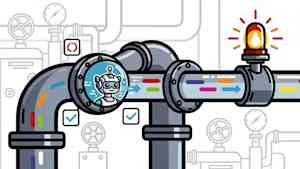
Agentic AI needs clean data; catch pipeline failures before they strike.
Definity is revolutionizing data pipeline reliability by embedding agents directly within Spark and DBT drivers, enabling real-time intervention during execution. Traditional monitoring tools often react to failures after they occur, leading to wasted resources and delayed insights. By catching issues before they impact downstream systems, Definity empowers data engineering teams to proactively optimize their workflows. In just one week, an enterprise customer identified 33% optimization opportunities and reduced troubleshooting efforts by 70%.
Open source YAML dashboards designed for AI-native analytics
Introducing an open-source dashboard-as-code tool designed for the modern data landscape. This code-first framework utilizes simple YAML and JSX files to build and deploy dynamic dashboards, enabling real-time generation of charts, tabs, and values. What sets it apart is its seamless integration with AI agents, creating a robust environment for AI-native analysis and business intelligence. Today marks its public release, and your feedback—whether constructive or critical—is invaluable. Explore the repository and join the conversation: https://github.com/bruin-data/dac.

Sharpen Your Python Skills with 400 Targeted Practice Exercises
Elevate your Python skills with "400+ Python Practice Exercises by Topic (2026)." This comprehensive resource features 136 free exercises and 298 premium ones, all designed to enhance your coding proficiency. Organized by topic and difficulty, these exercises can be solved directly in your browser, making practice both convenient and engaging. Additionally, the guide provides strategies for effective practice and highlights top external platforms for coding challenges. Embrace the opportunity to transform your Python journey through targeted, hands-on experience.
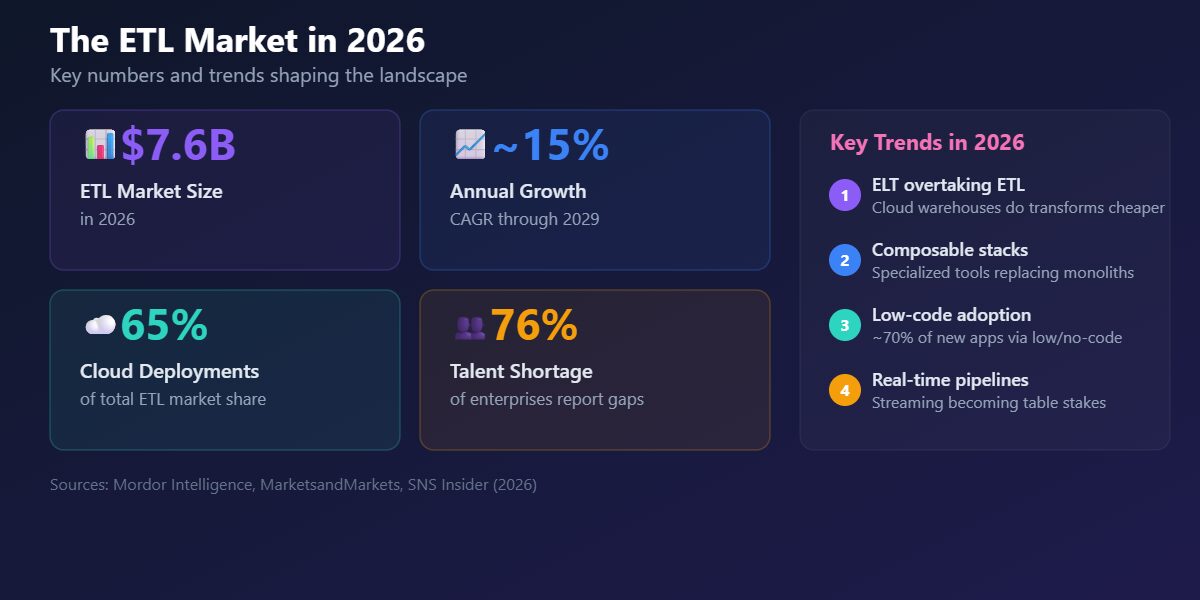
Your Data Pipeline Deserves More Than an Overcrowded Tool List
Choosing the right ETL tools is crucial when building a robust data stack, yet the abundance of overlapping options can be overwhelming. In 2026, the landscape continues to evolve, making it essential to understand which tools align with your specific needs. This practical guide not only highlights the best ETL tools available but also provides clear code examples to facilitate your decision-making process.

Mistral Workflows turns AI experiments into revenue-generating operations.
Mistral AI has unveiled Workflows, a powerful orchestration engine designed to elevate AI systems from mere proofs of concept to integral business processes. Operating within Mistral's Studio platform, Workflows already processes millions of daily executions, addressing critical gaps in operational infrastructure that hinder AI adoption. By separating orchestration from execution, it ensures data privacy and reliability, particularly for regulated industries.

Xiaomi's latest open models deliver powerful AI at an accessible price
Xiaomi has unveiled the MiMo-V2.5 and MiMo-V2.5-Pro, two powerful open-source AI large language models designed for efficient agentic "claw" tasks. Available under the MIT License, these models empower developers to adapt and deploy them in commercial applications without restrictions. Notably, MiMo-V2.5-Pro boasts a leading 63.8% success rate while using significantly fewer tokens than competitors for similar tasks. With competitive pricing and a commitment to innovation, Xiaomi positions itself as a formidable player in the open-source AI landscape, inviting developers to explore transformative

Supply chains reveal where traditional integration falls short
Supply chains are increasingly challenged by the limitations of legacy integration models, which struggle to keep pace with expanding partner networks and rising operational volatility. As traditional middleware falters under complexity and costs, automation-led Integration Platform as a Service (iPaaS) emerges as a vital solution. The evolving landscape of supply chains reveals the inadequacies of legacy systems and how next-gen iPaaS, enhanced by automation, can transform integration practices.

Explore how AI evolves its own training data and model architecture
Introducing ASI-EVOLVE, a groundbreaking framework developed by researchers at SII-GAIR, designed to automate the entire optimization loop for AI training data, model architectures, and algorithms. By employing a continuous "learn-design-experiment-analyze" cycle, ASI-EVOLVE significantly reduces manual engineering efforts while enhancing performance beyond traditional human baselines. This innovative system autonomously discovers novel designs, improves data curation, and refines learning algorithms. With ASI-EVOLVE, enterprises can streamline their AI workflows and unlock new efficiencies, making advanced AI capabilities more accessible and effective than ever before

Synthetic audiences make expert guesswork a relic of the past.
The consulting industry is on the brink of a transformation, as AI synthetic audiences emerge to challenge traditional methods. These digital representations of people enable rapid, cost-effective surveys, shifting the landscape of market research. While speed and affordability are appealing, questions about accuracy and data security linger. As established firms and agile startups navigate this evolving terrain, the future of consulting may not be a battleground but rather a collaborative journey.
Taming the unpredictable: A practical guide to testing AI's variability
In the realm of enterprise AI, monitoring large language model (LLM) behavior is critical to ensure reliability and compliance. Unlike traditional software, which operates predictably, generative AI presents unique challenges due to its stochastic nature. This guide introduces the AI Evaluation Stack, a structured framework for assessing model performance through deterministic and model-based assertions. By implementing robust evaluation pipelines, engineers can effectively identify drifts, retries, and refusal patterns, ultimately transforming the development process and enhancing user experiences.

DeepSeek reemerges with powerful AI at a fraction of the cost
DeepSeek-V4 has arrived, marking a significant leap in AI capabilities with its 1.6-trillion-parameter Mixture-of-Experts model, available at just 1/6th the cost of competitors like GPT-5.5 and Claude Opus 4.7. This latest release, rooted in innovative architecture and a commitment to open-source accessibility, empowers developers and enterprises to harness advanced AI without prohibitive costs. As DeepSeek researcher Deli Chen emphasizes, "AGI belongs to everyone," positioning this model as a game changer in the landscape of affordable, high-performance AI
The Data Scientist's Core Role Remains Distinct from AI Engineering
The evolving landscape of data science raises important questions about the core identity of data scientists in an age increasingly dominated by AI engineering. As industry demands shift towards integrating generalist models and refining existing workflows, many data scientists find their roles morphing into that of AI engineers. This transition, while economically sensible, risks overshadowing the critical aspects of data quality, problem framing, and model development that define the foundational work of data science.
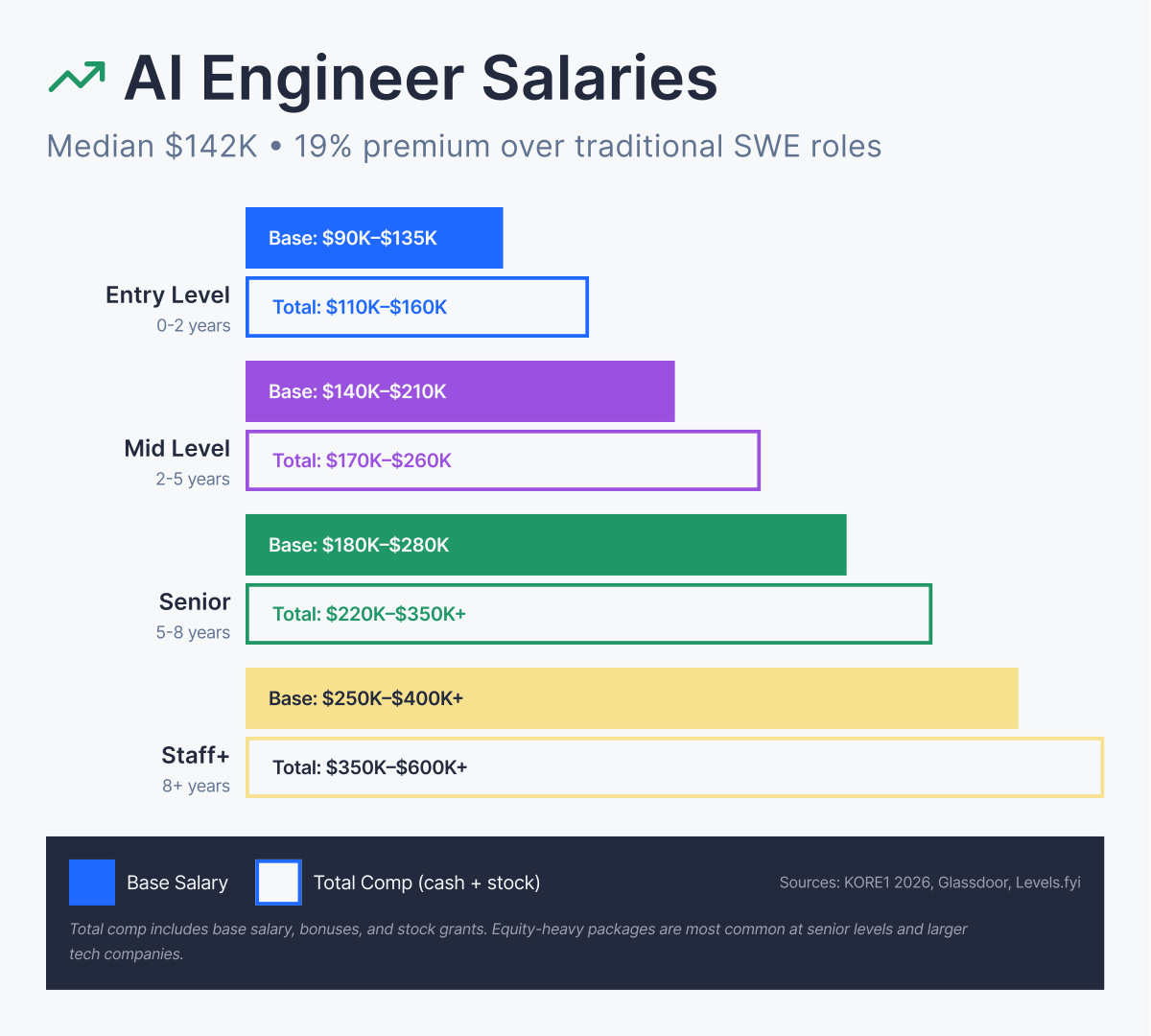
From First Prompt to Production AI in Under a Year
This comprehensive roadmap outlines the essential skills you need to acquire, such as Python, LLM APIs, RAG, and agents, presented in a logical learning sequence. With a realistic timeline of 8 to 12 months to transition from your first LLM prompt to deploying production AI systems, you'll also discover current salary expectations ranging from $130K to $250K+, depending on your experience.

Introducing GPT-5.5: a subtle but meaningful step forward in AI
OpenAI has officially launched GPT-5.5, a significant advancement in AI language models that narrowly surpasses Anthropic's Claude Mythos Preview on the Terminal-Bench 2.0. This model, which has been internally referred to as "Spud," showcases OpenAI's commitment to enhancing user experience by simplifying complex tasks and improving coding efficiency. With a focus on agentic performance, GPT-5.5 autonomously tackles intricate workflows, making it an invaluable tool for professionals across various fields.

OpenAI Workspace Agents put AI to work inside the tools you already use.
OpenAI has unveiled Workspace Agents, a significant advancement in AI-native tools for enterprises, enabling seamless integration with popular applications like Slack and Salesforce. These agents allow users to design and implement tailored workflows that streamline tasks across various platforms, promoting efficiency and collaboration. By shifting from traditional, session-based interactions to persistent, context-aware agents powered by Codex, OpenAI addresses longstanding challenges in workplace productivity. This innovative approach positions AI as a shared organizational resource, transforming how teams manage data and execute tasks, ultimately enhancing overall performance.

One overlooked OAuth grant opened the door to Vercel's production systems
The recent breach at Vercel highlights a critical gap in OAuth security that many organizations overlook. An employee's use of the Context.ai AI tool, combined with an infostealer infection, created an unmonitored entry point to Vercel’s production systems. This incident underscores the urgent need for robust governance around third-party AI tool permissions and environment variable classifications. As investigations continue, it serves as a crucial reminder for security teams to reassess their detection capabilities and adapt to the evolving landscape of AI-driven threats.
Trust Your Analysis, But Verify Every AI Output
Are you feeling a sense of detachment when using AI for data analysis? As a trained data scientist, I find myself increasingly reliant on AI tools, yet I'm often left feeling paranoid about the accuracy of my results. The subtlety of errors—like silent data drops or miscoded variables—can lead to misleading conclusions. I used to have an intimate relationship with my data, catching nuances that now often slip through the cracks.

Autonomous SOC agents turn AI breaches into direct firewall access.
In 2025, adversaries exploited vulnerabilities in AI security tools across more than 90 organizations, gaining unauthorized access to sensitive data and cryptocurrency. The emergence of autonomous SOC agents, which possess the capability to directly modify firewall rules and IAM policies, introduces a heightened risk of exploitation. As organizations adopt these advanced tools, a critical gap in governance remains, necessitating immediate audits against OWASP's Top 10 risk categories.

Von's AI picks the right model for every revenue task, automatically.
In the evolving landscape of revenue intelligence, Von emerges as a transformative AI platform designed to unify fragmented sales data and enhance decision-making for Go-To-Market teams. Unlike traditional AI solutions, Von builds a comprehensive context graph that integrates structured and unstructured data, empowering users with actionable insights. By leveraging a mixture of models, Von addresses common challenges in sales operations, automating tasks and providing deep analytical capabilities.
The Data Scientist's Honest Edge: Automation You Validate Yourself
In the evolving landscape of data science, many professionals are grappling with the implications of automation on their roles. As I develop a Data Science (DS) agent that shows promise yet lacks reliability for broader use, I’ve found that automating 40-60% of analytical tasks is achievable through validated Python packages. This approach enhances efficiency while minimizing errors, suggesting that partial automation of junior data scientist responsibilities is feasible.

The enforcement gap that lets rogue AI agents slip past identity checks.
A recent VentureBeat survey reveals that most enterprises are ill-equipped to counteract stage-three AI agent threats. Incidents at Meta and Mercor highlight vulnerabilities stemming from a common structural gap: insufficient monitoring and enforcement. The survey of 108 qualified enterprises indicates that many believe their security policies are robust, yet 88% reported AI security incidents in the past year. With only 21% achieving runtime visibility into agent actions, the pressing need for proactive isolation and comprehensive security measures has never been clearer.

Explore how AI can accelerate the journey from lab to life.
OpenAI has introduced GPT-Rosalind, a specialized model tailored for life sciences, designed to streamline the arduous journey from laboratory hypothesis to pharmacy shelf. Named after pioneering chemist Rosalind Franklin, this model transforms how researchers synthesize evidence, generate biological hypotheses, and plan experiments. By integrating with existing tools through a new Codex plugin on GitHub, GPT-Rosalind aims to enhance efficiency in scientific workflows.