financial modeling
Beyond Market Intelligence keeps financial modeling in one place: 201 stories so far. The section currently leads with “Mistral OCR 4 brings structured document intelligence to enterprise workflows”, “OpenAI's Jalapeño chip redefines inference for AI-native workflows”, and “Meet your new teammate: Claude Tag brings persistent AI into Slack”. Mistral AI has launched OCR 4, transforming document extraction into a full enterprise AI solution. OpenAI and Broadcom have jointly unveiled Jalapeño, a custom AI inference chip designed to accelerate large language model (LLM) workloads. Acme AI is the next-generation, AI-powered spreadsheet platform built to replace Excel and redefine how analysts, data scientists, and enterprise teams work… The list below is every financial modeling story on Beyond Market Intelligence, newest first.

Mistral OCR 4 brings structured document intelligence to enterprise workflows
Mistral AI has launched OCR 4, transforming document extraction into a full enterprise AI solution. This fourth-generation model delivers structured document representations, including bounding boxes, block classification, and confidence scores, moving beyond simple text extraction. Supporting 170 languages and deployable on-premise, OCR 4 addresses critical data sovereignty concerns, particularly relevant following recent U.S. export control actions. Early enterprise feedback highlights significant cost and latency reductions, positioning Mistral as a compelling alternative for document-intensive workflows.

OpenAI's Jalapeño chip redefines inference for AI-native workflows
OpenAI and Broadcom have jointly unveiled Jalapeño, a custom AI inference chip designed to accelerate large language model (LLM) workloads. This purpose-built processor, developed in a remarkably swift nine-month timeframe, aims to reduce inference costs by approximately 50% and will initially support ChatGPT, Codex, and future agentic products. Jalapeño represents a strategic expansion for OpenAI, enabling greater efficiency and broader access to advanced AI—a move that mirrors similar initiatives by tech giants like Google and Amazon.

Meet your new teammate: Claude Tag brings persistent AI into Slack
Anthropic’s Claude Tag introduces a transformative approach to enterprise collaboration, replacing its Slack app with a persistent, AI-powered teammate. This isn't a chatbot; it's an agent designed to learn, monitor, and autonomously work within teams, delegating tasks via @Claude. Built on Claude Opus 4.8, Tag offers multiplayer interaction, proactive insights, and asynchronous project management, streamlining workflows and boosting productivity. For organizations seeking to integrate AI into their daily operations, Claude Tag represents a significant step forward—a shift from reactive tools to an always-on, intelligent collaborator.

Alibaba Cloud's HappyHorse 1.1 makes production-ready AI video accessible to enterprises
Alibaba's HappyHorse 1.1 AI video model has surged to the No. 2 spot in global rankings, capitalizing on a dramatic shift in the generative video landscape. Following OpenAI’s Sora discontinuation and ByteDance's Seedance freeze, enterprise buyers now face limited options. HappyHorse, built for integration into business workflows and backed by Alibaba's substantial $52.7 billion infrastructure investment, offers production-ready video synthesis with features like multi-image reference capabilities and improved motion quality.
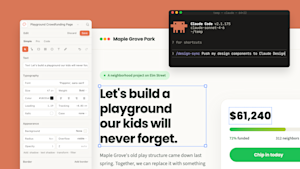
Claude Design refines its vision with smarter token use and deeper developer tools
Anthropic has overhauled Claude Design, transforming it from a prototyping tool into a key enterprise brand-compliance layer. The update introduces design system imports, enabling companies to ensure brand consistency across all generated assets, and a bidirectional code integration with Claude Code, streamlining the design-to-engineering handoff. Addressing initial token consumption concerns, Anthropic has also improved efficiency and integrated usage limits across its suite of tools.
Embrace Uncertainty to Make Smarter Design Decisions with AI
In an increasingly AI-driven design landscape, it's crucial to move beyond treating predictions as definitive truths. Probabilistic Design is a future-focused mindset empowering UX and product teams to embrace uncertainty and intelligently interpret AI outputs. Learn how to make adaptive decisions, transforming potential pitfalls into opportunities. Discover a framework for navigating complexity and building more resilient solutions. For deeper insights into the evolving AI landscape, explore "Probably raises $9M to build a more reliable kind of AI."

AI's real risk is making expertise obsolete, not just tasks easier
Satya Nadella cautions that unchecked AI concentration risks hollowing out entire industries, drawing a parallel to the disruptive effects of globalization. He introduces a framework centered on “human capital” and “token capital,” emphasizing that AI should empower, not replace, human expertise. Nadella advocates for businesses to build proprietary learning loops, decoupling institutional intelligence from specific models to ensure resilience and prevent value capture by a few dominant systems. For deeper insight into related tech trends, explore TechCrunch's coverage of SpaceX's recent IPO.

Sakana Marlin trades speed for strategic depth in autonomous business research
For businesses demanding insights beyond surface-level AI responses, Sakana AI introduces Marlin, a "Virtual CSO" designed for deep, strategic research. Unlike typical chatbots, Marlin leverages a novel Adaptive Branching Monte Carlo Tree Search (AB-MCTS) engine to autonomously generate comprehensive, 100-page reports and executive slides—often in just eight hours. Targeting enterprises like financial institutions and think tanks, Marlin represents a shift toward methodical reasoning over rapid generation, empowering data-driven decision-making. Explore sample reports and discover how this innovative agent can transform your research workflows.

Confidence in AI ownership drops sharply when leaders are asked directly.
Recent Ivanti research reveals a concerning disconnect: while 85% of IT teams confidently assert every AI agent has a designated owner, a stark 42% admit that ownership remains unclear. This gap, a staggering 43 points, highlights a critical vulnerability as organizational leaders are nearly twice as likely to conceal AI usage, often citing a "secret advantage.

Bridging the gap between AI prototypes and real-world results
Many enterprises struggle to translate promising AI prototypes into reliable, production-ready systems. At Capital One, we’ve observed that successful AI implementation demands a disciplined research and development approach, connecting foundational work to real-world applications and rigorously evaluating progress. Bridging the gap between research and practical use—as demonstrated by our work with multi-agent architectures—is key to unlocking impactful AI solutions. Learn how organizations can transform AI ambition into production reality through deliberate research, evaluation, and deployment.
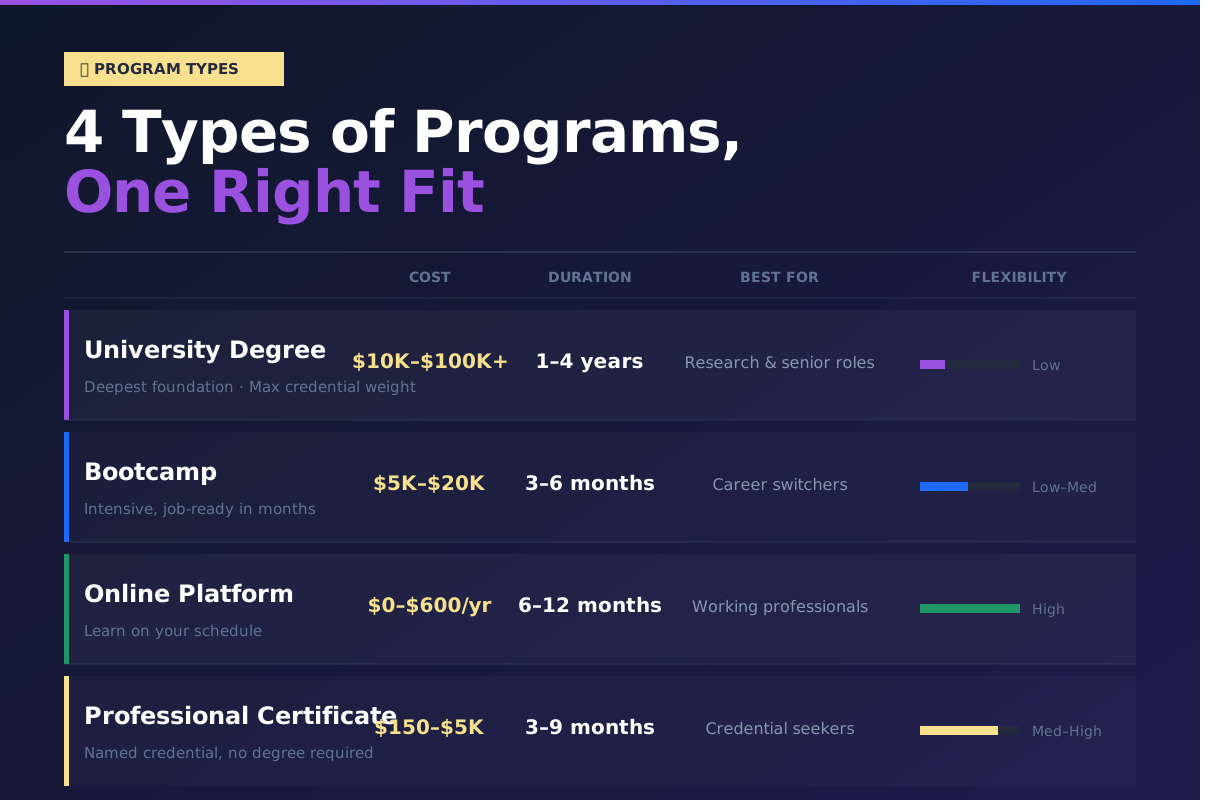
Navigating Data Science Education from Degrees to Self-Guided Paths
In 2026, navigating data science education feels like sprinting through a maze of degrees, bootcamps, and online courses, each claiming the quickest route to a career. The market ranges from free YouTube tutorials to multi‑hundred‑thousand‑dollar master’s programs, yet many comparison lists flatten these options without clarifying which path best fits your goals. This guide ranks programs by curriculum depth, industry relevance, and return on investment, helping you choose a course that truly transforms your data skills and accelerates your career.

Open source search agent redefines AI retrieval with focused recall power.
Researchers from UIUC, UC Berkeley, and the open‑source vector database Chroma have unveiled Harness‑1, a 20‑billion‑parameter AI search agent that outperforms GPT‑5.4 on information recall, achieving a 73 % average score across eight complex benchmarks. Built on OpenAI’s gpt‑oss‑20B model and released under Apache 2.0, Harness‑1 demonstrates that a well‑designed external “harness” can replace brute‑force context scaling, delivering enterprise‑grade accuracy with lower compute costs.

Claude Opus 4.8 expands with faster mode and parallel subagents for larger tasks
Anthropic has launched Claude Opus 4.8, a notable upgrade that maintains the same pricing as its predecessor while introducing a significantly cheaper "fast mode." This new tier reduces operational costs by 3X, making high-throughput tasks more accessible. The model also features the ability to spawn hundreds of parallel subagents for complex coding tasks, enhancing productivity. With improved alignment and efficiency, Claude Opus 4.8 positions itself as a powerful tool for enterprise applications.

DeepSeek's price cut challenges the economics of enterprise AI models
DeepSeek’s recent announcement of a permanent 75% price cut on its V4 Pro model marks a significant disruption in Silicon Valley’s AI landscape, challenging capital-intensive business models. By offering a solution that is 7x cheaper on inputs and 17x cheaper on outputs compared to leading competitors, DeepSeek not only enhances affordability but also promotes efficiency through innovative hardware-software architecture.

Sovereign data is the new foundation for resilient digital infrastructure
In a rapidly evolving digital landscape, data sovereignty is reshaping the rules of critical infrastructure. As the global datasphere expands, organizations face unprecedented demands for control over their data across interconnected systems. This shift emphasizes the importance of aligning authority with accountability, ensuring clarity in governance. By embracing data sovereignty as a foundational principle, enterprises can enhance resilience, navigate regulatory complexities, and empower innovation.

Visual coding meets production reality with Figma Make's Git integration.
Figma is redefining the role of designers with its new two-way GitHub integration for Figma Make, transforming it from a prototyping tool into a live software editor. This innovative update allows product managers and designers to visually edit production code while adhering to established engineering governance. By enabling seamless synchronization with existing codebases, Figma Make empowers teams to refine their design systems and accelerate workflows. As the landscape shifts toward “vibe coding,” Figma Make positions itself as an essential player.

Agentic AI delivers real results when data plumbing comes first.
Merck and Mastercard are witnessing significant advancements in agentic AI by prioritizing foundational infrastructure. Merck is leveraging AI to cut drug discovery cycles by a third and accelerate compliant marketing material delivery by up to 80%. VP Sean Finnerty emphasizes that these successes stem from robust digital plumbing established before AI deployment. Similarly, Mastercard focuses on optimizing transaction workflows, navigating complexities with AI while balancing efficiency and customer trust. For further insights on AI's evolving impact, explore our related article, "Google just broke SEO.

Your Vendor's Data Pacts May Be Sending More Than You Approved
A new report from DataGrail reveals a troubling reality for companies utilizing AI-driven software: 63.6% of vendors fail to disclose third-party AI subprocessors in their data processing agreements (DPAs). This alarming gap risks exposing sensitive customer data to AI models that businesses have not vetted. As AI adoption accelerates, the integrity of traditional DPAs is increasingly questioned. With significant regulatory scrutiny and rising costs tied to data breaches, privacy teams must adapt quickly. For additional insights, explore our article on Robinhood's new AI trading capabilities.

How one call bypasses your MFA and opens the door.
In the evolving landscape of financial services security, attackers are bypassing traditional defenses by resetting multifactor authentication (MFA) rather than stealing passwords. The latest CrowdStrike report identifies Mutant Spider as the most active threat, employing voice phishing tactics to manipulate employees into granting access. This shift highlights the need for organizations to reevaluate their security strategies, as vulnerabilities in legitimate authentication flows can leave systems exposed. For a deeper understanding of these trends, explore our article on "DeepSWE blows up the AI coding leaderboard."

When Trust Works Too Well: How Stolen Accounts Bypassed npm's Sigstore
On May 19, a significant security breach in the npm ecosystem saw 633 malicious package versions bypass Sigstore verification due to valid signing certificates being generated from a compromised maintainer account. This incident highlights a critical flaw in the automated trust signals within developer tools. With attackers exploiting vulnerabilities across multiple platforms, including a rapid attack on the Nx Console VS Code extension, the need for robust security measures has never been more urgent.

Give your agents direct access to raw data, not just summaries.
In the evolving landscape of AI-driven workflows, traditional retrieval systems often fall short, limiting agents' abilities to access real-time data. Researchers propose Direct Corpus Interaction (DCI), a game-changing technique allowing agents to interact directly with raw data using command-line tools, bypassing complex embedding models. This approach enhances precision in dynamic environments, ensuring agents can access the most relevant and current information. As enterprises adapt, DCI could redefine data management, supporting tasks that demand exact evidence and detailed insights.

Alibaba's Qwen model now powers autonomous AI agents across multiple days
Alibaba's Qwen3.7-Max marks a significant advancement in the AI landscape, boasting 35 hours of continuous autonomous operation. This proprietary model can execute complex tasks, positioning itself firmly in the emerging "agent era," where AI actively plans and adapts over extended periods. By integrating with external frameworks like Anthropic's Claude Code, Qwen3.7-Max offers enterprises a powerful tool for automation and innovation. However, its API-only access raises questions about accessibility, reflecting a shift from Alibaba's historically open approach.

Discover how AI agents transform enterprise workflows from months into days.
Kore.ai has launched its Artemis AI agent platform, marking a significant evolution in enterprise AI technology. Designed to empower organizations to build, govern, and optimize AI agents with remarkable speed and efficiency, Artemis leverages a new intermediary language, Agent Blueprint Language (ABL), to streamline complex processes. This launch positions Kore.ai as a neutral alternative amid fierce competition from giants like Microsoft and Salesforce. By prioritizing AI-driven development, Kore.ai invites enterprises to explore innovative solutions that enhance productivity and foster trust in AI.

Trillion-parameter AI inference runs seven times faster on Cerebras chips
Cerebras Systems has made a significant leap in the AI inference market, announcing that its chips can run the trillion-parameter Kimi K2.6 model nearly 7 times faster than any GPU cloud provider, achieving 981 output tokens per second. This milestone, independently verified by Artificial Analysis, showcases Cerebras' wafer-scale architecture's unique advantages, eliminating traditional bottlenecks. As the company positions itself at the forefront of AI technology, it invites enterprises to explore the transformative potential of its solutions.