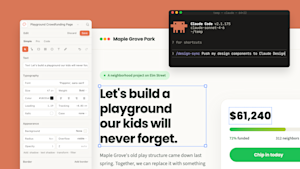
Anthropic’s overhaul of Claude Design signals a significant shift in the AI landscape, moving beyond fleeting viral demos towards establishing a foothold in the enterprise. When Anthropic quietly released Claude Design in April as a “research preview,” it generated the kind of instant traction most product teams dream about: more than one million users in its first week. It also generated a problem. The tool consumed tokens so voraciously that a PCWorld reviewer burned through 80 percent of his weekly Claude Pro allowance in roughly 25 minutes. This rapid adoption highlighted the potential of generative AI for design, but also underscored the challenges of scaling such tools sustainably. The difficulties in managing token consumption are mirrored in other areas of AI development, as explored in “AWS enters the context layer race with a graph that learns from agents, not manual curation,” where the bespoke nature of building robust AI systems necessitates careful resource management. Furthermore, the increasing customization of social media platforms, as detailed in “Social media’s next evolution: user-controlled algorithms,” reflects a broader trend of users demanding more control and efficiency from AI-powered tools.
The most compelling aspect of this update isn't simply the improved editor or expanded export options; it's the focus on design system compliance. By allowing enterprises to import and enforce their own branding guidelines, Anthropic is effectively transforming Claude Design from a potentially chaotic creative playground into a tool that strengthens brand consistency and streamlines workflows. This is a crucial pivot, addressing a key concern for larger organizations – the risk of brand dilution and the difficulty of ensuring visual consistency across a vast number of assets. The integration with Claude Code, enabling a bidirectional design-to-code workflow, represents an even more ambitious goal: to eliminate the notorious friction between design and engineering teams. This ambition aligns with a broader push to embed AI deeper into business processes, potentially reshaping how software is built and deployed, as evidenced by the discussions around American AI access in “World leaders want American AI. They just don’t want America to be able to turn it off.”
However, the elephant in the room remains token consumption. While Anthropic’s efforts to improve efficiency and share usage limits are welcome, generative design inherently demands significant computational resources. The fundamental tension between creating high-quality, varied designs and managing costs will continue to be a defining challenge. The success of Claude Design hinges on whether Anthropic can strike a balance between delivering a powerful tool and making it economically viable for a wider range of users, particularly individual professionals and smaller teams. The emergence of open-source alternatives like Open Design underscores the demand for accessible and customizable AI design tools, potentially putting pressure on Anthropic to further refine its pricing and usage model.
Ultimately, Anthropic’s strategy isn’t about creating a standalone design tool, but about building a cohesive AI platform that seamlessly integrates across various workflows. The evolution of Claude Design, coupled with the broader suite of Claude tools, paints a picture of an ecosystem where AI isn't just a chatbot assistant but a deeply embedded worker, operating within the systems where actual work happens. The question now is whether Anthropic can successfully navigate the technical and economic complexities of this strategy, establishing Claude as the central nervous system of the modern enterprise and solidifying its position as a leading force in the AI revolution.