Searching for the best data‑science program can feel like wandering through a maze of degrees, bootcamps, MOOCs, and certificates, each promising the fastest route to a new career. The landscape is littered with free YouTube tutorials on one end and $100,000‑plus master's degrees on the other, and many comparison articles flatten those options into a single list without helping readers understand which path truly matches their current skill set, budget, and timeline. To make sense of the clutter, we need a decision framework that aligns educational format with personal circumstance—a framework that our own AI‑native spreadsheet platform was built to support. For readers who have already explored "Best LLM Courses in 2026"(/post/best-llm-courses-in-2026-cmq5y5887005912xw9cg14f1q) or are refining a design system for AI readiness, the same principles apply: clarity, measurable outcomes, and a clear line from learning to production.
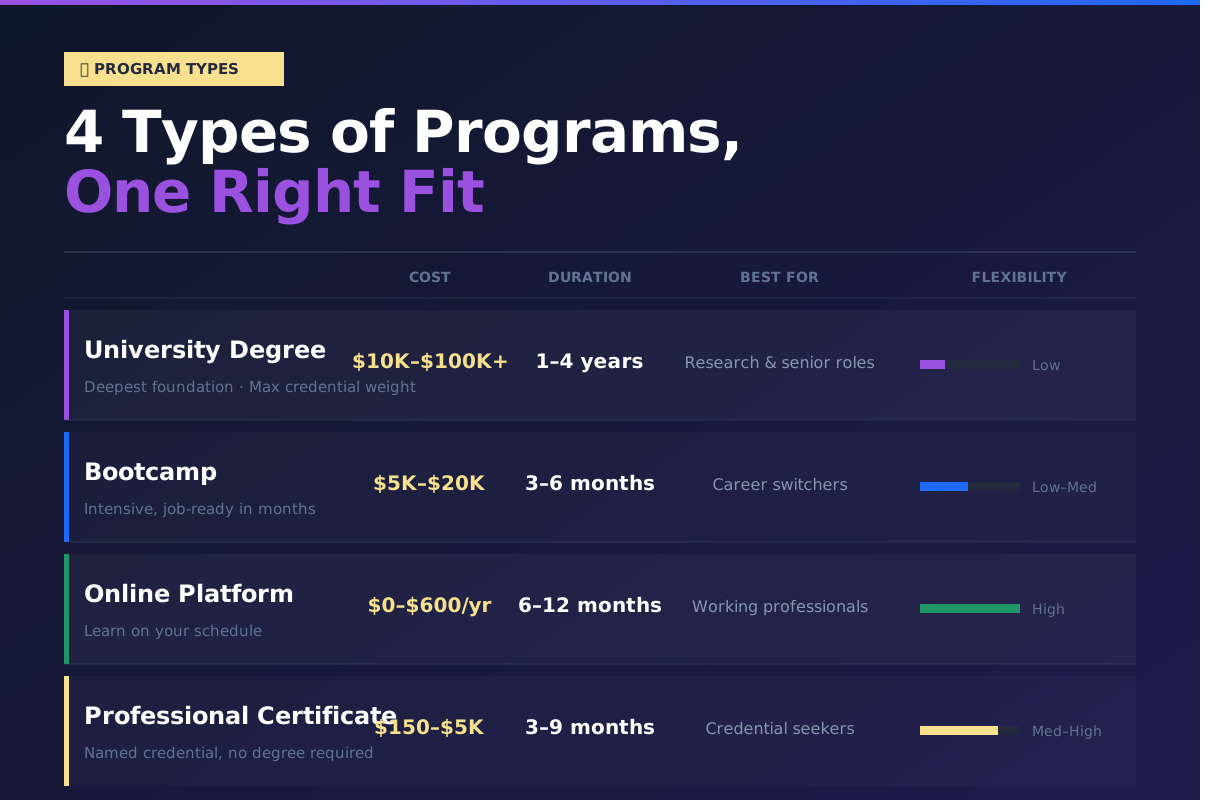
The honest breakdown of trade-offs across four major categories, traditional university programs, intensive bootcamps, online learning platforms, and professional certifications, is a key strength. University degrees still carry weight for employers who value academic rigor, but they often require a multi‑year commitment and significant financial outlay. Bootcamps, by contrast, deliver a condensed curriculum focused on practical tooling and portfolio projects, yet they can leave gaps in theoretical foundations that matter for long‑term career growth. Online platforms such as Coursera or edX excel at flexibility and cost efficiency, allowing learners to cherry‑pick modules that fit a specific project, but the self‑paced nature demands strong discipline. Professional certificates—often issued by tech giants or industry consortiums—provide a badge of competence that can be added to a resume quickly, though they sometimes lack the depth to prepare graduates for ambiguous, real‑world problems. By presenting these categories side by side with transparent cost tables and time commitments, the guide equips readers to map their current stage—whether they are fresh graduates, mid‑career analysts, or seasoned engineers—onto the most suitable learning track.
Why does this matter now? In 2026 the data‑science talent gap has widened as organizations embed AI into every layer of their operations, from product development to supply‑chain optimization. Companies are no longer looking for "data scientists" in the abstract; they need professionals who can integrate statistical insight directly into AI‑native workflows—exactly the kind of environment our spreadsheet solution empowers. A learner who selects a bootcamp that emphasizes Python, SQL, and model deployment will find immediate relevance when they import those models into an AI‑enhanced spreadsheet, turning raw data into interactive, decision‑ready dashboards without writing extensive code. Conversely, a student who chooses a master's program rich in statistical theory may discover new avenues for model interpretability that elevate the trustworthiness of those same dashboards. The decision matrix therefore does more than rank programs; it invites readers to explore how each educational path can transform their ability to deliver actionable intelligence within modern, data-centric products.
Looking ahead, the real differentiator will be how education providers embed continuous, AI‑driven feedback into the learning loop. Imagine a bootcamp that automatically assesses a student's notebook, surfaces hidden assumptions, and suggests refinements through an AI‑native spreadsheet interface. Or a university that pairs its capstone project with real‑time data streams from industry partners, allowing students to iterate on live dashboards that drive business outcomes. As these integrations mature, the line between learning and doing will blur, and the choice of program will shift from "where do I study?" to "how will my studies evolve with the tools I use every day?" For anyone navigating the crowded field of data‑science education, the question worth watching is not just which program tops the list, but which one equips you to discover, transform, and empower data in the AI‑first workplaces of tomorrow.