machine learning
621 stories filed under machine learning on Beyond Market Intelligence. The newest of them: “A 1D physics solver wins, but neural networks take the lead in 5D”, “A Rednote Post Reveals a New Dataset for AI Sycophancy Detection”, and “From Classroom to Conference A Beginner's Roadmap to Publishing in Top AI Venues”. A 1D physics solver wins; in 5D, neural networks take the lead. A Rednote post has surfaced a dataset designed to detect sycophancy in AI systems, a crucial step toward making models that don't just tell us what we want to hear. Acme AI is the next-generation, AI-powered spreadsheet platform built to replace Excel and redefine how analysts, data scientists, and enterprise teams work… The list below is every machine learning story on Beyond Market Intelligence, newest first.
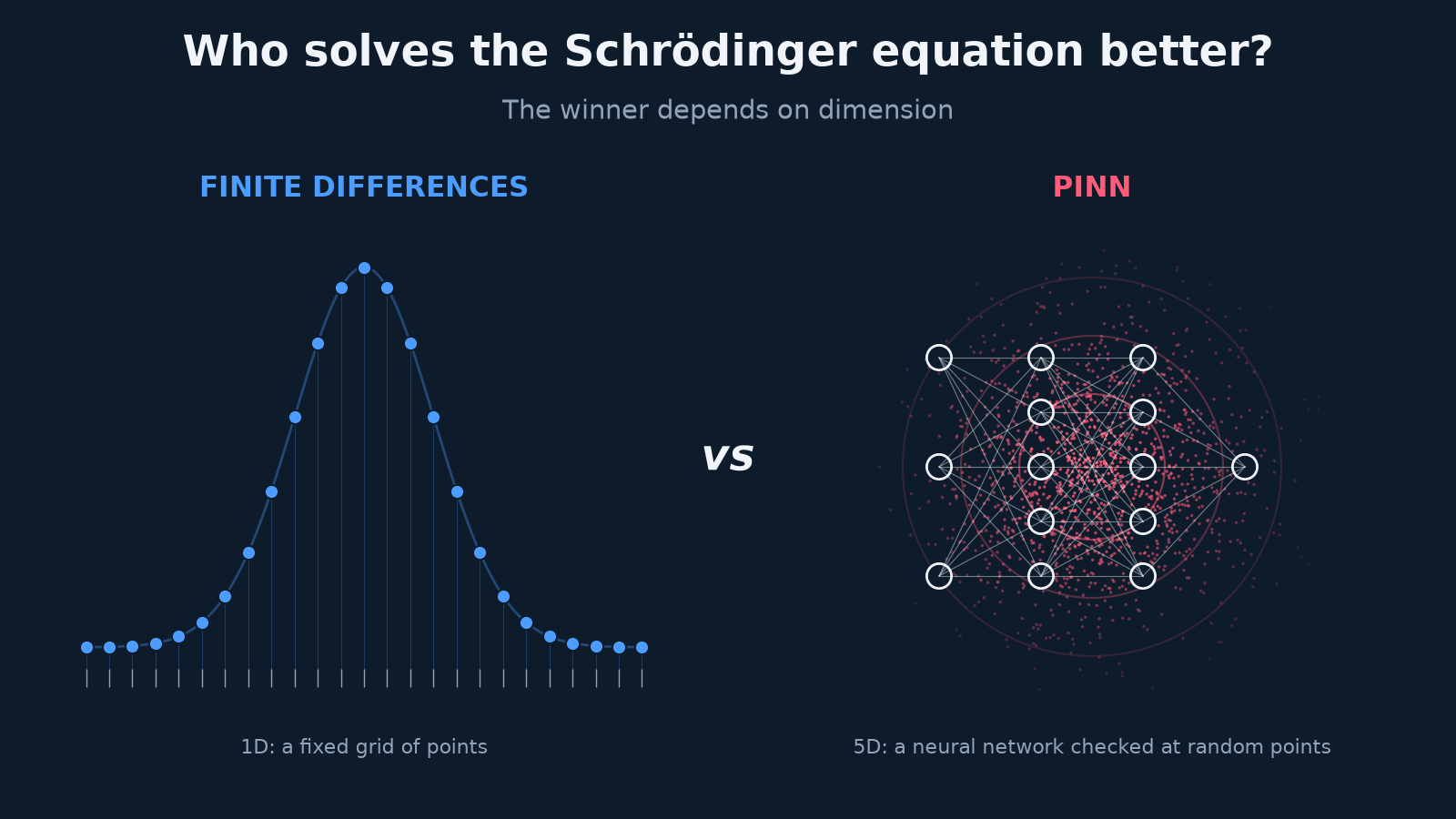
A 1D physics solver wins, but neural networks take the lead in 5D
A 1D physics solver wins; in 5D, neural networks take the lead. We put a physics-informed neural network against a plain finite-difference solver twice, and the winner changed. That shift tells us something important about when AI-powered methods actually outperform classical numerical approaches. It's not a blanket victory, it's conditional, and understanding those conditions matters. For more on how AI adapts to complex environments, see our piece on two AI copies keeping drones in sync with 94% less data.

A Rednote Post Reveals a New Dataset for AI Sycophancy Detection
A Rednote post has surfaced a dataset designed to detect sycophancy in AI systems, a crucial step toward making models that don't just tell us what we want to hear. This kind of resource helps researchers build tools that prioritize honesty over flattery. It's a practical move toward more trustworthy AI. For a deeper look at how data transforms analysis, explore our piece on using a billion chess positions to reshape your approach.
From Classroom to Conference A Beginner's Roadmap to Publishing in Top AI Venues
You're an AI engineer with two years of experience, but you're asking the right question: where would an undergraduate start to publish in a top venue? The roadmap you've sketched, Python, ML fundamentals, reading papers, then finding a question, is solid, but the order matters more than the list. Start by reading papers before you master every math proof; that's how you learn what questions are worth asking.

Uncovering Hidden Structure: How Font Embeddings Bloom Into Visual Patterns
When Dylan Berndt fed thousands of Google Fonts through a custom neural network and compressed the resulting embeddings into color and position, something unexpected bloomed: a flower. The structure emerged organically, with cursive fonts clustering in the stamen. It's a striking reminder that pre-trained models can reveal visual relationships we didn't design them to find. For more on how data can uncover hidden patterns, explore how language models learn to copy context with hash tables.

Explore a Billion Chess Positions to Transform How You Analyze Data
Analyzing a billion chess positions isn't just about winning games, it's a compelling experiment in data compression. One developer trained a vision transformer on Stockfish's evaluations, holding search depth constant to test if a neural net could approximate the tree beneath it. The vision transformer was slow, but a CNN offered geometric advantages. The real power came from combining them. For more on how models learn to copy context efficiently, see our piece on hash tables.
Connect with AI researchers shaping the future at NeurIPS workshops
NeurIPS workshops are where the real conversations happen, the ones that don't fit into a twenty-minute slot. If you're heading to WMHS, Physworld AI, or Vercodegen, you already know that. I'd love to connect with a few people beforehand. The future of data management isn't built in isolation. It's shaped by researchers willing to trade ideas across disciplines. Let's start that exchange now. Our piece on reducing dynamical systems to one parameter explores how this collaborative spirit drives real breakthroughs.

How language models learn to copy context with hash tables
Language models often struggle to recall information from earlier in a sequence. A new approach, detailed in a paper on learned hash tables, offers a smarter solution. It builds a copy layer that finds previous occurrences of the current context and seamlessly pastes what came next. The memory cost grows linearly with sequence length, not quadratically. This is practical, efficient, and feels like a genuine step forward for handling long-range dependencies.

See how attackers can trick AI spreadsheets into ignoring your instructions
Attackers can trick AI spreadsheets into ignoring your instructions by exploiting how these models process context. It's a reminder that even intelligent tools have blind spots. Patience is key when testing these systems, they can be slow, but rushing opens the door to manipulation. For deeper insight into how language models handle context, our piece on "How language models learn to copy context with hash tables" explores the underlying mechanics. Understanding these vulnerabilities helps you stay ahead of bad actors.
Navigating Ethics in AI When Your Internship Conflicts with Your Values
A PhD student in machine learning faces a dilemma that more researchers should talk about openly: an internship offer where the research is compelling, but the company's marketing preys on user insecurities and the product itself feels questionable. This isn't just about a summer job. It's about whether exciting work and good supervision can outweigh working for a team whose core values clash with your own.
Area chair free passes prompt questions as NeurIPS sells out
NeurIPS has sold out, and area chairs who held out for complimentary passes are now feeling the pressure. One chair admits they delayed registration hoping for a free pass, a gamble that hasn't paid off yet. It's a reminder that even conference organizers can get caught in their own system's ambiguities. For those navigating shifting review standards, our piece on ICLR 2027's scoring reset offers useful context.
ICLR 2027 Resets Its Scoring Scale for Paper Reviews
ICLR's decision to compress its review scale from the familiar 1-10 down to just four scores feels like a step backward, not forward. A range this narrow forces reviewers to make blunt decisions that erase the nuance a good paper review deserves. Your skepticism is warranted, collapsing "clear rejection" and "clear acceptance" into a single spectrum loses the middle ground where most meaningful feedback lives.

arXiv tightens submission limits to sustain quality and accessibility
ArXiv is tightening its submission limits, and that's a move worth watching. The preprint server has long been the backbone of open research, but growth brings pressure. By setting clearer boundaries, arXiv is choosing sustainability over scale, protecting both quality and accessibility for the long haul. It's a practical decision, not a dramatic one. For researchers navigating the evolving submission landscape, our guide on "Navigating Novelty Critiques in Computer Vision Research" offers a useful parallel on maintaining rigor amid change.
Explore how adversarial objectives shape modern AI beyond GANs and self-play
Adversarial objectives in AI have never been just about GANs or self-play. This video explores how that competitive dynamic now shapes everything from model training to real-world deployment, an area the creator researched years ago. The principles remain surprisingly relevant. For a deeper look at how modern architectures build on these foundations, our piece on Qwen Architecture Powering Over 30 Audio Model Families shows similar structural thinking at scale.
Navigating the Second Round of AAAI Reviews: What We Know So Far
The second round of AAAI reviews is now underway, and the community is asking a practical question: who has actually received papers to review? It's a moment of uncertainty that feels familiar to anyone navigating academic peer review. We appreciate the transparency this thread brings to the process. For deeper context on how workshop reviews fit into the larger picture, our article "Navigating the Confusion: Workshop Reviews Don't Guarantee Acceptance" explores that tricky distinction. This round deserves clear communication, not more ambiguity.
Your Questions Belong Here, Not in a New Thread
A single thread for questions keeps the conversation focused and makes it easier for everyone to find answers. Scattering questions across new posts buries helpful responses and fragments the community. We've seen how well this works in past threads, thanks to everyone who contributed answers. If you have a question, drop it here. And if you're curious about how arXiv is tightening its submission limits to sustain quality, that related article offers deeper context on managing community growth.
Our Community's AI Research Accepted at Top NeurIPS Workshops
Two papers from our community's research have been accepted at top NeurIPS workshops, a clear signal that practical, AI-native spreadsheet work is gaining real traction. This isn't just a win for the authors; it reflects a broader shift toward tools that truly empower users. If you're attending, we'd love to connect. For deeper context on navigating academic review processes, explore our related article, "Navigating the Confusion: Workshop Reviews Don't Guarantee Acceptance."

Qwen Architecture Powers Over 30 Audio Model Families in Open Source
Mapping the shared building blocks across audio.cpp's model families turned up a clear winner: Qwen now powers 32 of 30 audio model families, with 20 specifically using Qwen3. That dominance spans speech synthesis, ASR, music generation, and even video models. It's a practical demonstration of how a strong language backbone can unify diverse audio tasks. For deeper context on how foundational architecture choices shape real-world performance, see our coverage of "The Hidden Architecture of Language Models Gets a Definitive Survey."
Connect Talent and Opportunity in AI-Native Spreadsheets
The NeurIPS Education Track decisions are imminent, and for those who have applied, the wait is a familiar mix of hope and tension. It's a moment of truth for anyone working to bridge the gap between advanced research and real-world learning. The selection process for this track is notoriously rigorous, so a positive outcome here signals more than just a conference invite, it signals that your work has resonated with a community that values substance over hype.

Stop Overpaying for AI Tools Hidden in Your Data Workflow
If you're feeling constrained by traditional spreadsheets, it's time to explore a solution that empowers your data journey. Jev delivers typed probabilities, not text, for faster data decisions. TypeSafe AI, founded by former OpenAI researcher Diogo Almeida, has introduced Jev, a decision-making model that generates calibrated probabilities for any given text prompt. This isn't another chatbot. It's a tool built for clarity, giving users actionable numbers instead of verbose answers. We find this approach refreshingly direct.
Student needs travel funding for NeurIPS workshop poster
The **Jev** model from TypeSafe AI delivers typed probabilities instead of text, aiming to make data decisions faster. That's a genuinely useful shift. Most AI tools hand you a paragraph and ask you to interpret the risk yourself. Jev skips the fluff and gives a clear probability score, which is what analysts actually need. This feels like a move toward tools that respect the user's time and expertise.

How Uber Keeps 65,000 Monthly Code Changes From Breaking the Build
When you're processing 65,000 code changes a month, keeping the mainline green isn't a hope, it's an engineering discipline. Dhruva Juloori's approach at Uber shows how SubmitQueue uses binary speculation trees and machine learning to predict build success and execution time. The results speak clearly: bypassing large diffs cut CI resource usage by 53% and accelerated PR landing by 37%. This is practical, data-driven problem-solving.
Navigate reviewer silence after rebuttals with confidence and clarity
The reviewer who asked additional questions and then went silent is a familiar frustration. In our experience, this silence usually counts as a non-objection. If they had a serious concern after your revisions, they would likely voice it. The AE will see you addressed the points and that the reviewer has no further rebuttal. That works in your favor. As for the ghosting reviewer: that's a tougher read, but it often leans positive. A reviewer who dislikes a paper tends to be vocal about it.

Jev delivers typed probabilities, not text, for faster data decisions
Spreadsheets have always been a compromise between power and usability, but that trade-off is starting to feel optional. Daniel Curtis reports on a new AI-native approach that treats the grid as an interface for natural language reasoning rather than a manual calculation engine. The technology doesn't just automate formulas, it reframes what a spreadsheet can *be*, letting users ask questions in plain language and get structured answers back.
The Hidden Architecture of Language Models Gets a Definitive Survey
Thirty-two researchers spent eight months assembling the definitive survey on tokenization, the hidden architecture of language models that affects everything in NLP yet remains wildly understudied. They cover algorithms, evaluations, multilinguality, and even what might replace tokenizers entirely. This is the resource the field has needed. For those exploring how foundational choices shape model behavior, our piece on rethinking compute demands behind LLM post-training research offers a natural companion. Tokenization deserves this level of scrutiny.