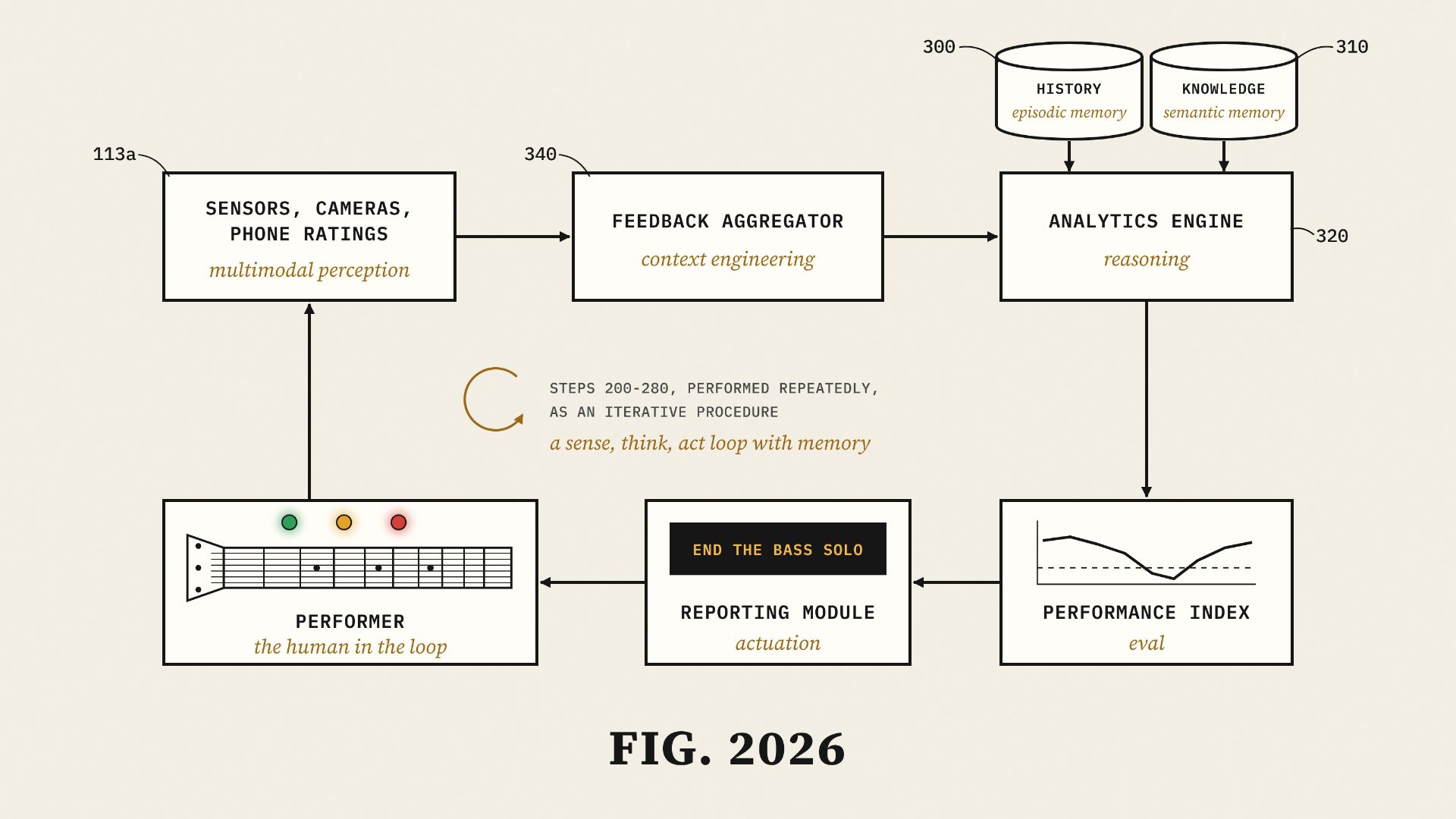
Patents age like maps: useful for where you've been, less reliable for where you're going. That's why re-reading a 2016 IBM patent on real-time concert feedback as an early agentic loop feels less like nostalgia and more like calibration. The system described, multimodal perception, memory-grounded inference, and a human in the loop, was labeled analytics at the time, but the architecture anticipated what we now call AI agents. The label was the limitation. The thinking was ahead of its moment.
What the patent got right was the loop itself, not the terminology. It treated data as something to perceive, interpret, and act upon, not merely to display. That is precisely the shift separating static dashboards from adaptive workflows. The patent also understood that a human should remain in the decision path, a principle that still separates trustworthy agents from autonomous black boxes. For builders today, the lesson is uncomfortable: we're not inventing a new paradigm so much as catching up to a decade-old blueprint. The Ten Hugging Face Models Reshaping How Data Works in 2026 show how far the tooling has come, but the underlying loop, perceive, infer, decide, learn, remains the same skeleton.
Hindsight also exposes what the patent missed. It assumed a single agent with a single context, whereas modern systems thrive on distributed, multi-agent coordination. It treated memory as a static store rather than a dynamic, retrievable state. And it underestimated how much of the loop's value would come from the quality of the inference layer, not the sensor inputs. These gaps matter because they point to where agent builders should invest today: grounding, context persistence, and explicit human override mechanisms. The Stop Waiting for Answers Your Local Model Already Knows article highlights how local models can deliver fast, private inference, exactly the kind of capability that makes memory-grounded agents practical rather than theoretical. The patent's authors couldn't have anticipated that compute would become cheap enough to run inference at the edge, but their loop assumed it would.
The deeper point is that naming matters less than structure. Calling an agent "analytics" didn't make it less agentic; it just made it harder for others to see what was already there. That suggests a concrete takeaway for anyone building today: don't wait for the vocabulary to catch up to your architecture. If your system perceives, reasons, and acts in a feedback loop, it's an agent, regardless of what your product roadmap calls it. The risk isn't being ahead of the curve, it's being so eager to label yourself that you miss the actual loop running underneath. Watch the When AI judges ignored the image, GPT-4o invented answers while Claude stuck with B example: models that invent answers when perception fails are breaking the loop, not advancing it. A decade from now, the agents that survive won't be the ones with the best marketing. They'll be the ones that kept the human in the loop and let memory shape their next move.