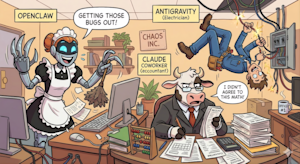
The arrival of agentic AI is not a distant possibility; it is here, and it is already reshaping how work gets done. We have watched the rise of tools like OpenClaw, Google's Antigravity, and Claude Cowork, and we see a clear pattern: these are not just smarter chatbots. They are autonomous actors with the ability to touch your files, your code, and your financial data. That is a profound shift, and it demands more than passive curiosity. It demands a deliberate, informed approach to how we integrate these tools into our daily operations.
For you, the user, this means the promise of offloading mundane tasks is real, but so is the risk of unintended consequences. OpenClaw, with its deep system access, is like handing a house key to a capable but unsupervised assistant. It can triage your inbox and curate content, but it can also make decisions you did not anticipate. Antigravity functions like a focused specialist, excellent at coding but limited to the scope you define. Claude Cowork, with its domain expertise, can navigate legal and financial complexities, yet it can also miss critical opportunities or, worse, introduce errors that are hard to detect. The practical takeaway is not to avoid these tools, but to understand their boundaries and to set clear, narrow parameters for their use. You are not handing over control; you are delegating specific tasks with defined guardrails.
The core challenge is trust, and it is not abstract. It is about accountability. When an agent acts, who is responsible for the outcome? OpenClaw, being open-source, lacks a central authority, which complicates oversight. Anthropic and Google, on the other hand, carry the burden of ensuring their agents do not leak data or provide unfair advantages. This is why principles like transparency and logging are not optional. They are essential. You need to see what an agent did, step by step, and you need the ability to approve or reject its actions. Human confirmation is not a bureaucratic hurdle; it is a safety net. Without it, you are flying blind, hoping the agent gets it right.
The path forward is not about slowing down progress or fearing the machines. It is about building a shared framework, a common language that agents can use to interact responsibly. Ontology matters here, because when agents speak the same language, they can be tracked and held accountable. This is how we move from chaos to control. If we can establish these ethical and technical standards, the potential is enormous. Agents can handle the repetitive, the tedious, and the time-consuming tasks, freeing you to focus on high-value work that requires judgment and creativity. The goal is not to replace human intelligence, but to extend it. The question is not whether to adopt agentic AI, but how to do so with intention, oversight, and a clear sense of responsibility.