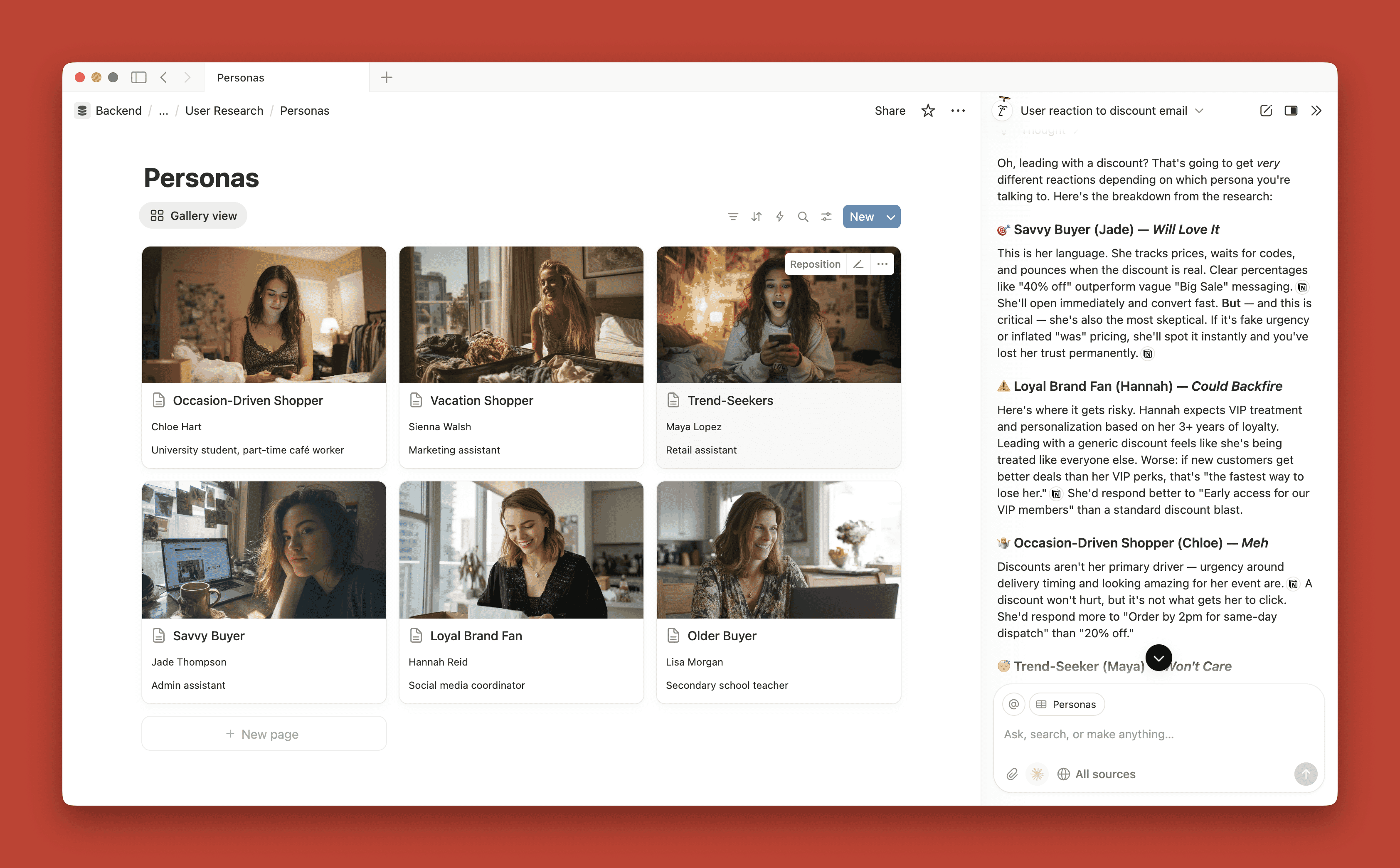
We think this approach solves a problem that most organizations don't even realize they have yet. The gap between creating user personas and actually putting them to work is where the real friction lives. Too often, research gets locked in documents, presentation decks, or the heads of a few specialists. When someone in marketing, product, or support needs a quick read on how a particular user segment would react to a feature, they either guess or hunt down a report they don't have time to read. That's not a workflow problem. It's a design problem.
By packaging personas as AI-driven agents that answer questions on demand, the method described here turns static profiles into living resources. Anyone in the organization can ask one question, "Would our power user find this onboarding step confusing?", and get a synthesized response grounded in real research. The key insight is that this isn't about making personas smarter. It's about making insights more accessible. When you remove the barrier of having to interpret raw data or dig through notes, you suddenly equip every decision-maker with the same context that the research team has. That changes how quickly teams can align on direction.
What matters most is that this doesn't require a massive overhaul of your existing research process. You don't need to start from scratch or collect new data. The personas are built from the material you already have: interview transcripts, survey responses, usability test notes. The AI does the work of synthesizing those inputs into distinct perspectives, then lets you query them naturally. That means the person who never opens a research repository can still benefit from its contents. And the person who built the personas doesn't have to field the same three questions every sprint.
The practical takeaway is this: if your personas live in a slide deck, they are decoration. If they live in a system that answers questions, they are infrastructure. The difference is not in the quality of the research. It is in how many people can actually use it.