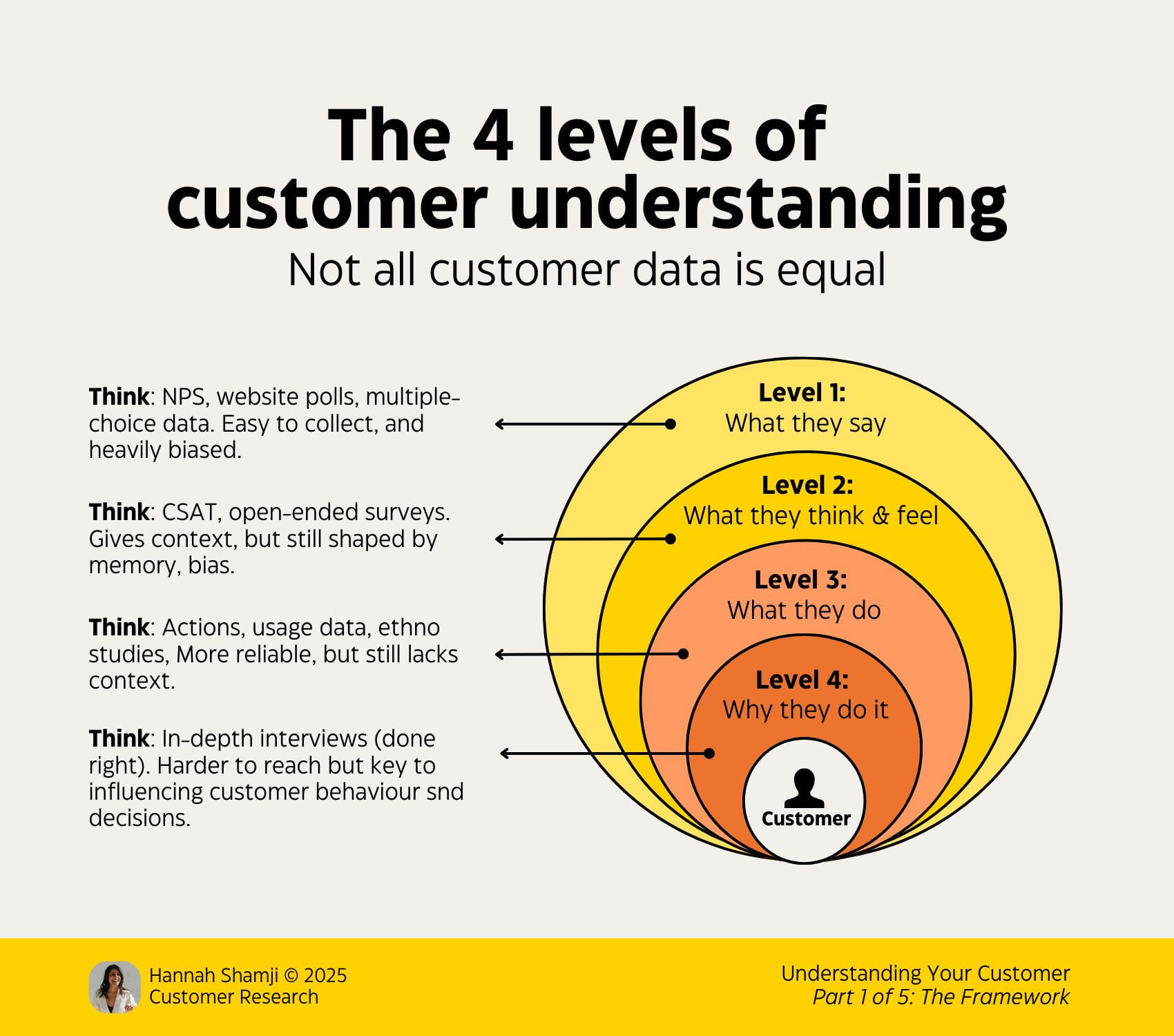
Understanding customer behavior is crucial for companies aiming to create meaningful products and services. What users say, feel, think, and do often diverges significantly. This discrepancy suggests that businesses cannot rely solely on surface-level insights or assumptions about their customers. Instead, they should delve deeper to uncover the hidden motivations and root causes that drive user actions. For instance, in our recent article Remove Duplicated and Originals?, we discussed how understanding the nuances of user needs can lead to more effective solutions in managing data, similar to the deeper customer understanding needed for broader UX design.
The concept of triangulating across four levels of customer understanding, as introduced by Hannah Shamji, presents a structured approach for businesses to gain comprehensive insights into their users. Often, organizations operate on assumptions that may seem valid but lack empirical support. For example, a company might believe that users are primarily motivated by price, when in reality, factors such as usability, brand loyalty, and emotional connection play more significant roles. Businesses must look beyond just what is obvious or assumed. This approach aligns with ongoing discussions about the importance of user-centered design in technology, as seen in another recent article, Need formula to identify unpaid job numbers, where understanding user requirements led to the creation of a formula that simplifies task management.
By embracing a more nuanced view of customer behavior, companies can better align their products and services with actual user needs. This is particularly relevant in the context of the fast-evolving landscape of AI and data management. As organizations increasingly rely on AI-native technologies, understanding the complexities of user interactions becomes even more critical. The traditional methods of gathering feedback, such as surveys or focus groups, may not capture the full spectrum of user experiences, leading to misalignment between what is offered and what users genuinely require. As highlighted in our coverage of Cloudflare's advancements in its infrastructure, which enhances user experience through improved performance, the underlying root causes of user satisfaction must be understood and addressed for technology to be truly effective.
Looking ahead, businesses must prioritize deep customer understanding as a foundation for innovation. The implications of this approach extend beyond product development; they influence marketing strategies, customer service, and overall brand loyalty. As companies become more adept at uncovering the layers of user motivations, they will not only enhance their offerings but also cultivate a more engaged and satisfied customer base. The challenge lies in consistently applying these insights in a rapidly changing market. As a question worth pondering, how can organizations ensure that their understanding of customer behavior evolves in tandem with the technologies they employ? This ongoing dialogue will be crucial as we navigate the future of user experience and technology integration.