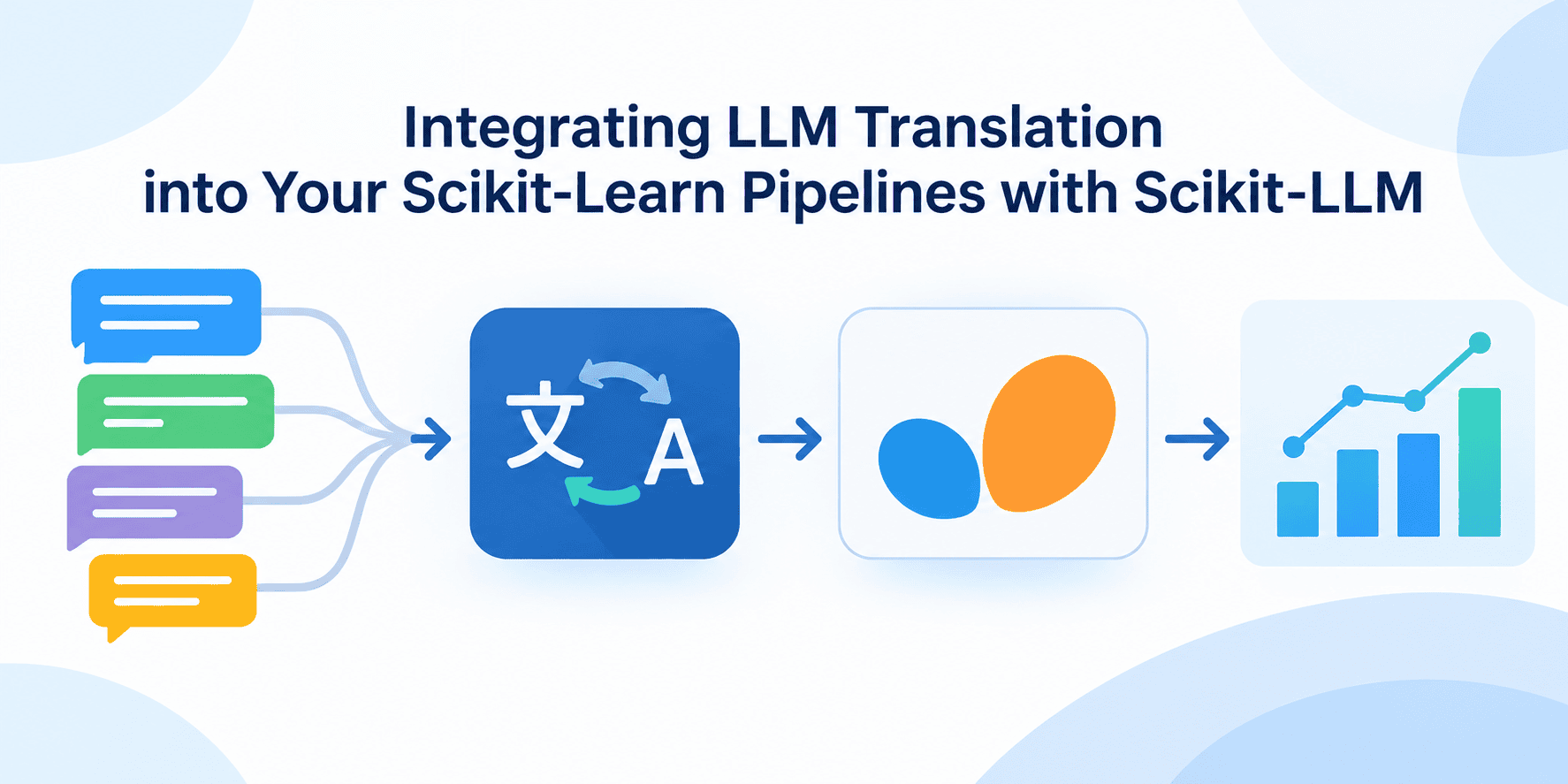
The promise of multilingual text classification has always been tangled in complexity: train separate models per language, source enough labeled data for each, or accept that half your global user base gets a degraded experience. This week's walkthrough on building a two-stage scikit-learn pipeline with Scikit-LLM cuts straight through that knot, and our reaction is simple: this is the kind of practical, modular thinking that makes AI-native tools feel less like science experiments and more like daily drivers. Instead of asking teams to become polyglot machine learning engineers, the approach leans on two pre-trained language models working in sequence, one for translation, one for zero-shot classification, all orchestrated inside the familiar scikit-learn framework. It is an elegant shortcut, and one that deserves attention.
What makes this concrete is how it connects to work we have covered before. For readers who explored Build smarter text pipelines by merging AI summarization with classic scikit-learn tools, the pattern here will feel like a natural extension: the same principle of composing LLM-powered estimators with traditional sklearn components, now applied to multilingual data rather than summarization. And for those who followed Make LLM Reasoning Your NER Engine in Just a Few Steps, the zero-shot classification stage echoes that same reliance on LLM reasoning to bypass the need for task-specific training data. The through line is clear: when you treat LLMs as pluggable estimators rather than monolithic black boxes, you unlock pipelines that are both smarter and more maintainable.
The practical consequence for teams building multilingual systems is direct. You no longer need to curate labeled datasets for every language your product supports. The translation step handles the input diversity; the zero-shot classifier handles the labeling. That means a customer support ticket triage system, for example, can be deployed across Spanish, Mandarin, and Arabic with the same underlying logic, tested once and scaled horizontally. The trade-off, and it is worth naming plainly, is latency and cost. Two LLM calls per document adds up, and the quality of the final classification depends on the translation model's fidelity. But for many use cases, especially internal tools, content moderation, or early-stage product launches, the speed of implementation outweighs those concerns.
The specific detail to watch here is how the pipeline handles language mixing within a single document. The walkthrough assumes clean monolingual inputs per row, but real-world text often blends languages in a single sentence. That edge case is where this architecture will either shine or break, and it is the kind of nuance that separates a demo from a production system. For now, the takeaway is actionable: if you have been avoiding multilingual classification because it felt like a separate product problem, you can stop. Build the two-stage pipeline, test it against your data, and decide whether the trade-offs fit. The tools are already in your hands.