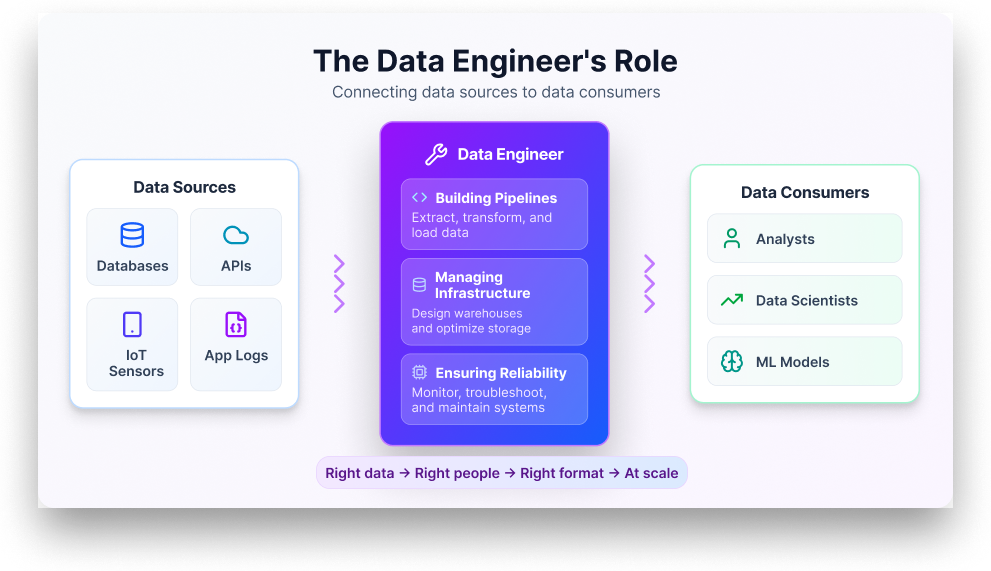
The data engineering skills race is leaving too many talented people behind, and the problem isn't a lack of capability, it's a lack of clarity. When every job posting demands a different stack of SQL, Python, Spark, Kafka, Airflow, and cloud certifications, the signal gets lost in the noise. What matters most for 2026 isn't chasing every new tool; it's mastering the fundamentals that make you adaptable.
Start with SQL and Python. They are the non-negotiables. SQL remains the language of data access, and Python is the glue for everything else, pipelines, automation, even the orchestration layers that coordinate complex workflows. If you can write clean, performant queries and build modular Python scripts, you already have a foundation that transfers across roles and platforms. Cloud certifications help, but only after you understand how data moves and transforms. A certified engineer who cannot debug a broken pipeline is still stuck. Focus on the concepts: distributed computing with Spark, event streaming with Kafka, and workflow orchestration with Airflow. These are the patterns that power real-time recommendations and business intelligence at scale. Learn one deeply, then generalize.
The median salary of $131K and growing job postings reflect a market that values infrastructure builders. But the trap is trying to learn everything at once. Pick two core skills, SQL and Python, then layer one streaming and one orchestration tool. Build a project that moves data from a source to a warehouse, transforms it, and schedules the process. That portfolio speaks louder than any certification list. Employers in 2026 will hire for problem-solving, not tool fluency. The tools will change; the ability to design reliable pipelines will not.
What this means for you is straightforward: stop comparing your skill stack to job descriptions that were written by committee. Start with the few skills that every data pipeline depends on, then prove you can deliver a working system. The job postings will keep evolving, but the engineers who focus on fundamentals will be the ones defining what comes next.