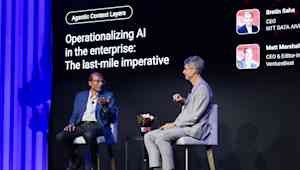
The headline from NTT DATA AIVista's session at VB Transform 2026 is a refreshing slap of reality for anyone who thought buying a better model was the same thing as building a better business. Bratin Saha's point about the "last mile" cuts through the noise: the frontier model is the easy part. The hard, valuable work is wrapping that raw intelligence in your proprietary data, your undocumented workflows, and the unspoken judgment of your most experienced workers. This is where Building A UX ROI Case That Survives The Boardroom and the broader push toward AI value converge; you can't measure the return on a model any more than you can measure the return on a lightbulb. The return comes from the work the light allows you to do after dark.
Our take is that Saha is right to kill the fine-tuning myth. The fact that it ranked last in enterprise model-selection priorities should be a wake-up call to every team that thinks a few extra epochs on a training set is the secret sauce. The real secret sauce is the system around the model: the ensemble that keeps costs from exploding, the guardrails that force a redo when the output is wrong, and the absorption of tribal knowledge that never made it into a standard operating procedure. This isn't just a technical architecture; it's a management philosophy. It means the biggest gains come from talking to the person who has been doing the job for twenty years and encoding their instincts into a digital worker. That is a far more human-centric and practical approach than chasing the next GPT release, even one as significant as 'Welcome to the AGI era': OpenAI launches GPT-6 Astra. That model is a tool; the system around it is the solution.
For our readers, the practical implication is a reordering of budgets and attention. If you are pouring money into AI and not seeing the return, the problem is likely not the model's reasoning ability. It's the integration. It's the change management. It's the failure to capture the "how" that lives in your employees' heads. Saha's point about starting with embedding AI into existing workflows before reimagining them is the smart, low-risk path. Mission-critical operations will not tolerate a midstream rip-and-replace, and they shouldn't have to. The value is in the journey from point A to point B, not in the technology that powers the movement. This is a strong counterpoint to the constant drumbeat of disruption, reminding us that sustainable transformation is a slow, deliberate process of building trust and proving value in the existing environment.
The one thing to watch is the claim that technology is not the bottleneck. In a world where Microsoft AI’s MAI-Transcribe-2 undercuts OpenAI, Google and ElevenLabs on price and speed, the model landscape is shifting fast, and the ability to swap components matters. NTT's bet on an ensemble that mixes frontier and open-weight models is the correct one, but it only works if the guardrails and the context layer are truly portable. The durable moat is the 20 years of trust and tribal knowledge that cannot be instantly replicated. The specific, concrete takeaway to quote is this: your competitive advantage is not the AI model you buy, but the system you build around it from the knowledge you already own. The next question to ask your vendor is not "what can your model do?" but "how will you capture what my people know and turn it into a guardrail?" That is the last mile that matters.