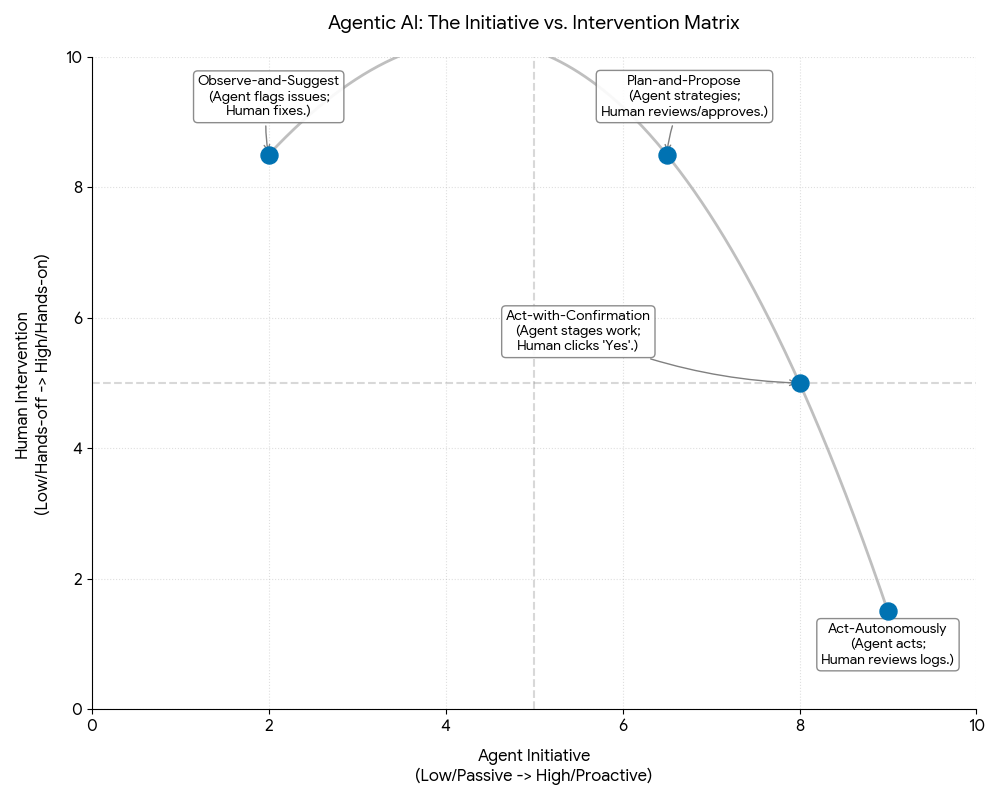
Agentic AI systems that plan, decide, and act on our behalf demand a fundamental rethinking of how we design for trust, consent, and accountability. Victor Yocco is right to argue that UX teams cannot rely on traditional usability testing alone when the software no longer just responds to a click but initiates actions independently. The practical challenge for product leaders is immediate: if your AI orders inventory, schedules meetings, or drafts contracts without human approval at every step, who owns the outcome when something goes wrong?
This shifts the designer's job from making features easy to use to making boundaries visible and negotiable. Yocco's research playbook points to methods that probe how users perceive the system's autonomy, not just whether they can complete a task, but whether they understand when the AI is acting on their behalf and when it is making a judgment call. For most organizations, that means embedding consent mechanisms that are not buried in a terms-of-service screen. It means designing for explicit opt-in moments where the user confirms, "Yes, I authorize this system to proceed." It also means building accountability into the interface itself: a clear audit trail that shows what the AI decided, why, and how a human can override it.
The temptation will be to treat these requirements as friction that slows adoption. That is the wrong instinct. Trust is not a feature you add after launch; it is the foundation that determines whether users actually let the agent act. If a system plans and persists without transparent consent loops, users will either ignore it or actively work against it. The opportunity here is to lead with clarity. Show your users exactly what the agent can do, what it cannot do, and how they retain control. That transparency becomes a competitive advantage, not a compliance checkbox.
What this means in concrete terms: start your next agentic AI project by mapping every decision point where the system acts without human confirmation. For each one, design a consent interaction that is simple, reversible, and logged. Then test not for speed of completion, but for user confidence in the outcome. That is the metric that will separate tools people trust from tools people tolerate.