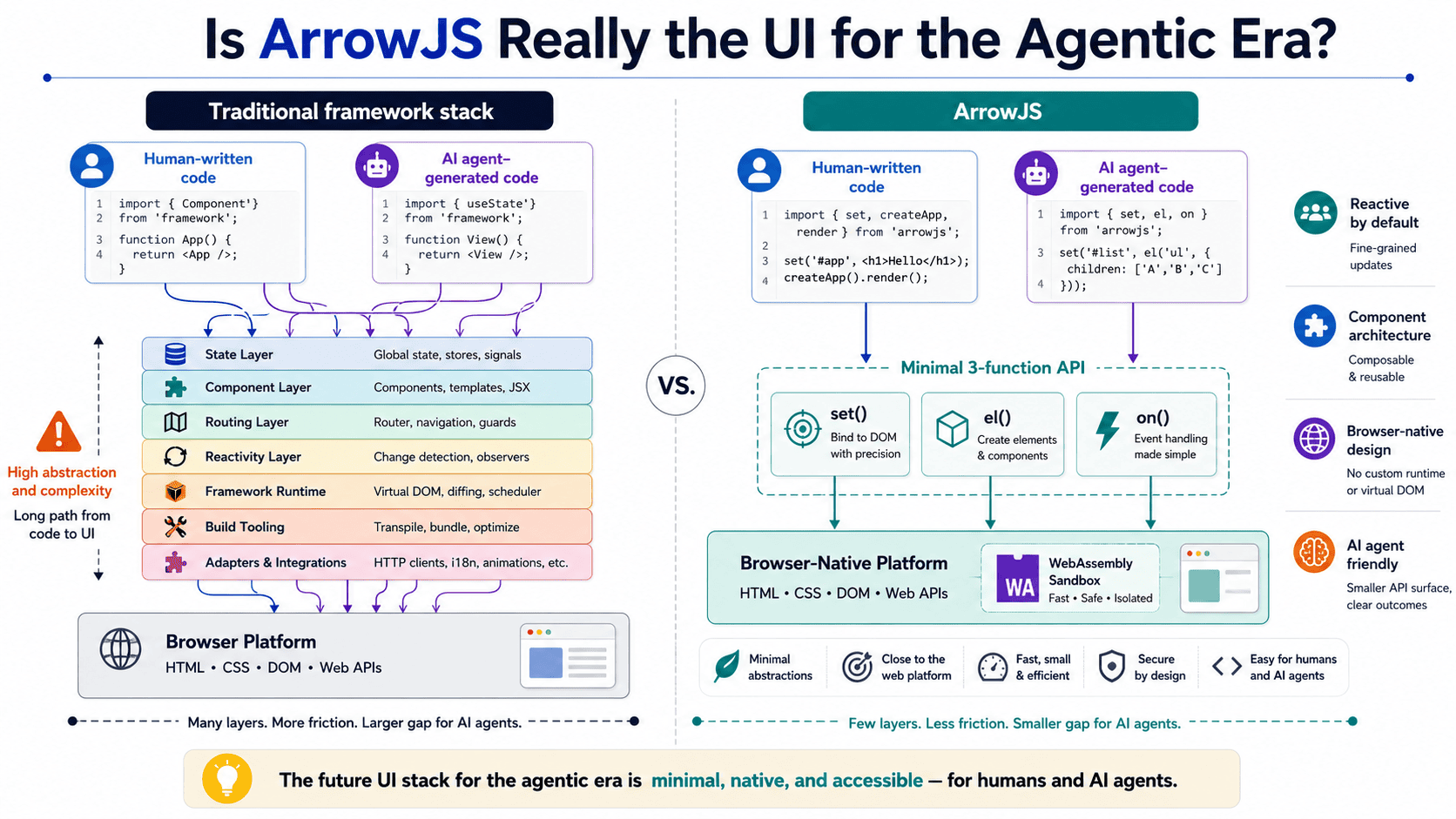
The way we build interfaces is changing, and for the first time in decades, the tools we use to render code may be the bottleneck. As AI agents write more of our software, the static, component-driven world we've grown comfortable with starts to feel like a constraint rather than a foundation. ArrowJS enters that conversation with a bold premise: what if the UI layer itself needs to adapt to the agentic era, not just the code that powers it? It's a question worth taking seriously, because the answer will determine whether we're building for the next five years or the last five.
We've seen this pattern before. When Navigating AI/ML Job Requirements: A Shift in Expected Skills highlighted how job descriptions now demand a hybrid of software engineering and machine learning expertise, it wasn't just a hiring quirk. It was a signal that the boundaries between disciplines are dissolving. The same thing is happening with interface rendering. Traditional frameworks assume a human is writing the logic and a human is reading the output. But when an agent is the author, the rendering model changes. ArrowJS appears to embrace that shift by treating the UI as a dynamic system that can be reasoned about and mutated by an AI, rather than a static tree to be mounted once. That's not a minor technical detail. It's a philosophical pivot.
Here's where we land, and we'll be direct: the promise is real, but the execution is still unproven. We're not going to tell you ArrowJS is the answer, because anyone who claims certainty here is selling something. What we will say is that the conversation it opens is the right one. The way we verify AI-generated code today is still deeply rooted in human review, but as Verify Your AI's Understanding: A Simple Check for Tax Season reminds us, verification is becoming a design problem, not just a testing problem. If an AI builds a component, how do you validate that it renders correctly across states? How do you trust the interaction model? ArrowJS's bet is that you build a system where the agent can reason about the UI in a structured, token-aware way, similar to how Exploring Paragraph Structure: How LLMs Navigate Token Space shows that structure itself becomes a coordinate system for meaning.
The practical takeaway for our readers is simple: don't rewrite your stack based on a blog post, but do start paying attention to how your tools handle agent-authored code. The specific detail to watch is whether ArrowJS can move beyond demos and into real-world state management, because that's where agentic UIs will live or die. If it stumbles there, it's just another framework. If it doesn't, it might be the first glimpse of a UI layer that actually understands what it's building. That's the question we'd put to anyone asking us for advice: does your rendering tool understand the code it's showing, or is it just showing it?