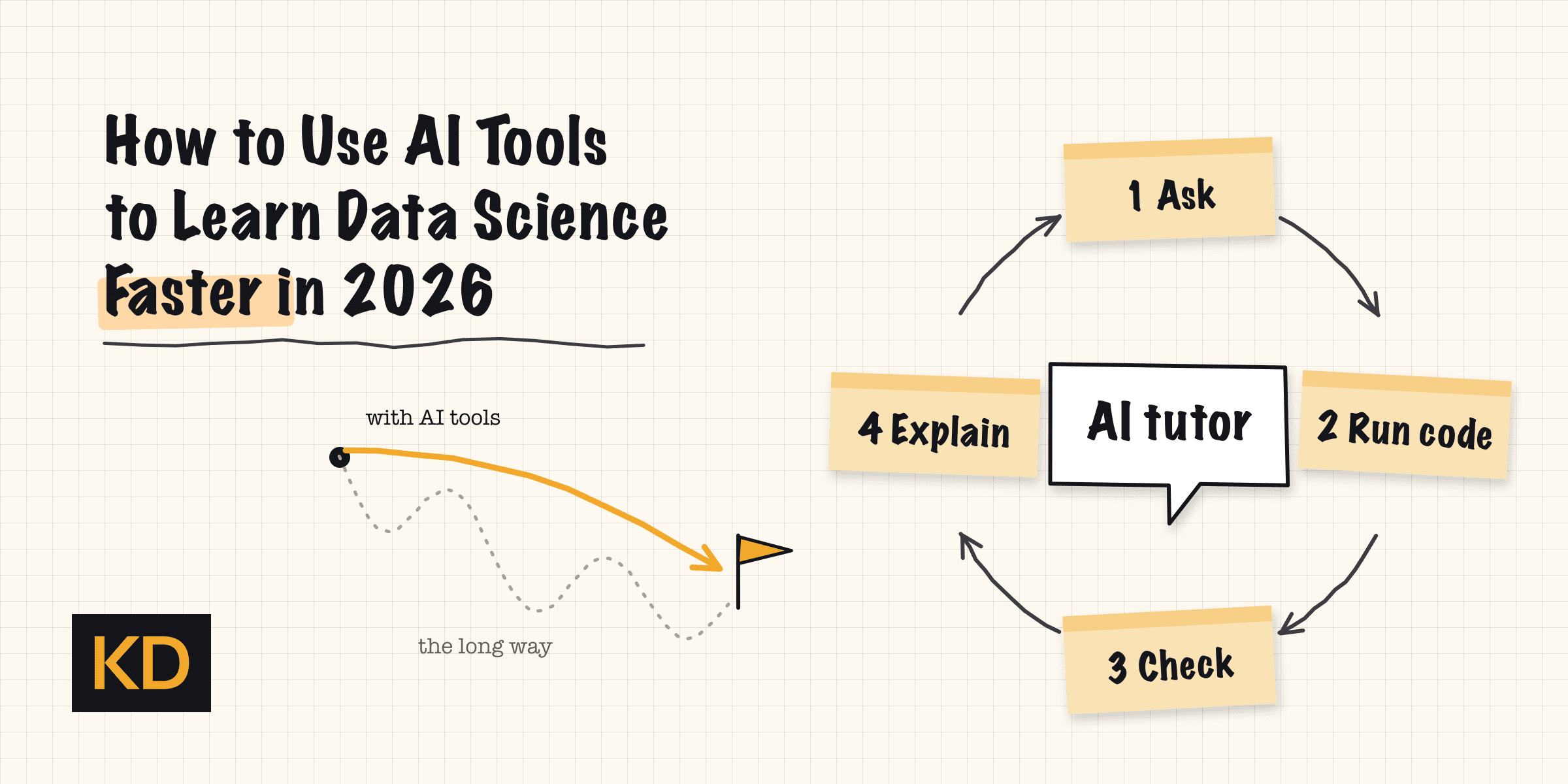
The conventional wisdom says you learn data science by grinding through theory first, master the math, memorize the syntax, then maybe touch a real dataset. That path is slow, discouraging, and increasingly unnecessary. AI tools don't just make data science faster; they fundamentally reshape how you build practical skills, and we believe anyone serious about learning should lean into that shift now.
Pairing an AI assistant with a coding environment and an adaptive learning platform compresses what used to take months into weeks. The reason is straightforward: you spend less time fighting syntax and more time understanding outcomes. When an AI writes boilerplate code or suggests a visualization, your job shifts to evaluating, questioning, and refining, exactly the skills that separate competent practitioners from great ones. This is not about taking shortcuts. It is about moving up the abstraction ladder, much like Treat AI agents as junior teammates to rethink your analytics workflow describes. You still own the problem framing and the model evaluation; you just delegate the mechanical parts. The result is a learning curve that bends toward competence faster than any textbook can deliver.
What makes this moment different from earlier waves of automation tools is the feedback loop. AI assistants that generate code also explain it, letting you ask "why this function?" or "what does that parameter do?" in natural language. That conversational layer turns every output into a teaching moment. And because these tools improve with use, your own growth accelerates alongside them. The same logic applies to data science education platforms that adapt to your pace and gaps, they surface exactly the lesson you need next, not the one the syllabus says you should be on. The combination is more than the sum of its parts. As a recent analysis on Beyond a 90% Cache Hit Rate: What Latency Reveals About AI Prompts shows, even subtle performance metrics in AI systems reveal deeper patterns about how they respond; the same principle applies to learning. The pattern you notice in your AI's output, the way it handles edge cases, the questions it stumbles on, is a signal about your own understanding.
The practical takeaway is direct: stop waiting until you feel "ready" to work with real data. Use AI tools to get started today, and treat every output as raw material for your next question. The most efficient learning path is not the one that moves slowest; it is the one that maximizes your time spent thinking about what the data means. That is a skill AI cannot automate for you, and it is the one worth protecting.