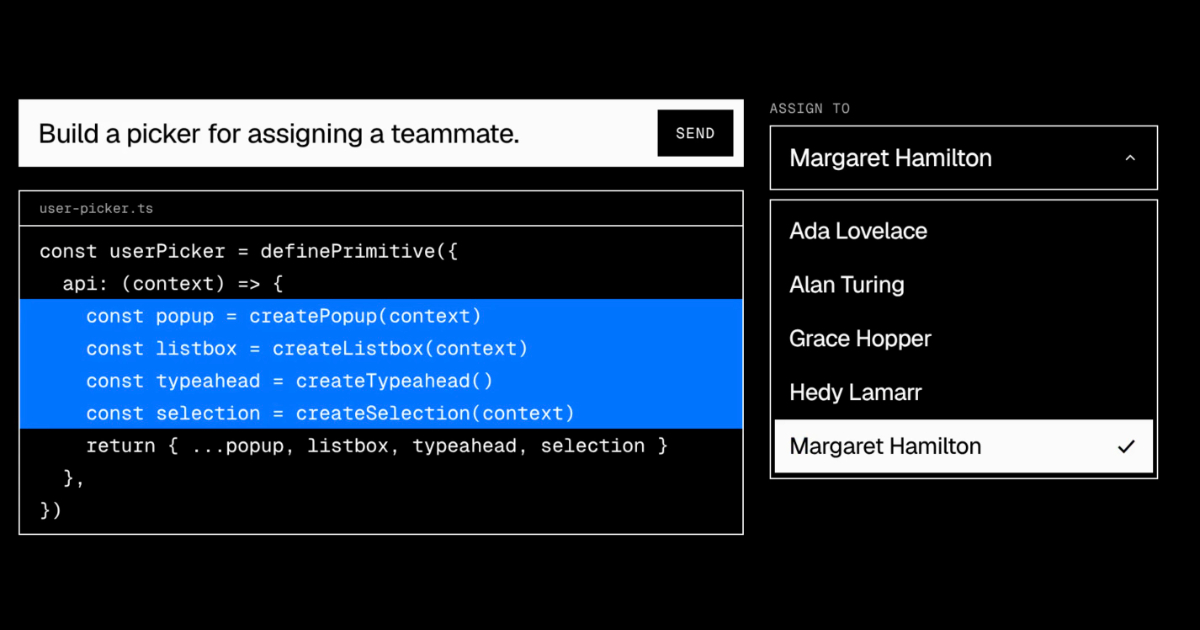
The promise of AI agents has always outpaced their practical utility, particularly when it comes to the interfaces they build on the fly. Vercel's new UI SDK, released in beta as an Apache 2.0 TypeScript library, directly addresses this gap with more than 50 UI behaviors in `@ui-sdk/core` and adapters for React, Vue, Svelte, Solid, and Web Components. This is a meaningful step forward, not because it's flashy, but because it treats accessibility and composability as first-class concerns for agent-generated interfaces rather than afterthoughts. For anyone who has watched an agent struggle to produce a usable form or a readable data table, this feels less like a feature release and more like a necessary correction.
What makes this SDK worth your attention is the documented agent bridge that connects the UI behaviors to the agents themselves. This isn't a black-box solution; it's a transparent protocol that agents can use to compose components and operate them. In practice, this means an agent tasked with building a dashboard for your team can now generate a date picker, a filter bar, or a sortable table that actually works with screen readers and keyboard navigation. We've seen how agents can reshape complex workflows in fields like investment banking, where context and accuracy matter most, as covered in our piece on How AI agents are reshaping investment banking workflows. The bottleneck there wasn't intelligence, it was execution. An agent that understands a deal's full context is only as useful as the interface it builds to present that context. Vercel's SDK gives that agent a reliable toolkit, and that changes the calculus for production deployments.
The accessibility angle is particularly smart. Most agent-generated interfaces today are visually brittle and functionally opaque. By baking accessible behaviors into the core library, Vercel ensures that agents don't accidentally exclude users or violate compliance requirements. This aligns with a broader pattern we're tracking: the shift from agents that merely process data to agents that present it in human-friendly ways. The SDK's support for multiple frameworks, React, Vue, Svelte, Solid, and Web Components, also signals that Vercel isn't trying to lock you into a single ecosystem. They're betting that the future of agent-driven interfaces will be polyglot, and they're providing the shared vocabulary to make that work.
One specific takeaway stands out: the agent bridge documentation is the real product here. The 50 UI behaviors are valuable, but the ability for any agent to compose and control those behaviors through a standardized protocol is what makes this SDK extensible beyond Vercel's own platform. If you're building agentic systems today, you should explore this bridge as a reference pattern for how your agents can communicate with UI components. The alternative, letting each agent reinvent the wheel for every dropdown or modal, is exactly the kind of friction that keeps agents in demo mode instead of production. We've explored the cost of that friction before, particularly in our analysis of When Your Spreadsheet Agent Pauses for Hours Waiting on a Human, where synchronous bottlenecks undermine the whole point of automation. Vercel's SDK doesn't solve every agent coordination problem, but it does solve the interface layer with a clarity that deserves attention. The open question now is whether the agent community will adopt this protocol as a standard or fragment into competing approaches. That answer will determine whether this SDK becomes a foundation or a footnote.