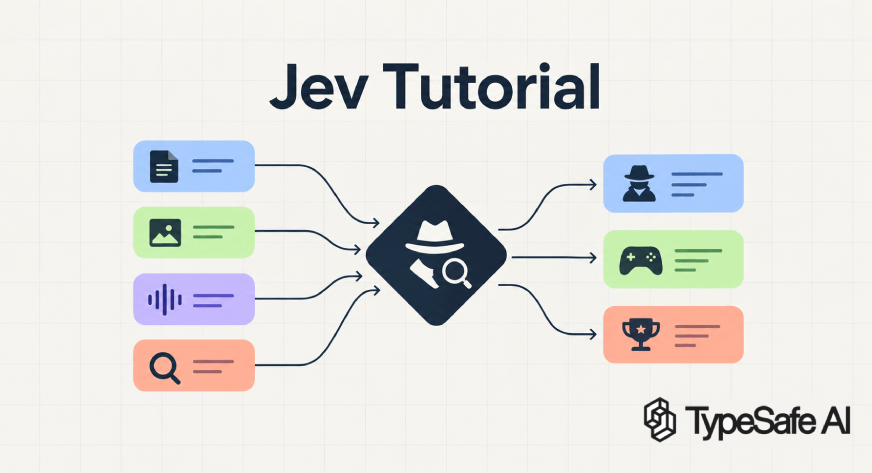
The most interesting thing about Jev, TypeSafe AI's System One model, is not that it answers questions. It is that it knows when it should not answer them at all. While most AI models are built to generate text, Jev is built to classify, score, and return structured answers with confidence scores. That is a fundamentally different job, and it deserves more attention than it gets.
For anyone who has spent time wrestling with Explore Scikit-LLM for Practical Few-Shot Text Classification, the appeal is immediate. Few-shot classification is useful precisely because you do not want a paragraph of explanation. You want a label, a number, or a yes-or-no answer. Jev treats that as the core task rather than an afterthought. Where generative models tend to hedge or over-explain, a model designed for structured output gives you something closer to a verdict. And the confidence score is the part that matters most. It tells you not just what the model thinks, but how much weight you should give it.
This is a practical shift, not a philosophical one. In workflows where a human reviews every AI suggestion, a confidence score lets you triage. High-confidence answers can move faster; low-confidence ones can trigger a second look. That is the kind of design choice that respects the user's time. Compare that to the broad capabilities of Exploring Gemini 4 Argon in Practice: Capabilities and Real-World Limits, which excels at creative and document-heavy tasks but is not built for this specific, narrow decision loop. Jev is not trying to replace those models. It is trying to fill the gap where you do not need prose, you need an answer.
Our take is simple: the spreadsheet era taught us that structured data is not a limitation, it is a strength. Jev applies that same logic to AI. By returning structured answers instead of free text, it makes AI more predictable and more auditable. That is a meaningful step for teams that want to integrate AI into operational decisions without losing control. The confidence score is the key detail here. It transforms the model from a black box into a tool you can calibrate, test, and trust incrementally.
The open question is how users will react to a model that refuses to elaborate. We are conditioned to expect AI to explain itself. But in many cases, an explanation is just noise. The concrete point to watch is whether TypeSafe AI extends this approach beyond classification into ranking, routing, or data validation tasks. If they do, the next wave of spreadsheet-native AI will not be about generating more text. It will be about generating fewer, better answers, each one carrying its own measure of certainty. That is a future worth exploring.