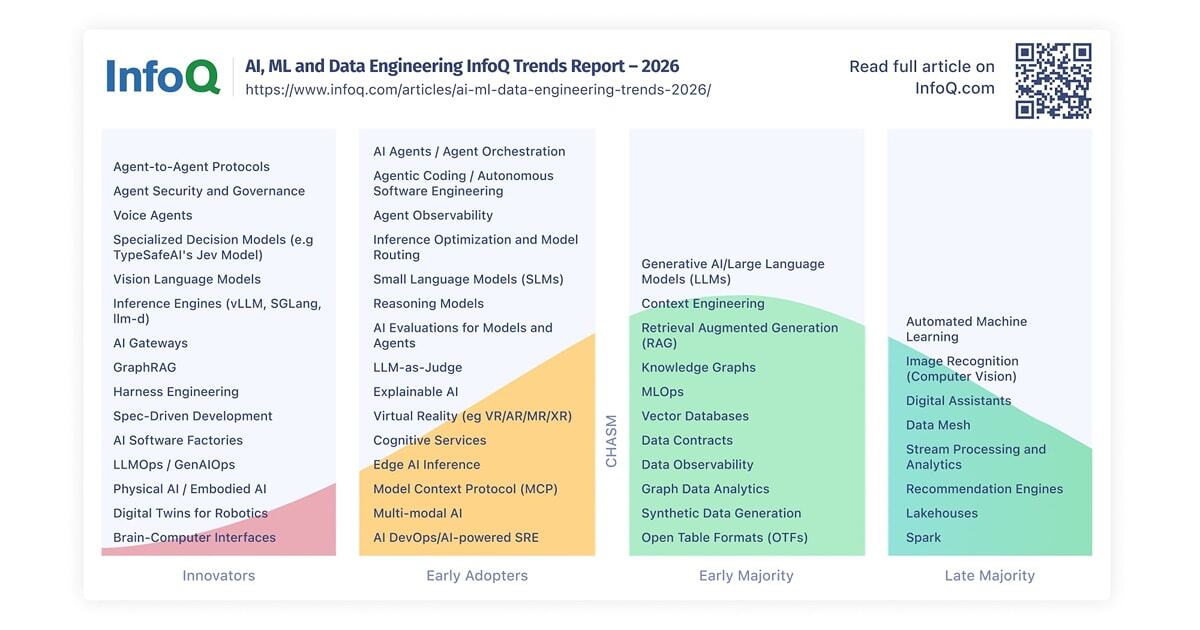
The 2026 InfoQ Trends Report makes one thing clear: the gap between what AI can do and what most organizations actually implement is still dangerously wide. This isn't a failure of technology, it's a failure of integration. The report, compiled by Srini Penchikala, Chip Huyen, and their colleagues, maps the next twelve months of AI, ML, and data engineering, but its real value lies in what it reveals about the friction points between innovation and adoption. For teams still wrestling with legacy spreadsheets and siloed workflows, this is the roadmap they need, not for chasing hype, but for making practical, human-centered progress.
Consider the contrast with a story like Secular beliefs can justify AI exemptions in the workplace, where an employee's religious exemption from AI use signals a deeper cultural resistance. The InfoQ report doesn't address exemptions, but it does point to a parallel challenge: the tools are advancing faster than our organizational norms can absorb them. Meanwhile, Thrive Holdings brings OpenAI-backed AI to home security with ADT acquisition shows how AI is being pushed into consumer spaces at massive scale. The InfoQ report grounds that push in practical engineering, what architectures, data pipelines, and model governance structures actually need to exist for these deployments to work. It's a necessary antidote to the "AI everywhere" narrative.
Our take is straightforward: stop treating AI trends as a shopping list. The report's strength is its honest assessment of where technologies like retrieval-augmented generation, real-time feature stores, and declarative data orchestration actually sit on the maturity curve. Too many teams adopt the latest model framework without first solving the data engineering fundamentals. The report's authors are right to emphasize that the next twelve months belong not to the flashiest algorithm, but to the teams that build reliable, observable data foundations. If you're still manually cleaning spreadsheets or managing data pipelines through ad hoc scripts, the trends here are a signal to invest in infrastructure before adding another AI layer.
The specific consequence to watch is the growing tension between centralized governance and decentralized experimentation. The report highlights how organizations are struggling to balance model access with security and compliance. That tension will define the next year's success stories, and failures. The teams that solve it will be the ones that treat AI not as a separate initiative, but as a native capability embedded in the tools their people already use. For anyone still wondering whether their current data stack can support the coming wave, the answer from this report is clear: it cannot, and that's exactly the problem worth solving.