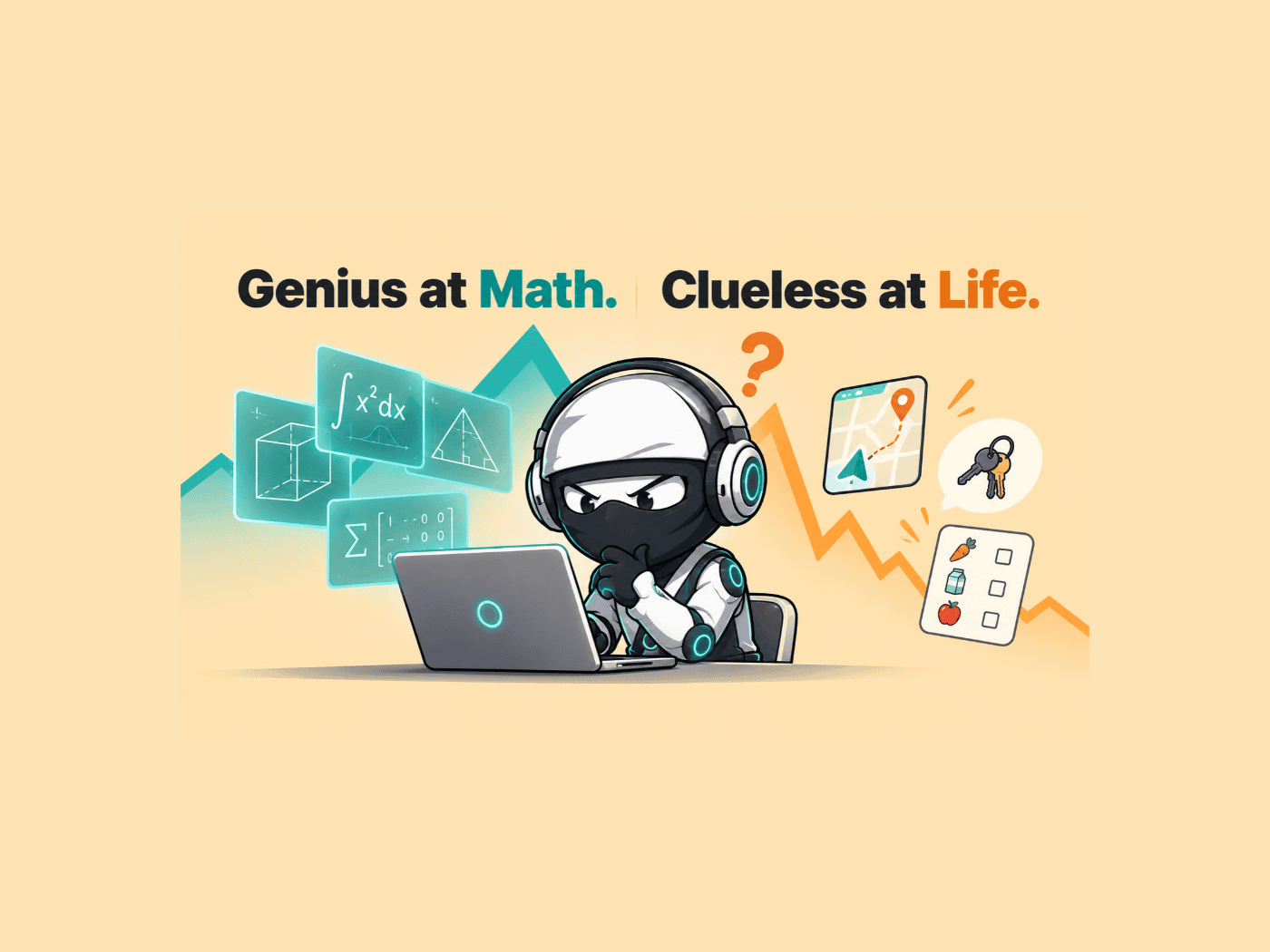
The gap between an AI solving an Olympiad math problem and one that can reliably sort your inbox is not a bug, it's a feature of how these models are built, and it tells us something important about where they belong in our work. Models trained on vast, clean datasets of formal logic can perform brilliantly on closed, well-defined challenges. The same model will stumble on the messy, context-dependent tasks that make up most of a typical workday. This isn't a failure of engineering; it's a signal about what kind of partner AI is ready to be.
This matters because the hype cycle wants us to believe that if a model can handle abstract reasoning, it can handle anything. The future of AI demands human control, not Silicon Valley hype is a useful corrective here. The conversation around AI capability too often skips over the mundane reality: a tool that can write a proof but cannot reliably update a shared budget spreadsheet is not a general-purpose replacement for human judgment. It is a powerful specialist. And as Coding agents already think like us: here's how to explore their potential suggests, the most productive path forward is to explore these tools as collaborators, not oracles. We should be asking what each model is genuinely good at, not assuming that proficiency in one domain transfers to all.
For our readers, people who use spreadsheets daily and are evaluating whether to trust AI with real tasks, the practical takeaway is direct. When you see a demo of a model acing a math competition, do not assume it can handle your messy, multi-sheet workbook with inconsistent column headers and a mix of text and dates. That task requires understanding context, managing ambiguity, and making judgment calls about data integrity. Those are human strengths, and the research on Olympiad math versus everyday tasks confirms they remain human strengths. The smart move is to use AI where it excels: pattern recognition, formula generation, and rapid iteration over structured problems. Reserve the decisions about data meaning, workflow logic, and error tolerance for yourself.
This also reframes the caution we see in financial services. Banks shift AI agent risk to customers as Citi halts rollout shows that institutions with the most to lose are pulling back precisely because they understand this gap. They know that an AI that can analyze a portfolio cannot yet be trusted to manage a household budget without human oversight, because the latter involves unpredictable, real-world context. The same principle applies to your data workflows. AI can accelerate parts of your process, but it cannot replace the person who understands why a particular number matters. The open question is not whether models will get better at everyday tasks, they will, but whether we will build our workflows to keep humans in control while that improvement happens.