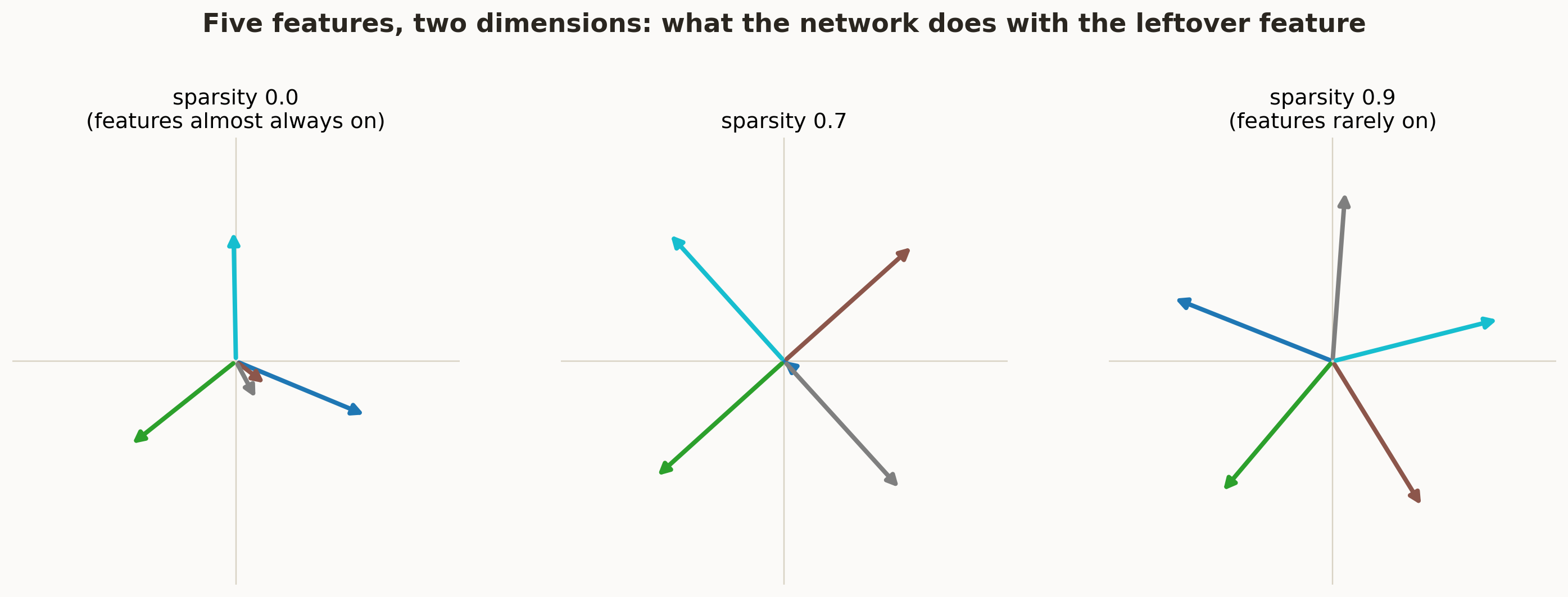
The recent demonstration of reproducing Anthropic’s "Toy Models of Superposition" – a tiny neural network capable of generating surprisingly complex visual patterns from compressed data – is a compelling illustration of the power of simplified models. As we’ve explored in detail in our breakdown of Anthropic’s Claude Opus 5.5 [Understand Anthropic’s Claude Opus 5.5: A Detailed Breakdown], understanding the underlying mechanics of large language models is crucial, and this project offers a rare opportunity to examine a foundational element in a much more accessible way. The ability to recreate this model from scratch, using NumPy and hand-derived gradients, highlights the elegance and efficiency that can be achieved even with minimal resources. This isn't about replicating the scale of today's behemoth AI systems; it’s about demonstrating that fundamental insights into data compression and pattern recognition can be gleaned from surprisingly small networks. Building your own world model, as shown in our practical Python guide [Build Your First World Model: A Practical Python Guide], reveals the potential for AI to learn and represent its environment, and this "pentagon-drawing" network exemplifies that same principle – albeit in a far more distilled form.
The significance of this work extends beyond the novelty of a network producing geometric shapes. It speaks to a broader trend in AI research: a move away from simply scaling up models and towards exploring more efficient and interpretable architectures. The original "Toy Models of Superposition" were designed to illustrate how even simple neural networks can exhibit complex behavior when trained to compress and reconstruct data. This recreation, meticulously documented, provides a tangible example of that principle in action. The fact that the network, trained on a limited dataset, spontaneously generated a pentagon – a shape not explicitly present in the training data – suggests an underlying ability to identify and represent patterns in a way that transcends mere memorization. This aligns with the observations of enhanced reasoning power we’ve seen in models like Claude Opus 5.5 [Unlock New Reasoning Power: A Deep Dive into Claude Opus 5.5], which demonstrate that improved efficiency and understanding can lead to significant gains in performance.
The beauty of this project lies in its accessibility. By eschewing pre-trained weights and complex libraries, the author has created a transparent and reproducible example that can be easily understood and modified by anyone with a basic understanding of Python and linear algebra. This is a departure from the often-opaque nature of modern AI development, where models are frequently treated as black boxes. This approach encourages experimentation and fosters a deeper understanding of the fundamental principles that govern AI behavior. It’s a reminder that powerful insights can be derived not just from massive datasets and complex architectures, but also from carefully designed, small-scale experiments. The ability to compress information and then visualize it in a meaningful way—even if that visualization is just a pentagon—has implications for everything from data visualization to anomaly detection.
Looking ahead, it’s fascinating to consider how these principles of efficient compression and pattern recognition could be applied to other domains. Could similar techniques be used to develop more compact and energy-efficient AI models for edge devices? Could they provide new insights into the nature of human perception and cognition? Perhaps the most compelling question is: what other unexpected patterns would emerge from these tiny networks if trained on different datasets, and what would those patterns tell us about the fundamental nature of data itself? The continued exploration of these "toy models" promises to yield valuable insights as we navigate the future of AI-native data management.