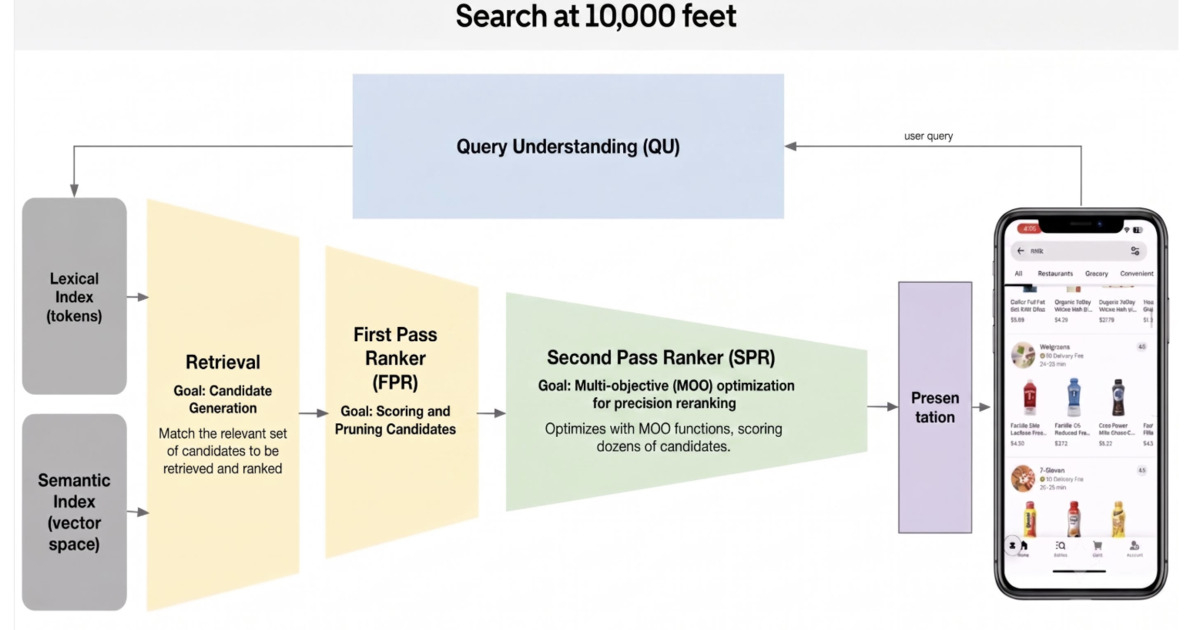
Uber Eats just cut its search latency in half, and that matters far more than a faster loading screen. This is a concrete example of how intelligent pipeline design, not brute-force hardware upgrades, can transform user experience at scale. When a platform processes millions of searches daily, shaving milliseconds from each query compounds into real productivity gains for users and significant infrastructure savings for the company. For anyone building data-intensive applications, this is a case study worth studying.
The technical details reveal a philosophy that prioritizes user perception over raw metrics. Uber's adoption of Above-the-Fold measurement, optimizing for what the user sees first rather than the full page load, is a smart acknowledgment that human patience is the real bottleneck. Reducing retrieval work, parallelizing hydration, and redesigning the advertising data pipeline all contribute to the headline number, but the agentic coding workflow is the most intriguing piece. It suggests Uber is letting AI assist in optimizing the optimization itself, a feedback loop that could accelerate future improvements. This approach contrasts with the more traditional scaling controls Uber has detailed elsewhere, like the How Uber Keeps 65,000 Monthly Code Changes From Breaking the Build strategy, which focuses on maintaining stability across a massive monorepo. Here, the goal is speed, not just stability, and the methods reflect that shift.
What does this mean for the average Uber Eats user? It means the app feels more responsive when you're hungry and impatient. The search results that matter, the ones near the top, appear faster, and the system wastes less time on work the user may never see. For developers and architects, the takeaway is clear: latency optimization is no longer just about faster databases or better caching. It's about rethinking the entire pipeline from the user's perspective. Uber is also exploring microbatching, product-based retrieval, and HTTP multipart streaming, which signal a continued commitment to this approach. Meanwhile, competitors like DoorDash are taking a different route, betting on conversational AI with DoorDash lets you text your food order with a new AI agent to gain an edge. Both strategies aim to reduce friction, but Uber's focus on backend efficiency feels like a more durable foundation.
The specific detail to watch is the agentic coding workflow. If Uber can train AI to identify and implement latency improvements automatically, it could create a compounding advantage that is difficult for competitors to match without similar investments. The question is whether these gains will hold as the system scales further and as user expectations continue to rise. That is the real test of any optimization effort, not just whether it works today, but whether the architecture can adapt to tomorrow's demands.