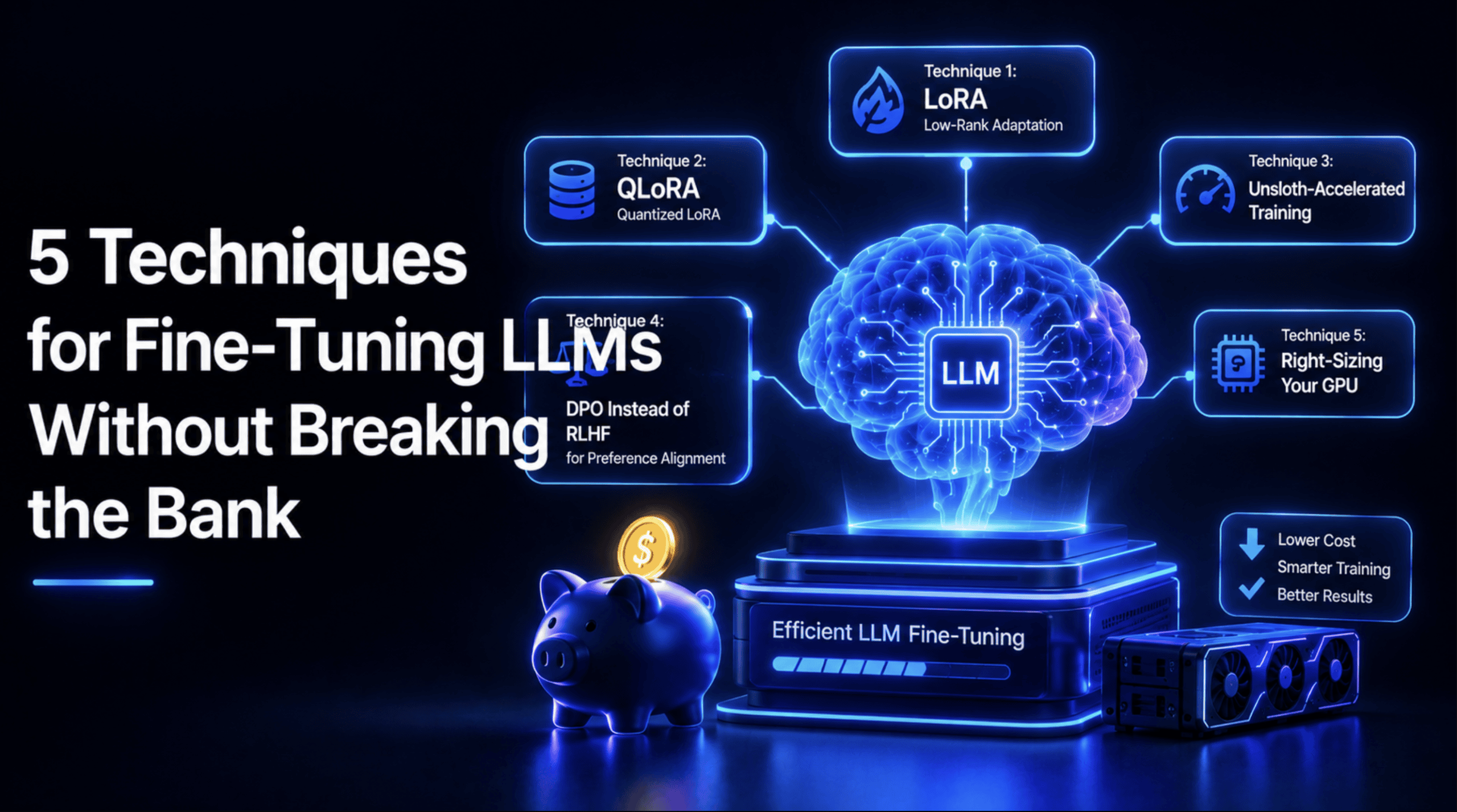
Fine-tuning large language models on a limited budget sounds like a contradiction in terms. The prevailing narrative has been that you need a cluster of enterprise GPUs and a research budget to even attempt it. That story is wrong, and these five practical techniques prove it. By focusing on methods like LoRA, QLoRA, and Unsloth, this work directly challenges the assumption that customizing a model requires deep pockets. For anyone who has felt locked out of this capability, this is the permission slip you have been waiting for.
The implications are more concrete than they first appear. When a university intern can start turning research gaps into testable hypotheses with AI assistance, and a hobbyist can build an image generator from scratch on a home rig, the barrier to entry is already collapsing. Fine-tuning on a budget is the next logical step in that progression. It means the same people who are prototyping and experimenting today can now tailor models to their specific data without asking for a grant. That changes who gets to participate in the conversation. It is no longer the exclusive domain of well-funded labs. It becomes accessible to the solo developer, the small startup, and the curious researcher.
The specific takeaway here is that you do not need to fine-tune the whole model. Techniques like LoRA and QLoRA work by freezing the original weights and training a small set of adapter parameters instead. That reduces the memory and compute requirements dramatically. DPO adds a layer of preference alignment without the complexity of reinforcement learning from human feedback. And right-sizing your GPU is a reminder that bigger hardware is not always better hardware. The code provided for each technique is not theoretical. It is ready to run. That is the difference between a concept and a tool.
There is a nuance worth watching closely. The same efficiency that makes fine-tuning affordable also introduces new failure modes. When you train a small adapter on a narrow dataset, the model can overfit or forget capabilities it previously had. The LEGO caption study shows how easily a model can misinterpret brevity in training data, skipping the first line of a caption because the pattern was not reinforced. That same risk applies here. A budget-friendly fine-tuning pipeline is only as good as the data you feed it. The question worth asking is not whether you can afford to fine-tune, but whether you have prepared your training examples carefully enough to get the result you actually want.