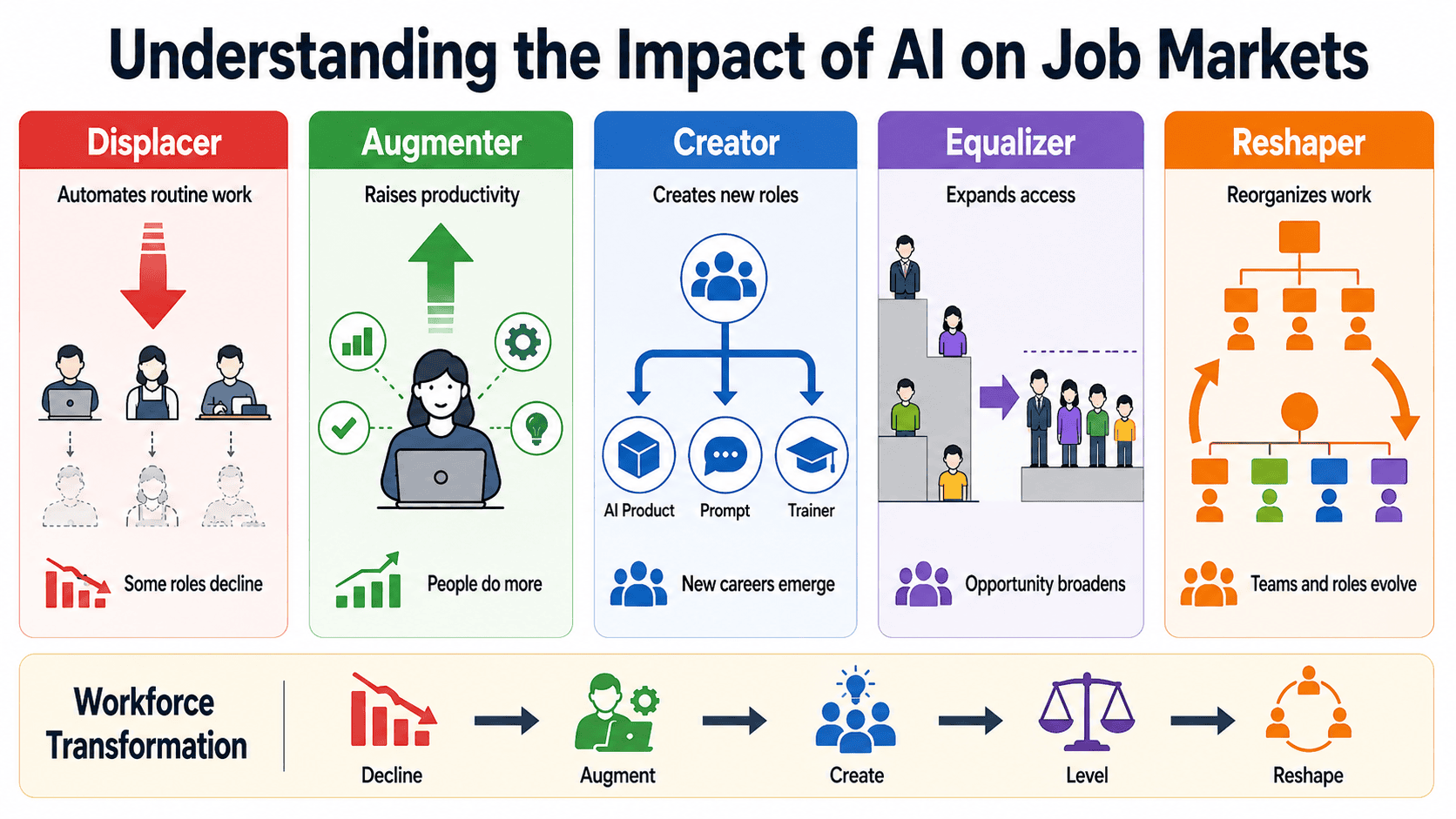
The conversation about AI and jobs tends to split between two camps: those who see automation as a quiet efficiency gain and those who see it as a slow erosion of opportunity. Five ways AI is reshaping work are laid out, from taking over routine tasks to thinning the pipeline for entry-level roles. That second point is the one that deserves your attention. It is easy to frame AI as a tool that removes drudgery, but the reality is more uncomfortable. When the first rung of the career ladder starts to disappear, we are not just losing tasks; we are losing the training grounds where people learn how work actually happens.
There is a parallel here to what we have been tracking in our own reporting. When we spoke with someone who built an interactive AI clone, the experience left them questioning how much of their own judgment they were outsourcing. That is not a critique of the technology; it is a caution about how quickly we accept AI's role in areas where we previously relied on human context. Similarly, the shift in AI and machine learning job postings shows that even the roles meant to build these systems now demand a broader software engineering skill set, which raises the bar for newcomers. The observation about thinning entry-level hiring is not just a labor market statistic. It is a signal that the traditional path of learning by doing is being compressed, and the people who lose out are often the ones who need that on-the-job mentoring the most.
What should you do with this? First, stop treating AI as a monolith that either helps or hurts everyone equally. The practical question is not whether AI will take your job, but which of your current tasks are routine enough to be automated and which require the kind of judgment that remains stubbornly human. If you are early in your career, the answer is not to avoid AI but to become deliberate about the skills it cannot replicate: asking better questions, navigating ambiguity, and understanding the context behind the data. For managers, this means rethinking how you onboard junior staff. If the entry-level work is gone, you have to be more intentional about creating projects that teach judgment, not just output.
It gives us a clear lens, but stops short of prescribing a path forward. The thinning of entry-level hiring is not an inevitable cost of progress; it is a design choice. Companies that automate the busywork without rethinking how people learn the business will find themselves with a leadership gap in a decade. The specific thing to watch is how organizations respond to that gap. Will they double down on apprenticeships and rotational programs, or will they simply demand more experience from new hires? The answer will tell you more about the future of work than any headline about AI's capabilities. For now, the most actionable takeaway is this: if you are not actively mapping which parts of your role are automatable, you are already behind, not because the machine is coming for you, but because the game has changed and the rules are being rewritten in real time.