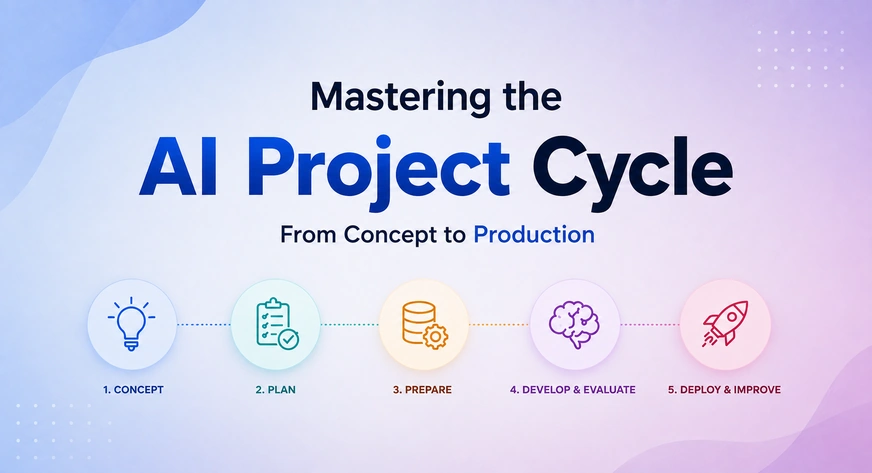
There's a quiet assumption buried in most conversations about artificial intelligence: that the hard part is the model. Pick the right one, feed it enough data, and the rest will follow. Mastering the AI Project Cycle from Analytics Vidhya dismantles that idea with a much more grounded truth. AI systems are not built in a single step; they are guided through a structured journey that begins with problem identification and only ends with continuous improvement after deployment. That distinction matters, because it reframes the entire conversation from "what can the algorithm do?" to "how do we build something that actually works in the real world?"
This is a perspective we find increasingly relevant, especially as the industry shifts toward practical implementation. It echoes themes we have explored in Unlock LLM Training: A Practical Guide to Distributed Algorithms, where the focus is on the mechanics of scaling, not just the novelty of the model. Similarly, Exploring Paragraph Structure: How LLMs Navigate Token Space reminds us that understanding the underlying structure of how these systems process information is what separates informed users from those who simply follow trends. The AI Project Cycle is not a departure from that thinking; it is the operational backbone that makes it possible.
For our readers, the takeaway is direct: stop treating AI projects like experiments and start treating them like products. Deployment is not the finish line but the starting point for monitoring and iteration. That is a hard lesson for teams that pour months into building a model only to discover that data drift or user behavior shifts render it obsolete. If we were advising someone just beginning their AI journey, we would tell them to spend less time hunting for the perfect model and more time defining the problem clearly, because every stage of the cycle depends on that clarity. The model is a component, not the project itself.
What we find most compelling is the implicit challenge this poses to the hype cycle. While others chase the next breakthrough, the unglamorous discipline of process grounds us. It is a welcome counterweight to the noise. The question we should all be asking is not whether our model is smarter, but whether our system is more resilient. That is the metric that will separate lasting success from fleeting demos. Watch for teams that treat monitoring as an afterthought; they will be the first to learn why the cycle exists in the first place.