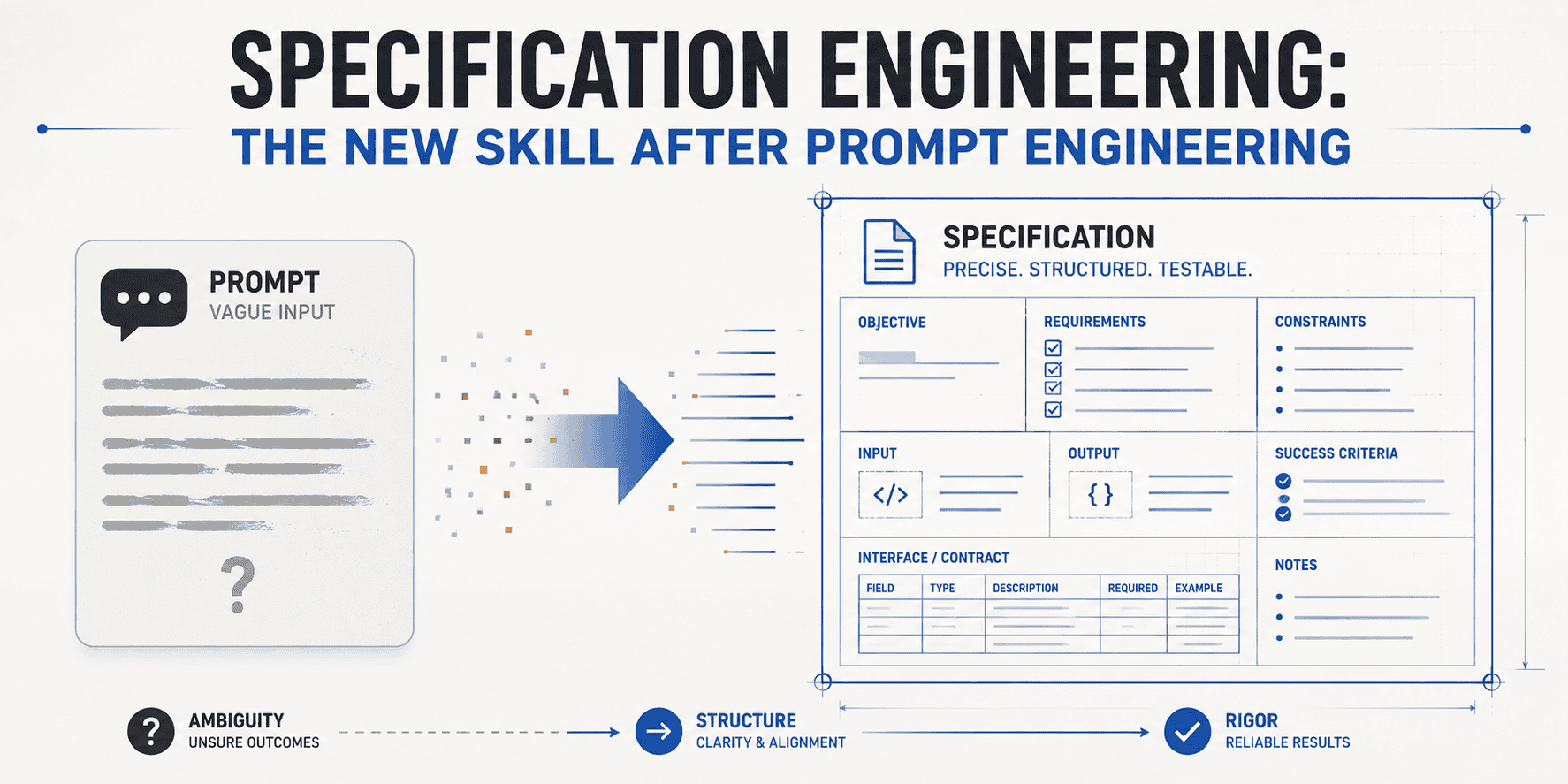
Prompt engineering was always going to be a gateway, not a destination. It taught us how to phrase questions that get useful answers out of a large language model. But asking a better question is still just the opening move. The real work, the kind that separates curious users from people who actually ship things, is defining what *done* looks like before a single token is generated. That is why the shift to specification engineering feels less like a trend and more like a maturation of the entire field. We are moving from the art of the query to the discipline of the blueprint.
This evolution is happening because we are finally admitting that a blank prompt box is not a canvas; it is a liability. When you ask an AI to "analyze this spreadsheet," you are outsourcing your thinking to a model that has no context for what "this" means, what "analyze" should produce, or what your manager expects to see on the slide. Specification engineering is the antidote to that vagueness. It is the practice of writing down the constraints, the edge cases, the acceptance criteria, and the output format before you let the model do its thing. It feels less glamorous than prompting, but it is far more honest. And it is a skill that is directly tied to the broader unease we have been tracking in our coverage, like the mixed feelings that surface when you train an AI clone to discuss fraud, or the growing confusion around what an "AI/ML engineer" actually does when job requirements demand software engineering chops. The throughline is that we are all trying to figure out where human judgment ends and automated execution begins.
For our readers, this is not an abstract philosophical debate. It is a practical shift in how you should approach your next project. If you are still treating the AI like a very fast typist who just needs a clear sentence, you are leaving value on the table. The people who are getting real results are the ones who treat the model like a junior developer on a short leash. They write the spec, they define the test cases, and they refuse to accept the first output as the final answer. They also know that the model's confidence is not a source of truth; they verify its understanding, a practice we have highlighted as a simple check during tax season. The takeaway is blunt: stop asking the AI to do a job and start telling it what the job is. If you cannot write down the acceptance criteria for the output, you do not have a prompt problem; you have a thinking problem.
The concrete consequence to watch is the rise of the specification reviewer. As teams adopt this mindset, the bottleneck will no longer be who can write the cleverest prompt. It will be who can write the clearest spec. That person will not need a computer science degree. They will need the ability to articulate what success looks like in a way that a literal-minded machine cannot misinterpret. That is the skill to build, and it is also the skill that will keep you employed when the next model comes out and makes prompt engineering look like a party trick. Start writing your specs like you are handing them to a brilliant, but deeply literal, new hire. Because you are. And that new hire is watching to see if you know what you want.