Google and Industry Partners Announce Agentic Resource Discovery Specification for AI Agents
Our take
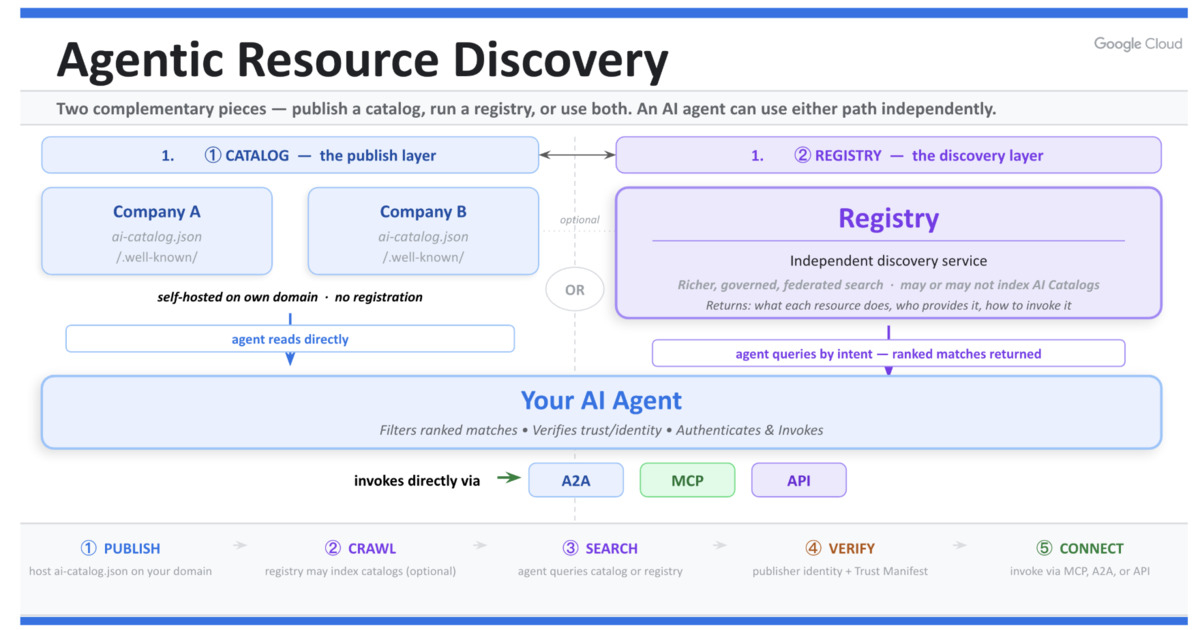
The announcement of the Agentic Resource Discovery (ARD) Specification by Google and its partners signifies a crucial step towards a more structured and interoperable AI agent ecosystem. For too long, harnessing the power of AI agents has felt like assembling a collection of disparate tools, each with its own unique interface and limitations. The ARD specification aims to solve this by establishing a standardized way for AI agents to discover and utilize available resources – tools, APIs, and even other agents – dynamically. This is particularly relevant given the increasing complexity of AI workflows, as highlighted in You can build your AI's memory just by talking. Here's the catch. - the ability for agents to intelligently utilize external resources is intrinsically linked to their memory and overall cognitive capabilities. The move leverages existing protocols like MCP and OpenAPI, a pragmatic approach that minimizes disruption and maximizes compatibility within existing development pipelines. This focus on utilizing established frameworks underscores a commitment to practical implementation rather than purely theoretical advancements.
The core innovation lies in the introduction of catalogs and registries, essentially providing a searchable index of available AI capabilities. Imagine a world where an AI agent tasked with analyzing market trends can automatically identify and integrate a sentiment analysis API, a financial data provider, and a visualization tool – all without requiring manual configuration. This dynamic capability discovery promises to significantly accelerate AI development cycles and unlock new possibilities for automation. Furthermore, the emphasis on trust and interoperability is paramount. While the speed of innovation in AI is breathtaking, ensuring the reliability and security of these systems is equally critical. As we grapple with the architectural complexities of AI, as discussed in Article: Comprehension at AI Speed: Building a Context Store for Evolutionary Architecture, clear standards for resource verification become essential to maintain integrity and prevent unintended consequences. The ARD specification’s focus on these aspects indicates a growing awareness of the need for robust governance alongside rapid advancement.
This development isn’t occurring in a vacuum; it’s part of a broader trend toward modularity and composability in AI. Google’s own Genkit Agents API, with its support for detached turns and human-in-the-loop workflows, as detailed in Google's Genkit Ships Agents API with Detached Turns and Human-in-the-Loop for TypeScript and Go, exemplifies this shift. By providing building blocks that can be combined and orchestrated, developers can create more sophisticated and adaptable AI systems. The ARD specification essentially provides the infrastructure layer that enables this composability on a broader scale, allowing different agents and tools to seamlessly communicate and collaborate. This represents a significant departure from the monolithic AI models that have historically dominated the landscape, paving the way for more flexible and specialized AI solutions.
Ultimately, the Agentic Resource Discovery Specification represents a move towards a more mature and sustainable AI ecosystem. It acknowledges that the future of AI lies not in isolated breakthroughs, but in the ability to effectively integrate and orchestrate a diverse range of capabilities. The standardization of resource discovery will reduce friction, accelerate innovation, and empower developers to build more powerful and reliable AI agents. The question now is: will the industry coalesce around this standard, or will competing discovery mechanisms emerge, potentially fragmenting the AI landscape? The success of ARD will hinge on broad adoption and a shared commitment to interoperability within the developer community.
Google and industry partners announced Agentic Resource Discovery (ARD) Specification, an open standard for publishing, discovering, and verifying AI tools, APIs, and agents. ARD introduces a discovery layer built on catalogs and registries, enabling dynamic capability discovery while leveraging existing protocols such as MCP and OpenAPI for execution and emphasizing trust and interoperability.
By Leela KumiliRead on the original site
Open the publisher's page for the full experience