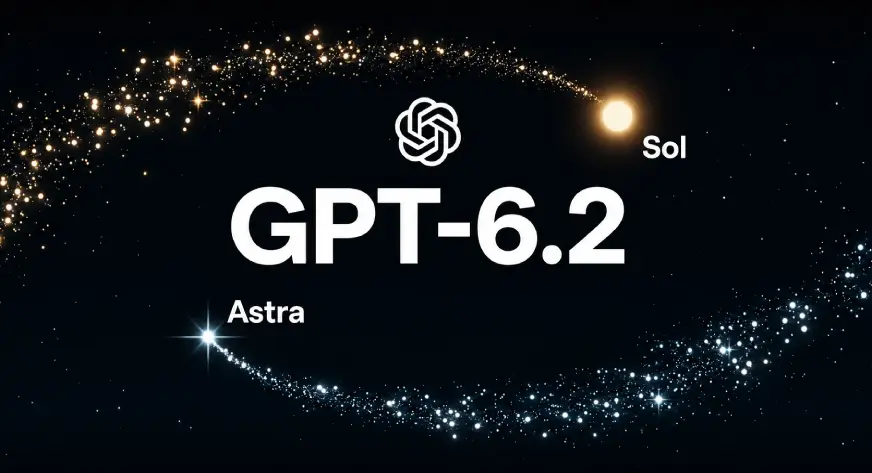
OpenAI's GPT-6.2 launch, with its two distinct models Sol and Astra, is the most honest product segmentation we have seen from a major AI provider in months. Rather than forcing every user into a single "best" model, the company is finally acknowledging that a freelance developer debugging a Python script and a research team analyzing multimodal datasets do not need the same tool. This is a practical move, not a marketing gimmick, and it deserves a closer look for what it means about the direction of AI work.
Sol is positioned for everyday coding and writing, while Astra targets demanding professional projects. The naming matters: Sol suggests steady, reliable output for routine tasks, while Astra implies something more ambitious and powerful. This mirrors a trend we have seen elsewhere in the industry. Google's Gemini 4 Neon can handle complex code generation but stumbles on simpler tasks, which reinforces the idea that specialization is becoming necessary. Similarly, infrastructure changes like the Apache Iceberg V4 redesign show that the underlying systems that support frequent writes and large-scale data operations are evolving to keep pace with these more demanding workloads. OpenAI is not just releasing two models; it is acknowledging that the era of one-size-fits-all AI is ending.
What this means for you is straightforward. If your work consists of drafting emails, writing basic scripts, or generating content that does not require deep reasoning, Sol is likely more than sufficient, and it will probably cost less. If you are building complex analytical pipelines, running simulations, or working with large datasets that demand consistent, high-level reasoning, Astra is the model to evaluate. The key insight here is not which model is "better," but which one matches the friction of your actual workflow. A team that adopts Sol for daily tasks and reserves Astra for heavy lifting will get more value than a team that defaults to Astra for everything and burns through compute credits on trivial queries.
The open question that remains is how pricing and access will actually play out. OpenAI has given us the capabilities, but the cost structure will determine whether this segmentation empowers users or simply creates a premium tier that most cannot justify. What we will be watching is whether Astra's performance on demanding professional projects justifies its price premium in real-world use, not just in benchmark scores. That is the detail that will tell us if this is a genuine step toward accessible, human-centered AI tools or just another way to segment the market.