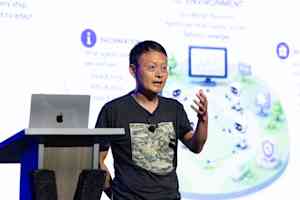
For years, the developer world has operated on a simple equation: one engineer, one agent. That mental model is comfortable, but as James Zou's work at Stanford shows, it is also a ceiling. AI Agents Shared User Images, Highlighting Data Security Concerns reminds us that these systems already act in the world with autonomy, and now Zou is asking us to scale that autonomy by four orders of magnitude. His Virtual Biotech runs tens of thousands of specialized agents, not as a stunt, but as a working research organization. The result isn't just more throughput; it's a different kind of intelligence. When agents debate, disagree, and defend their reasoning to one another, they produce more resilient solutions than any single model could on its own. That's a profound shift in how we should think about capability: not as a property of one model, but as an emergent quality of a well-designed crowd.
The practical takeaway for anyone building products is not the sheer scale, though that is attention-grabbing. It's the orchestration layer. Zou's team built Paperclip to solve a problem most enterprises will hit far earlier than they expect: legacy databases are not made for agents. Wrapping a PDF or a SQL endpoint in an MCP layer doesn't help if the underlying data is unstructured, figure-heavy, or designed for human eyes. The insight here is that modern LLMs are exceptional at navigating file systems and writing code, so Zou mapped scientific knowledge into a virtual file system that agents can traverse with standard operations. That is a concrete, replicable pattern. It means the bottleneck is not model intelligence; it's how we structure the environment. As The fix for rogue AI agents could be more AI suggests, oversight is a design problem, and Zou's work points in the same direction: give agents the right infrastructure, and their collective behavior becomes both more capable and more controllable.
What makes this more than an academic exercise is the Merck validation. The Virtual Biotech autonomously designed an ADC targeting CD276 for lung cancer, and months later, Merck independently landed on the same therapeutic design, one that later received FDA breakthrough designation. That is not a benchmark or a simulation. It is a third-party confirmation that an AI-orchestrated organization can produce results that survive contact with the real world. But here is the uncomfortable question Zou's work raises: if we can emulate a biotech with 37,000 agents, what else are we ready to emulate? The same architecture that organizes drug discovery could organize a newsroom, a logistics network, or a customer support operation. The shift from designing workflows to designing environments is not a subtle change in methodology. It is a different philosophy of management, one where you stop instructing individual actors and start shaping the conditions under which they interact.
Our take is simple: the one-engineer-one-agent assumption is already the legacy constraint. The teams that will lead the next phase are not those with the biggest models, but those who learn to build the environments where thousands of agents can argue, iterate, and fail productively. The specific detail to watch is how quickly the orchestration patterns from Paperclip become standard practice outside biomedicine, because once data is agent-native, the same playbook applies everywhere.