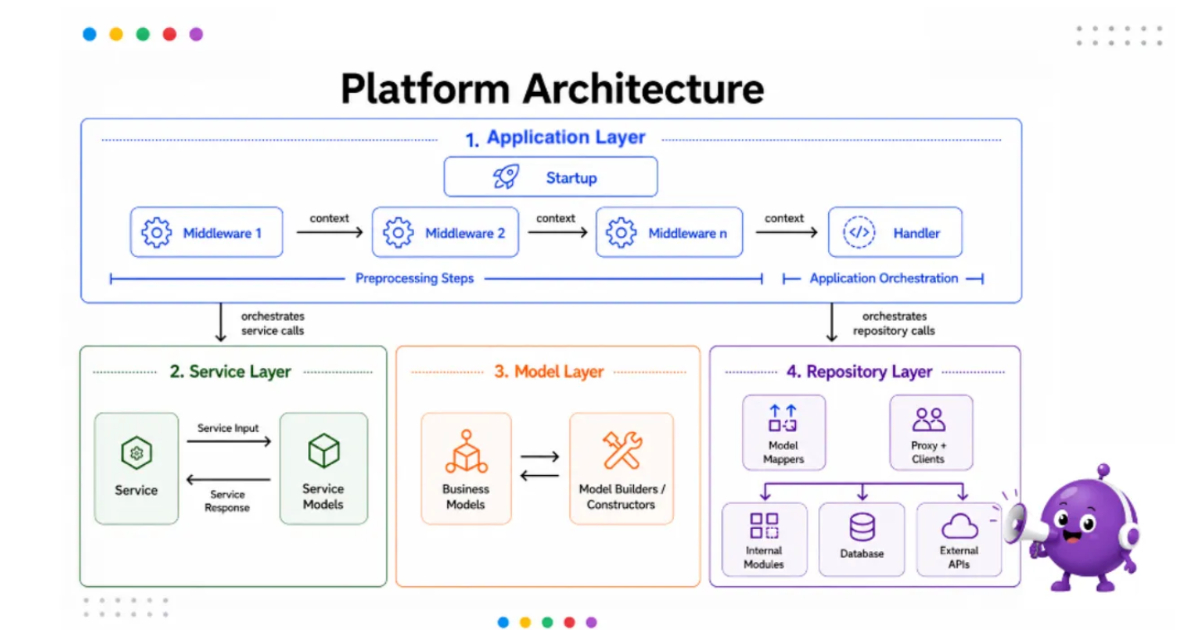
The real story here isn't that Agoda cut API review delays by 64%. It's that they did it without a rewrite. That distinction matters more than the headline number, because it challenges a deeply ingrained habit in engineering culture: the belief that legacy code must be torn down to be improved. Agoda's modular monolith framework, built with domain components, Data Mapper patterns, typed builders, and ArchUnit tests, proves that structural discipline can deliver speed without the cost and risk of starting over. This is a practical lesson for every team wrestling with coupling and slow reviews.
The approach resonates with a theme we've seen play out in different contexts. When Discord stripped away abstraction layers to rebuild chat with Rust and GPU speed, they chose a full rewrite because their problem was fundamentally about performance ceilings and platform constraints. Agoda faced a different obstacle: not performance, but process friction. Their framework didn't replace the codebase; it introduced enforceable boundaries that made the existing code easier to work with. That distinction is worth paying attention to. Not every problem demands a rewrite. Sometimes the smarter move is to build a better container, not replace the contents.
The practical takeaway for engineering leaders is direct and actionable. Agoda's framework-backed changes not only reduced median code review time by 64%, but also delivered 34% faster initial feedback compared to legacy changes. Those are not marginal gains. They represent a structural improvement in how teams collaborate. When code reviews become the bottleneck, the instinct is often to hire more reviewers or enforce stricter deadlines. Agoda's solution suggests a different path: make each change smaller and more self-contained by enforcing architectural boundaries. The tooling matters, but the principle is what scales.
This is not about dismissing rewrites entirely. It is about recognizing that most teams face coupling problems, not capability problems. The same modular thinking that helped Agoda could apply to any API layer where review cycles have become a drag. The open question is how far this pattern can extend. Can the same framework approach reduce friction in frontend code, data pipelines, or infrastructure-as-code? Agoda has shown a specific, measurable win. The next step is for others to test whether the principle generalizes.