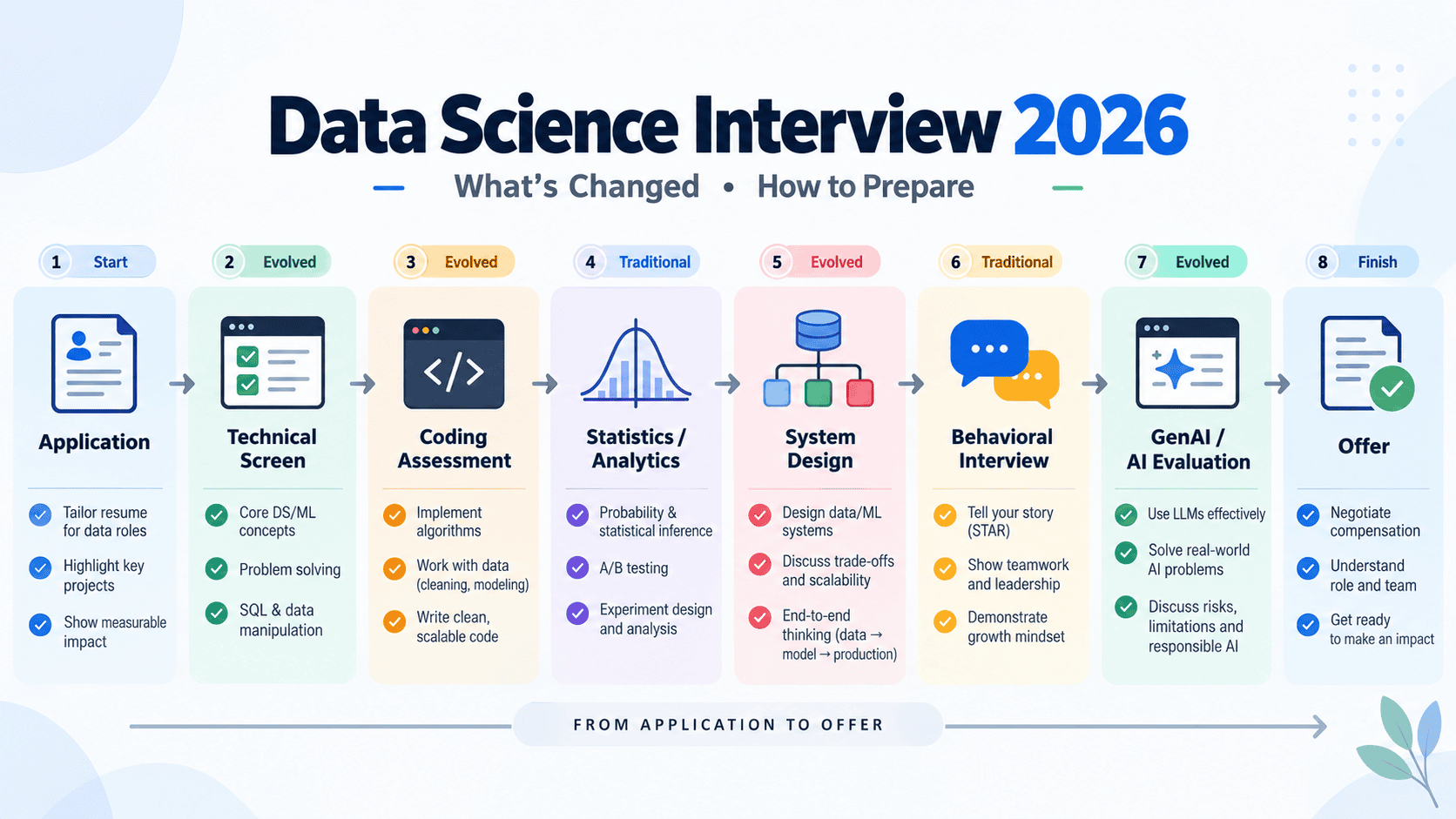
The shift in data science hiring isn't a subtle adjustment, it's a fundamental redefinition of what the role actually requires, and most candidates are still preparing for last year's interview. We see this as a direct consequence of the same forces that are making Move from isolated agents to shared team workflows that actually scale a necessary evolution for engineering teams. If your interview prep still focuses on handwriting gradient descent from scratch while ignoring how to evaluate a GenAI model's output, you are training for a job that no longer exists.
The new interview structure reported in this story reveals a clear pattern: companies now assume you can code, so they test you on judgment. The coding rounds have shifted from algorithmic puzzles to AI-assisted sessions where you are expected to use tools like Copilot or ChatGPT strategically, knowing when to accept a suggestion and when to override it. That is a very different skill set from memorizing LeetCode patterns. It requires the same kind of structured thinking explored in Explore a coding challenge that transforms spreadsheet puzzles into data discovery, where the real test is not whether you can write a loop but whether you can design a solution when the obvious answer is hidden inside a mess of null values. The parallel is direct: interviewers want to see how you think when the tool does the grunt work.
The GenAI evaluation questions are where the real separation happens. Candidates are being asked to critique a model's output, identify hallucinations, and propose prompt refinements on the spot. This is not trivia about transformer architectures. It is a practical test of whether you understand what these models produce and, more importantly, what they miss. The companies running these interviews are not looking for people who can recite attention mechanisms, they want people who can decide when a model is wrong and articulate why. This aligns with the broader trend visible in Explore how coherent quantum models advance time-series prediction, where the value is not in the architecture itself but in understanding what it can and cannot do for your specific data. The same principle applies to interviewing: knowing the limits of the tool is now more important than knowing the tool's internals.
Here is the concrete takeaway: if you are preparing for a data science interview in the next six months, spend your time on prompt engineering and output evaluation, not on sorting algorithms. Practice reading a model's generated analysis and identifying the three things it got subtly wrong. That is the skill being tested, and it is the one most preparation materials ignore. The open question that remains is how quickly the rest of the industry will adopt this structure, and whether the candidates who adapt first will create a new baseline that forces every hiring process to follow suit.