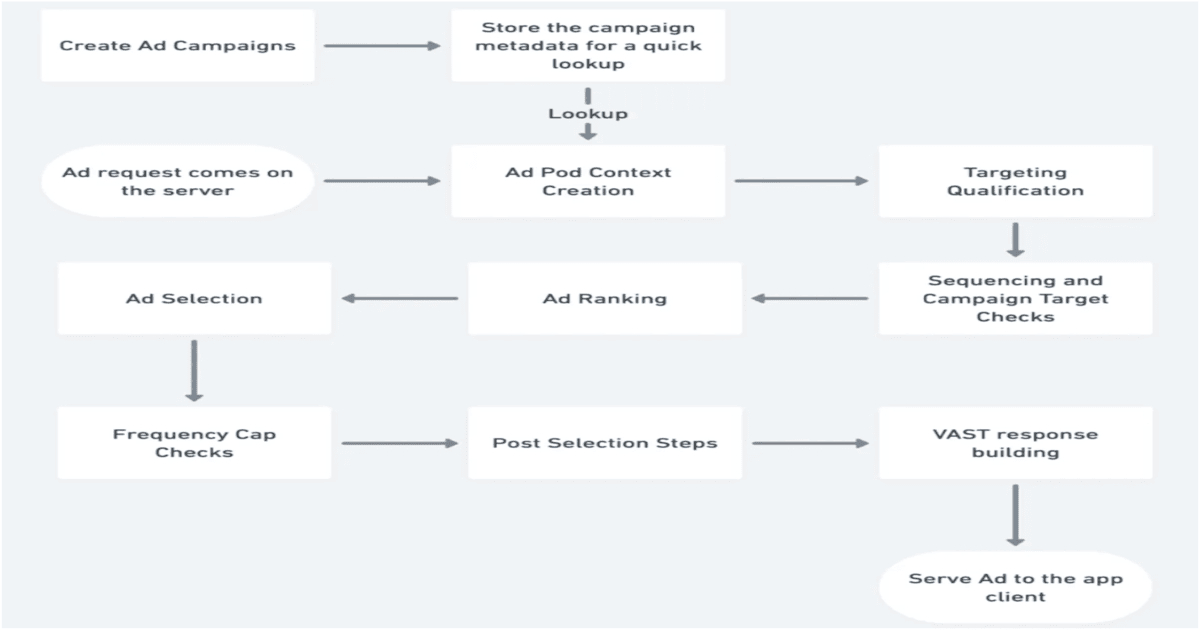
JioHotstar's engineering team recently pulled back the curtain on the distributed system that powers its personalized ad requests, and the detail that stands out isn't the machine learning or the real-time bidding. It's the orchestration. Choosing an ad during live streaming isn't a single decision; it's a sequence of coordinated handoffs between services that must each respect a hard latency budget. The company's explanation of waterfall tiering and pacing algorithms shows that personalization at scale is less about a clever model and more about disciplined systems design. For anyone who has wrestled with building reliable real-time pipelines, this is the kind of transparency that helps demystify what "streaming scale" actually demands. It also connects to a broader pattern we've seen in related work, such as how Scale AWS Server Deployments Effortlessly with Stateless Model Context Protocol highlights the operational cost of session management, or how Bridging Retrieval and Action: A New Approach to AI Tasks separates concerns between retrieval and execution. In both cases, the lesson is the same: complexity doesn't vanish, it gets distributed.
What impresses us most is the honesty about trade-offs. JioHotstar doesn't pretend its ad decisioning is instantaneous or magical. Instead, they walk through how they use waterfall tiering to fall back from higher-value demand sources to lower-value ones, and how pacing algorithms smooth out traffic spikes so that no single service gets overwhelmed. This is practical engineering. It acknowledges that the highest bidder isn't always available, and that the system's job is to make the best possible choice within a few hundred milliseconds. For practitioners, this is a useful counterpoint to the usual hype around "real-time personalization." It's not about being first or being smart; it's about being fast enough and reliable enough that the user never notices the machinery. That's a humbler, more useful framing than most vendor content offers.
Our take, and what we'd tell a reader who asked: don't look at this as a case study in ad tech. Look at it as a template for building any low-latency, high-throughput service. The same principles apply whether you're serving recommendations, processing financial transactions, or routing messages. The key takeaway is that you need to design for degradation and coordination, not just peak performance. JioHotstar's approach to service coordination and latency optimization is a reminder that the real innovation often lives in the plumbing. And if you're exploring how to make your own systems more responsive, the connection to stateless designs in Scale AWS Server Deployments Effortlessly with Stateless Model Context Protocol is worth studying, since statelessness reduces coordination overhead. Similarly, the divide between retrieval and action in Bridging Retrieval and Action: A New Approach to AI Tasks mirrors the separation between ad selection and delivery that JioHotstar relies on.
The one detail we'll be watching closely is how they handle pacing at the edge during major live events, when traffic can multiply in seconds. If their architecture holds under a World Cup final, it's a genuine reference model. If not, the next iteration will need to push more decisioning closer to the user. Either way, the question isn't whether you can afford to build this; it's whether you can afford not to understand the trade-offs involved.