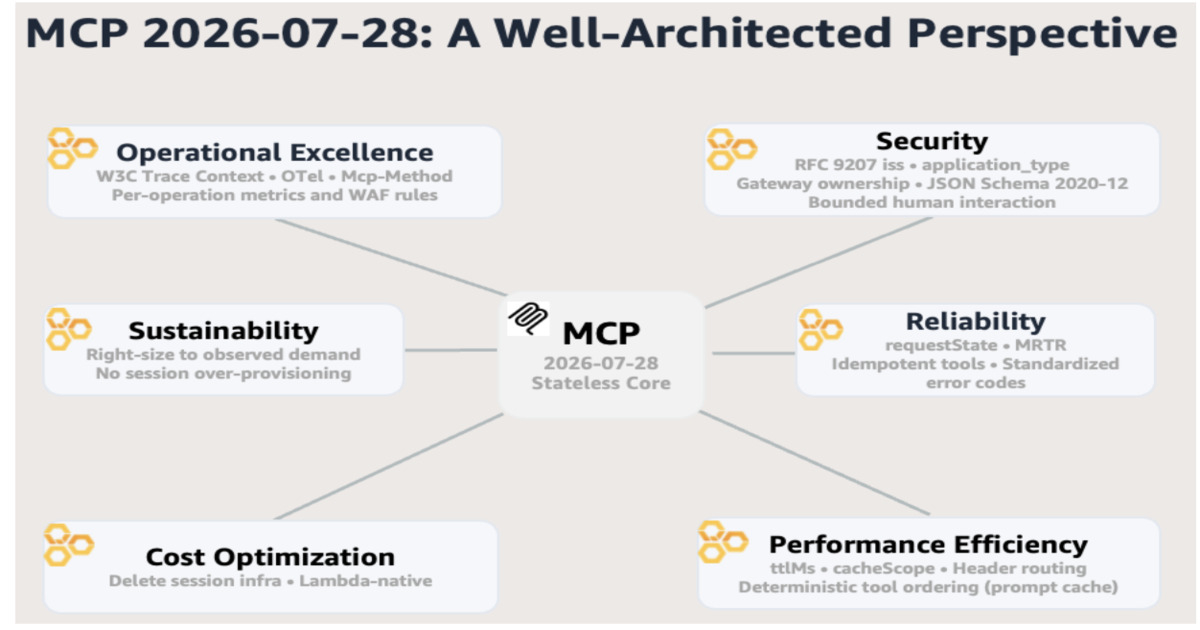
The evolution of the Model Context Protocol (MCP) within AWS, as detailed by Leela Kumili, represents a significant step toward more scalable and resilient AI deployments. Removing protocol-level sessions and sticky-session requirements fundamentally alters how we architect these systems, moving away from the complexities of managing state within the protocol itself. This shift allows for independent request routing, a critical enabler for horizontal scaling, particularly as AI models grow in size and demand. Understanding this architectural shift is crucial, especially considering the broader landscape of AI tooling; we've previously explored [Unlocking MCP: A Visual Guide to Empower Your Workflow] to help clarify its core function, and also looked at how observability plays a key role in ensuring reliable performance, as demonstrated in [Monitor Cypress Tests with Grafana: Persistent Observability for Your Data]. The ability to decouple state management from the protocol simplifies deployments and opens the door for more dynamic resource allocation.
The beauty of this new specification lies not just in the technical simplification, but in the strategic relocation of responsibilities. Shifting concerns like application state, retries, observability, and idempotency to other layers—application code, service meshes, or dedicated observability platforms—allows each component to focus on its core function. This modularity fosters greater flexibility and maintainability, allowing teams to adapt to changing requirements and optimize performance without rewriting core protocol logic. While this places a greater onus on developers to handle these concerns effectively, it also provides significantly more granular control and allows for more sophisticated error handling and monitoring strategies. The implications for building AI-powered mobile UIs, as discussed in [Architecting AI-Powered Mobile UIs: Speed, Delight, and Scalability], are particularly relevant, as these applications often require high levels of scalability and responsiveness.
Historically, maintaining session state within protocols has been a major bottleneck for scaling distributed systems. The need for sticky sessions, where requests from a single user are consistently routed to the same server, introduces complexity and limits the ability to distribute load effectively. Eliminating this requirement unlocks a new paradigm for AI deployments, where requests can be routed to any available server based on factors like latency, resource utilization, or model version. This flexibility is essential for handling unpredictable traffic patterns and ensuring high availability. The move also aligns with a broader trend toward stateless architectures, which are inherently more scalable and resilient. It encourages a shift in mindset from managing state at the protocol level to embracing a more decentralized approach, where state is managed and handled by the application itself.
Ultimately, AWS's latest MCP specification represents a pragmatic evolution driven by the demands of increasingly complex AI workloads. It’s a move toward a more modular, scalable, and resilient architecture that empowers developers to build and deploy AI-powered applications with greater ease and confidence. The shift in responsibility demands a more sophisticated approach to application design and observability, but the benefits in terms of scalability and maintainability are undeniable. A key question moving forward will be how this shift impacts the development of new AI frameworks and tools—will they be designed to natively support this stateless model, or will legacy approaches continue to create friction?