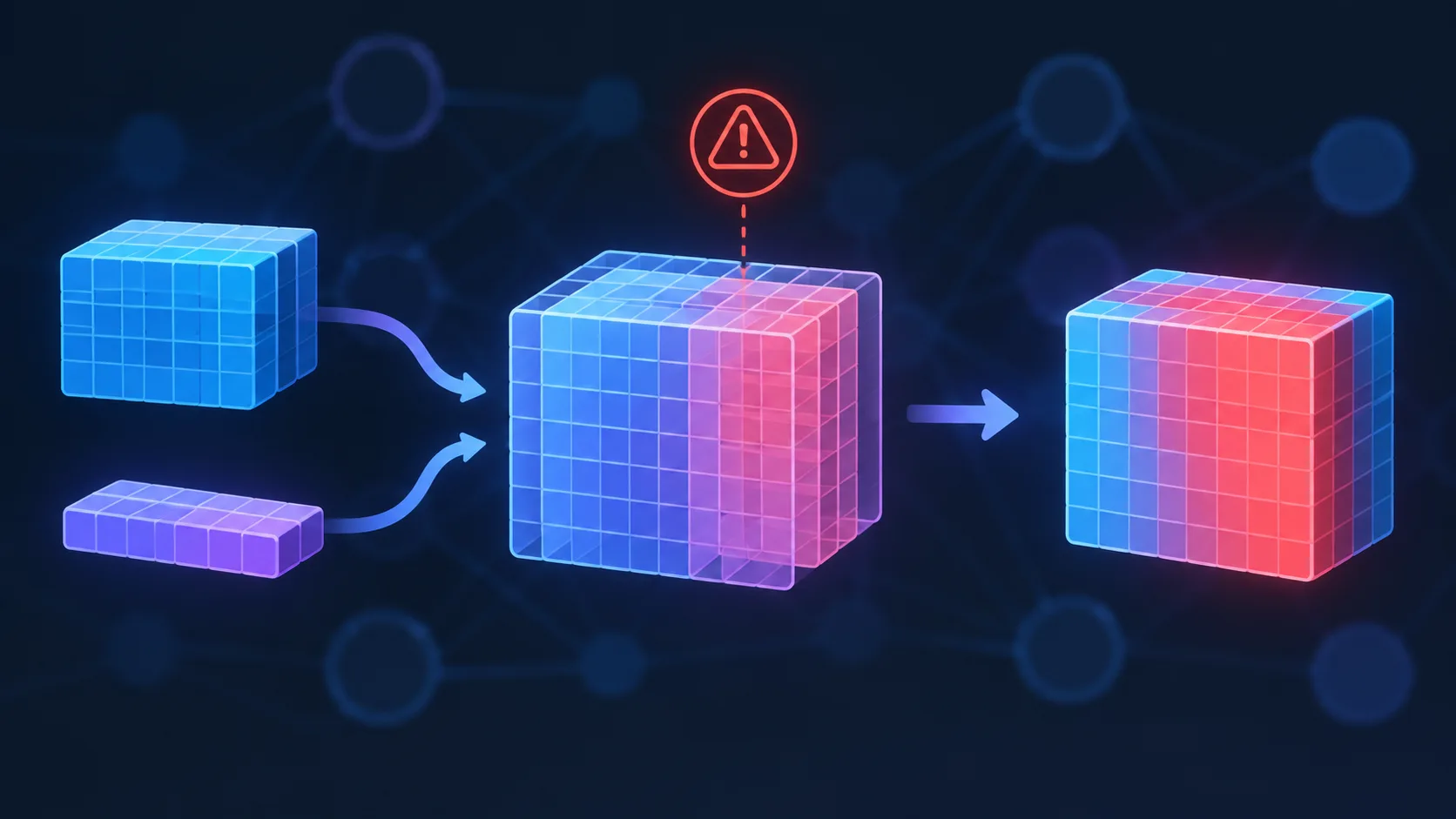
The quiet bug in machine learning is almost always the one that does not announce itself. Silent broadcasting in PyTorch and TensorFlow makes this painfully clear: shape errors that should crash your training loop instead pass through, bending your model's behavior in ways you did not intend and might not notice until much later. This is not a niche annoyance. It is the kind of problem that erodes trust in your own results, because the numbers look plausible. The model runs. The loss decreases. But the math underneath is not doing what you think it is.
Broadcasting is a convenience that becomes a curse when it operates without visibility. When two tensors have mismatched shapes, the frameworks do not always refuse. They stretch, repeat, and align dimensions according to rules that are elegant in theory and opaque in practice. The point is direct: silent broadcasting turns a type error into a logic error. A type error is loud. It stops you. A logic error is quiet. It waits until you have drawn conclusions from faulty outputs, then forces you to question every experiment you ran in the last week. For anyone building models seriously, this is the difference between a speedbump and a sinkhole.
What makes this worth our attention is not the technical detail itself, but what it says about the tools we have learned to trust. We often assume that if a framework accepts an operation, the operation is valid. That assumption is exactly what silent broadcasting exploits. The fix is not to abandon broadcasting, but to build habits that make the invisible visible. Explicitly checking shapes at critical boundaries, logging tensor dimensions during debugging, and writing small tests for tensor operations are not glamorous practices. They are the difference between a model you understand and a model you are merely running. This connects to a broader theme we have explored in Exploring Real-World Computer Vision: Deployments, Edge Models, and Current Challenges, where the gap between a working prototype and a reliable deployment often comes down to the same kind of hidden assumptions. Similarly, Expanding Your Tech Fluency: Key Insights Beyond Artificial Intelligence reminds us that fluency is not about knowing more frameworks, but about understanding the failure modes that those frameworks introduce.
If a reader came to us with this, our take would be simple: treat silent broadcasting as a discipline problem, not a debugging puzzle. The frameworks are not going to change their behavior to protect you from yourself, and waiting for an error that never comes is not a strategy. The practical takeaway is concrete: before you run a training loop, verify the shapes of your inputs and labels. After you load a batch, print the shape once. When you write a custom layer, test it with dummy data that has an intentional mismatch. These checks take minutes and save hours of confused staring at loss curves that look fine but mean nothing. This is right to frame as a risk to your model, but the deeper risk is to your confidence in the work itself. And once that confidence cracks, every result becomes suspect. That is the real cost of a silent broadcast, and it is not a technical cost. It is a human one.