InfoQ Launches Online AI Engineering Cohort and Certification for Senior Software Practitioners
Our take
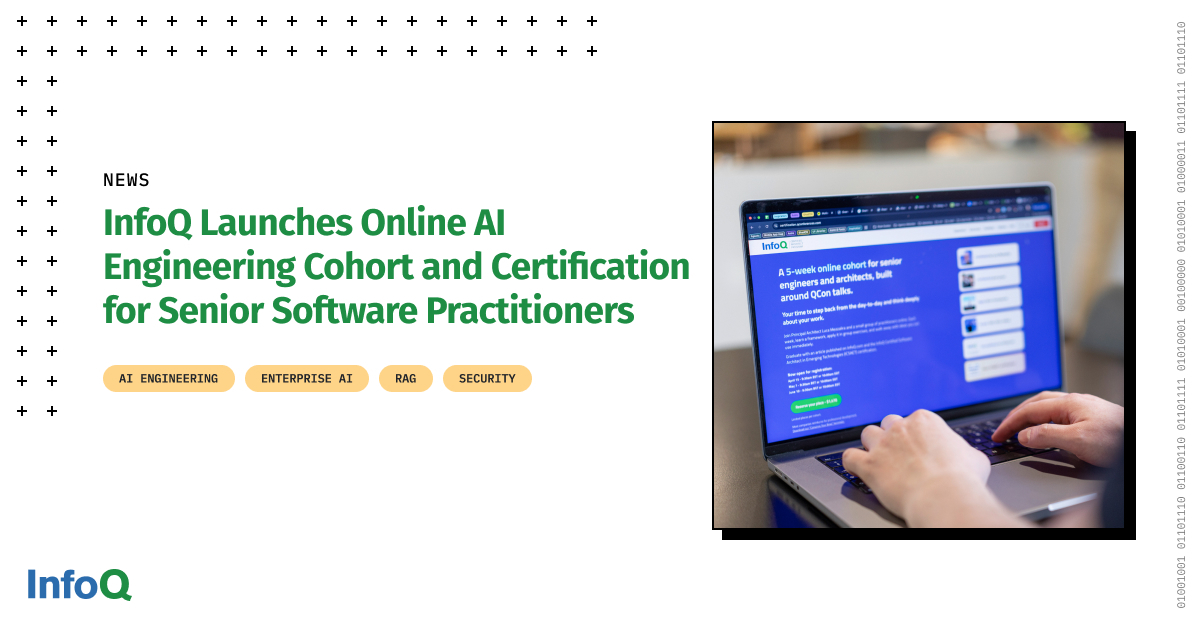
The recent launch of InfoQ’s five-week online AI Engineering certification for senior practitioners marks a significant step forward in the professional development landscape for those working with production AI systems. As organizations increasingly rely on artificial intelligence, the demand for skilled professionals who can navigate complexities such as retrieval-augmented generation (RAG), AI agents, and operational trade-offs has surged. This certification program directly addresses that need, providing an essential foundation for practitioners who must balance innovation with reliability and performance in their deployment strategies.
In a world where AI is transforming industries, it is paramount for senior software practitioners to stay ahead of the curve. The topics covered in this certification reflect current industry trends and challenges, including the essential evaluation of AI platforms and the importance of reliability in production systems. As highlighted in related articles like Uber Improves Restaurant Recommendations Using Real-Time Signals and Listwise Ranking and Qwen3.7-Max: Alibaba’s New Agent-First LLM for Coding, Reasoning, and Long-Horizon AI Workflows, understanding how to effectively implement AI solutions is critical. These articles illustrate not just the capabilities of AI technologies but also the operational challenges that arise when integrating them into existing systems. The InfoQ certification aims to equip professionals with the necessary skills to tackle these challenges head-on.
Moreover, this initiative aligns with a broader shift in the tech landscape, where traditional software engineering roles are evolving to include AI-specific skill sets. The focus on operational trade-offs and system reliability in the certification curriculum reflects an acknowledgment that deploying AI is not merely about leveraging new technologies but also about ensuring they work effectively within the constraints of real-world applications. This is particularly relevant as we see increasing discussions around the ethical implications of AI, as noted in the article Lost in Translation: How AI Exposes the Rift Between Law and Logic. The need for practitioners who can thoughtfully navigate these complexities cannot be overstated.
As we look to the future, the implications of this certification extend beyond individual career development. It signals a recognition within the industry that advanced training and education in AI engineering are not just beneficial but essential for fostering innovation and maintaining competitive advantage. Companies will benefit from investing in their workforce's continuous education, as this will ultimately lead to more robust AI solutions that can adapt to the ever-evolving demands of the market.
In conclusion, InfoQ's new certification program represents a timely response to the growing challenges faced by AI practitioners. As the field continues to evolve, the ability to blend technical expertise with a deep understanding of operational dynamics will be crucial. It will be interesting to observe how this initiative influences the standards for AI practice in the industry and what new competencies will emerge as essential for success in this rapidly changing environment. Will we soon see a shift in hiring practices that prioritizes these newly certified professionals? Only time will tell.
InfoQ has launched a five-week online AI Engineering certification for senior practitioners working on production AI systems, covering RAG, agents, AI platforms, evals, reliability, and operational trade-offs.
By Artenisa ChatziouRead on the original site
Open the publisher's page for the full experience