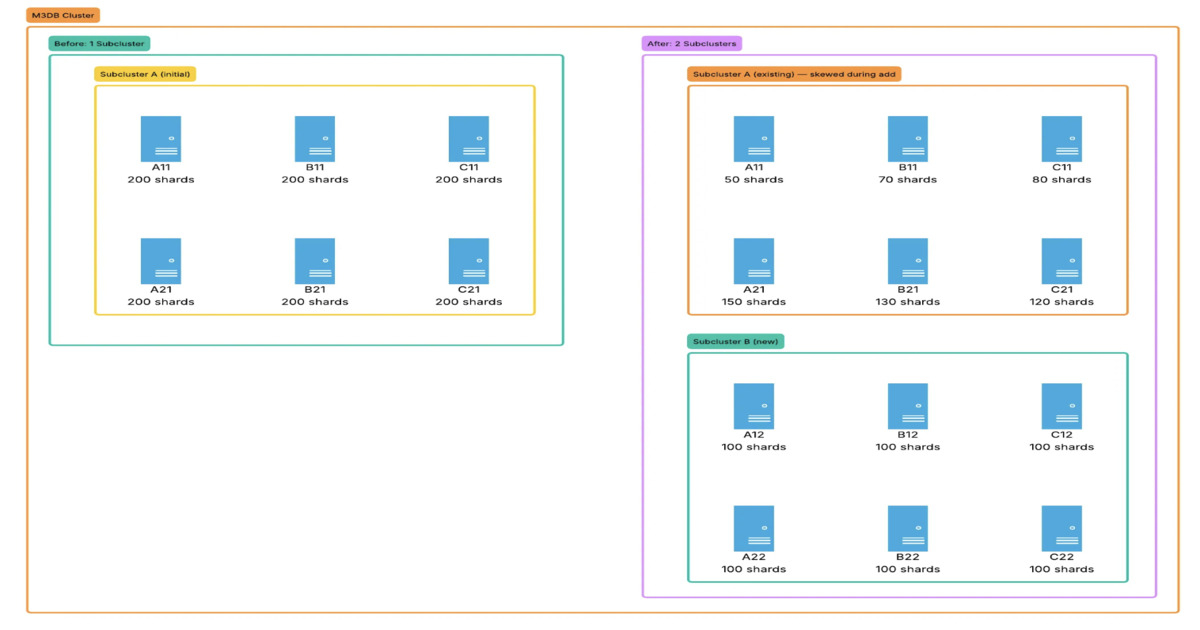
Uber's M3DB redesign is the kind of quiet, deliberate engineering that rarely makes headlines, but it should. The company has reworked how shards are placed across its distributed time-series database, moving to fixed size subclusters. The goal is straightforward: when a node fails, or when maintenance or scaling forces a change, the damage stays contained. Instead of letting a failure ripple across the entire cluster, the new design bounds the number of shards any single node depends on. That is not a flashy feature. It is a structural improvement that makes failure modes predictable, and predictability is what you actually want when your database is the backbone of real-time operations.
We have seen this pattern before in large-scale systems. The teams that succeed are the ones that treat failure as an inevitable event to be designed around, not an anomaly to be feared. Uber's approach preserves replica isolation, meaning that copies of the same data are not placed on the same subcluster, and it uses a greedy algorithm to select shard migrations. What stands out is what they avoided: a separate rebalancing pass. By integrating migration decisions into the placement logic, they sidestep the costly data movement that often accompanies cluster scaling. For anyone running a stateful system at scale, this is the difference between a controlled shuffle and a cascading series of hot spots. The practical takeaway is simple: you can limit failure impact without resorting to over-provisioning or constant manual intervention.
For our readers, the implications go beyond Uber's internal infrastructure. If you are evaluating time-series databases, or any distributed storage system, this design choice should be part of your checklist. Ask whether the system can bound the blast radius of a node loss. Ask whether maintenance windows force a full rebalance or just a targeted migration. The greedy algorithm approach is particularly interesting because it shows that good outcomes do not require perfect optimization upfront. A greedy choice, made at each step, can yield a placement that is good enough to keep the system healthy without the overhead of a global recomputation. That is a lesson in pragmatism that applies well beyond databases. It is worth reading more about how Uber manages its data infrastructure and the broader challenges of distributed systems design. The original article also touches on the trade-offs, which we recommend reviewing for the full context.
The thing to watch now is how this holds up under real-world pressure. Uber's team has clearly thought through the failure scenarios, but the proof is in the operation. We would tell any engineer looking at this to pay attention to the operational overhead. The greedy algorithm avoids unnecessary data movement, but it still requires careful monitoring during migrations. The real test will be how the system behaves during a large-scale failover, when multiple nodes are involved and the subcluster boundaries are stressed. That is where the design either earns its keep or reveals hidden dependencies. A specific detail to watch is whether Uber publishes any post-incident analysis of a major event that exercises these new placement rules. Until then, the design is promising, but the industry will be watching for the first real-world stress test.