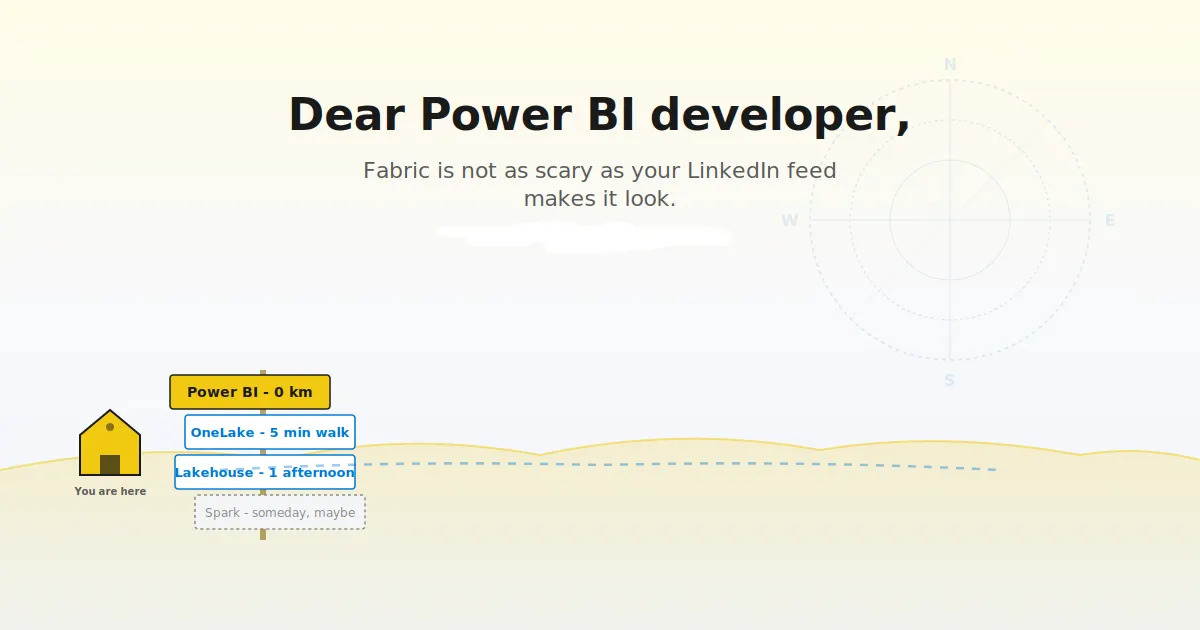
The transition away from Power BI Premium into Microsoft Fabric has a familiar shape for anyone who has watched a platform evolve under their feet. It is not a demolition job, and it is not a rebranding gimmick. It is a shift in where the work happens. For the developer who has spent years mastering one toolset, the instinct is to brace for impact. The calmer read, and the more useful one, is that the core of what you do remains intact while the environment around it expands. That is the message buried in the survival guide, and it is worth sitting with before you start rewriting your entire workflow.
What stands out is how much of the old mental model carries over. The guide does not claim that everything is new. It acknowledges that the fundamentals of data modeling, DAX, and report building still anchor the practice. What changes is the container. Fabric pulls together storage, compute, and governance into a single mesh, which means the boundaries between data engineering and analytics start to blur. For a Power BI developer, that is either a threat or an opportunity depending on how you frame it. We would frame it as a chance to stretch. The practical consequence is that your next project might not start with a dataset handed to you. It might start with you deciding where the data lives in the first place. That is a different kind of responsibility, and it rewards people who think in systems rather than just visuals.
This is where the related work on Exploring Paragraph Structure: How LLMs Navigate Token Space and Bridging Retrieval and Action: A New Approach to AI Tasks becomes relevant in an unexpected way. Both are about how large language models impose order on messy inputs, whether that is token coordinates or retrieval paths. Fabric is doing something similar for enterprise data. It is creating a layer where the underlying structure is less visible, but the outcomes are more coherent. If you are comfortable with the idea that a model can navigate token space without you seeing every weight, then you can also get comfortable with the idea that your data platform can handle governance and compute without you managing every node. The connection is not about the technology being the same. It is about the mindset of trusting the layer above you while staying fluent in the layer beneath.
The guide wisely avoids the panic that usually accompanies platform migrations. It does not pretend that Fabric is a small update, and it does not pretend that your existing skills are wasted. The honest take is that your value is shifting from knowing the specific buttons to understanding the logic of the whole pipeline. That is a harder skill to automate away. If we were advising a reader who asked about this, we would say this: spend less time mourning the old interface and more time mapping your current projects onto the Fabric structure. The takeaway that matters is simple. Your DAX skills still matter, your data modeling instincts still matter, but your willingness to move up the stack matters more. The guide gives you a map, not a new language. That is the most useful thing it could offer. Watch how quickly your team starts treating storage and compute as one conversation instead of two, because that is where the real adjustment lives.