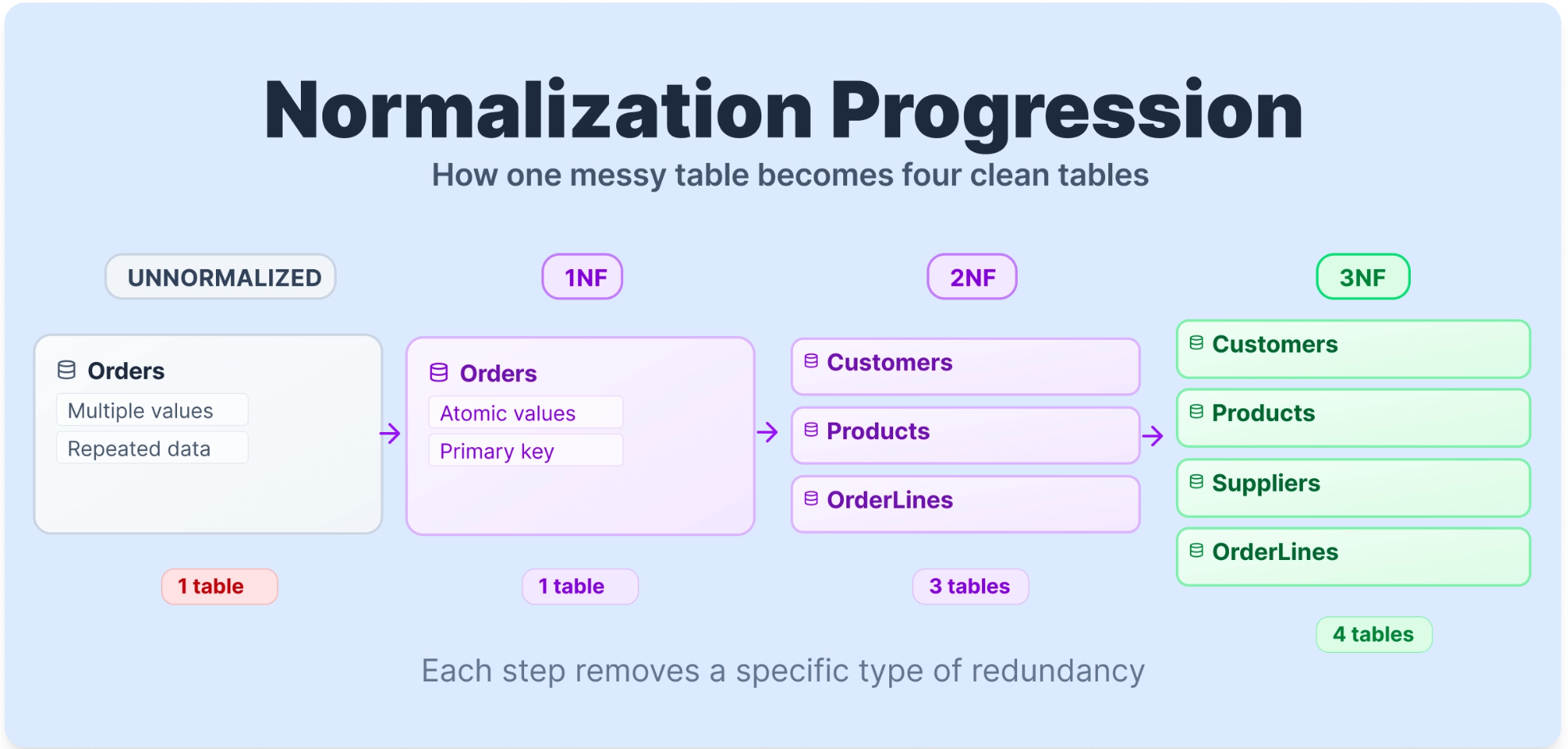
Normalization in SQL is one of those concepts that sounds academic until you actually have to use it, and then it becomes painfully practical. Our view is straightforward: if you've ever struggled with duplicate supplier names or spent an afternoon hunting down a customer's email across hundreds of rows, you already understand why normalization matters. The textbook definitions just failed to meet you where you were.
What this means for you is that normalization isn't about memorizing normal forms or reciting rules about transitive dependencies. It's about making your data work for you, not against you. When the same supplier name appears under three spellings in your orders table, that's not a data entry problem, it's a structural one. Changing a customer's email across 200 rows isn't a tedious task; it's a sign that your database is costing you time and introducing errors with every update. Normalization solves these problems by organizing data so that each fact lives in exactly one place. The result is simpler queries, fewer bugs, and a system that adapts when real-world details change.
The confusion usually starts when people try to apply normalization in isolation, treating it as a theoretical checklist rather than a practical tool. You don't need to master third normal form before you can improve a table. Start with the most common pain point: repeated data. If you see the same information stored over and over, split it into its own table and reference it with a key. That single step eliminates the spelling-mistake problem and the update-hunt problem in one move. Over time, you can layer on further refinements as your data grows, but the core principle is simple, reduce redundancy to increase reliability.
The real takeaway is this: normalization is not a barrier to entry; it's a lever for control. The next time you encounter a table that feels unwieldy, ask yourself where the repetition lives. Then break it apart. You don't need a textbook to tell you that less duplication means less cleanup.